 |
 |
 |
 |
 |
 |
 |
 |
 |

 |
Tsunami Aid Worth $7,100 Per Person
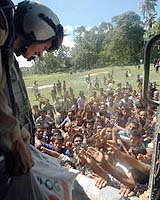
Geneva (AFP) Jul 14, 2006 The massive international relief effort after the 2004 Indian Ocean tsunami was marked by publicity-seeking aid operations which were riddled with errors and ignored the real needs of disaster survivors, according to a new report Friday. The study by the Tsunami Evaluation Coalition (TEC), an international group of aid agencies, delivered a no-holds-barred verdict on the effectiveness of international help in the wake of the disaster. Total tsunami aid translated into an average of 7,100 dollars per affected person, and donors' generosity contrasted starkly with spending in other disasters that failed to grab the headlines, said the TEC. The 2004 flooding catastrophe in Bangladesh, for example, drew just three dollars per affected person. The tsunami claimed around 227,000 lives, hitting Indonesia hardest, and left at least 1.8 million people homeless around the Indian Ocean. The disaster sparked an unprecedented outpouring of 13.5 billion dollars in aid donations. Some 5.5 billion dollars of that was given by individuals, something the TEC said it applauded. "The high-profile coverage of the tsunami led to the largest and fastest response ever," the report's author John Telford said. "But the glare of public attention pressurised agencies to spend quickly and visibly, often causing them to neglect formal needs assessments and under-estimate the complexity of post-disaster relief," he cautioned. "That led to many poorly executed aid projects and acted against the best interest of affected people." Half the funds collected ended up being spent on emergency relief and half on reconstruction efforts, when the latter should have taken the lion's share, Telford told journalists. Immediate life-saving operations were in fact better handled by locals who provided rapid relief for family members and neighbours, looking after the injured and taking in the homeless. "The local response was the determinant factor in saving lives," said Telford. "These ordinary people are the heroes of this emergency response." The root of the problem for international agencies was "lack of understanding of the local conext," he said, as well as an inability to work alongside locals, thus undermining their own efforts. Well-meant but over-optimistic operations frequently underestimated the time needed to rebuild, with foreign organisations sometimes misleading locals about their plans and failing to understand issues such as property rights. Pointing to flawed deliveries of medical supplies, Telford said that "what was provided very often was not necessarily what was requested." Commenting on the report, UN humanitarian chief Jan Egeland said: "The lessons are glaring." "We will take the recommendations very seriously as donors, as humanitarian agencies, as member states, because we can all learn both from our successes and our failures," he told journalists. The report called on donor governments to be more consistent in their aid policies and to provide more support prior to disasters in high-risk zones to help locals respond better when catastrophe strikes. In the wake of a disaster, aid agencies should not bypass but rather work through and help build up existing local structures when affected countries are overstretched, it said. More independent regulation of relief spending is also required to ensure that donations are spent in ways that genuinely help victims rebuild their lives, it said. "The scale and frequency of modern emergencies is on the rise and the quality, capacity and regulation of the international relief system is currently inadequate to support this," said Telford.
Source: Agence France-Presse Community Email This Article Comment On This Article Related Links - Bringing Order To A World Of Disasters A world of storm and tempest When the Earth Quakes
 REDiSat Network Available To Companies And First Responders
 Princeton NJ (SPX) Jul 14, 2006
SES AmeriCom announced Tuesday its REDiSat Network is now available for U.S. first responders, emergency management professionals and private enterprises from the financial, manufacturing, retail and oil and gas industries. |
|
|

| The content herein, unless otherwise known to be public domain, are Copyright 1995-2006 - SpaceDaily.AFP and UPI Wire Stories are copyright Agence France-Presse and United Press International. ESA PortalReports are copyright European Space Agency. All NASA sourced material is public domain. Additionalcopyrights may apply in whole or part to other bona fide parties. Advertising does not imply endorsement,agreement or approval of any opinions, statements or information provided by SpaceDaily on any Web page published or hosted by SpaceDaily. Privacy Statement |