 |
 |
 |
 |
 |
 |
 |
 |
 |

 |
REDiSat Network Available To Companies And First Responders
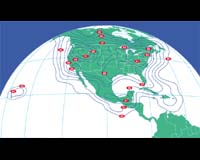
Princeton NJ (SPX) Jul 14, 2006 SES AmeriCom announced Tuesday its REDiSat Network is now available for U.S. first responders, emergency management professionals and private enterprises from the financial, manufacturing, retail and oil and gas industries. SES AmeriCom operates REDiSat from its AMC-6 satellite. Launched in October 2000, AMC-6 is the company's fifth hybrid C- and Ku-band satellite and operates at 72 degrees west longitude. From this position in the eastern part of the U.S. orbital arc, both the C- and Ku-bands of the satellite provide service to government, VSAT networks and entertainment customers in the continental United States, Mexico, Canada, Central America and the Caribbean. REDiSat is a system capable of variable-bandwidth management. It actively allocates satellite space bandwidth as needed to correspond to disaster and other emergency situations. The system is built on TDM/TDMA architecture, enabling multiple users to share a pool of Ku bandwidth set aside for REDiSat subscribers on the AMC-6 satellite. The network is affordable because the customer pays a small amount for the initial equipment, a minimal monthly subscription fee to secure access to the network, and a fee for bandwidth when the service is required. REDiSat supplies high-speed broadband Internet connections based on an iDirect platform-based service, and can transmit and receive data and voice transmissions. REDiSat is a proactive, secure, stable and flexible satellite-based communications network that is more reliable than a terrestrial-based network prone to service outages during a natural disaster, the company said in a news release. Customers can choose from two levels of service that are dynamically chosen by the customer based upon their needs when the communications are activated. SES will enhance the ability of REDiSat subscribers' sites to respond quickly by pre-deploying the proper antenna and other equipment. The equipment located on site includes a pre-aligned, removable 1.2-meter Ku-band antenna with non-penetrating roof mount, a low-noise block-down converter, a two-watt block-up converter and a satellite modem. "After extensive interviews, inquiries and research with private enterprises and government organizations, our REDiSat Network embodies the three facets they deemed vital if they were to employ a satellite-based emergency network," said Robert Phelan, SES AmeriCom's senior vice president for market and business solutions. "Those facets are affordability, quick access and response, and expandable bandwidth." "The REDiSat Network's 'always on' feature with both voice and data transmission capabilities plus redundancy will provide their clients with essential connectivity when it's most needed," said Christopher Baugh, president of Northern Sky Research. Community Email This Article Comment On This Article Related Links SES Bringing Order To A World Of Disasters A world of storm and tempest When the Earth Quakes
 India And Pakistan Ink Aid Pact Nine Months After Killer Quake
 New Delhi (AFP) Jul 11, 2006
India Tuesday approved a donation of 25 million dollars to buy building materials for Pakistani Kashmir nine months after a major earthquake killed 73,000 people there. The Indian foreign ministry said the assistance was part of a pledge made at an UN-sponsored donors' conference for the victims of the October 2005 earthquake which razed tens of thousands of homes in Pakistan. |
|
|

| The content herein, unless otherwise known to be public domain, are Copyright 1995-2006 - SpaceDaily.AFP and UPI Wire Stories are copyright Agence France-Presse and United Press International. ESA PortalReports are copyright European Space Agency. All NASA sourced material is public domain. Additionalcopyrights may apply in whole or part to other bona fide parties. Advertising does not imply endorsement,agreement or approval of any opinions, statements or information provided by SpaceDaily on any Web page published or hosted by SpaceDaily. Privacy Statement |