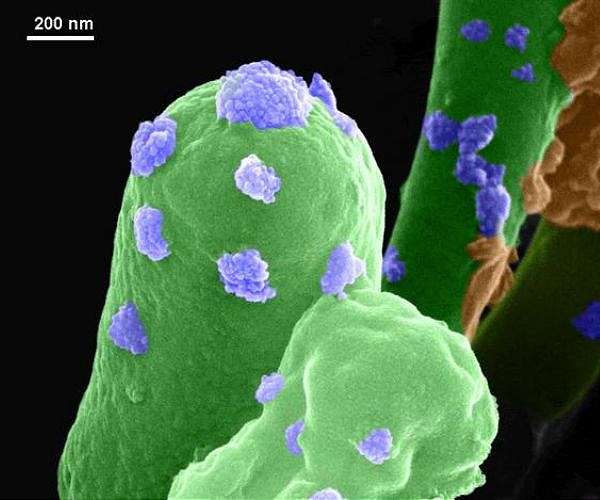
Bacteria that thrive on Earth may not survive easily on Mars, where the soil contains toxic perchlorate salts at levels that can reach about 1 percent by weight. Researchers at the Indian Institute of Science have now shown how a brick building soil bacterium responds to this chemical and discovered that although the toxin slows growth and stresses the cells, it can also yield stronger biocemented Martian bricks.
The work builds on earlier studies in which the team used the soil bacterium Sporosarcina pasteurii to turn synthetic Martian or lunar soil into solid "space bricks." When the microbe is supplied with urea and calcium in a granular simulant along with the natural polymer guar gum, it precipitates calcium carbonate crystals that bind soil grains together, a process known as biocementation. In contrast to previous experiments that relied on a standard laboratory strain, the new study used a more robust, native strain of S. pasteurii that the researchers had isolated from soils in Bengaluru.
After confirming that the Bengaluru strain could efficiently generate mineral precipitates in the simulant, the team introduced perchlorate at concentrations similar to those detected in Martian regolith. In collaboration with scientists at the Indian Institute of Science Education and Research in Kolkata, they observed that the chemical stressed the bacteria: cells divided more slowly, shifted from rod like to more circular shapes, and began to clump into multicellular like aggregates. Stressed cells also secreted greater amounts of extracellular matrix, a mixture of proteins and other molecules that formed a coating around the microbe clusters.
Electron microscopy revealed that in the presence of perchlorate there were more calcium chloride like and calcium carbonate precipitates throughout the soil matrix. The extracellular matrix extended between cells and mineral particles, forming tiny "microbridges" that appeared to connect bacterial clusters and precipitates. These microbridges stitched the forming bricks together at the microscale and may have helped route nutrients to pockets of stressed bacteria embedded within the material.
Commercial Martian soil simulants typically omit perchlorate because it is flammable, so the researchers added the compound in controlled amounts to test its effect on biocementation. Mechanical tests on cured samples showed that bricks formed with perchlorate were stronger and better glued together than control specimens, but only when guar gum and the catalyst nickel chloride were also present to support bacterial metabolism. When these additional components were omitted, perchlorate remained a net stress factor and impaired the bacterium's performance.
The team suggests that the paradoxical strengthening effect arises because stress induced extracellular matrix production reinforces the mineral framework, improving cohesion of the composite. First author Swati Dubey notes that when the toxin is studied in isolation, it clearly stresses the microbe, but in the full brick mixture "with the right ingredients in the mixture, perchlorate is helping." The researchers now plan to probe the microbridge mechanism in more detail, including whether the structures act as nutrient highways that help bacteria tolerate perchlorate rich environments over longer periods.
Future experiments will place the system in high carbon dioxide atmospheres to better mimic Martian surface conditions and assess how gas composition influences biocementation. The group also wants to evaluate how long the engineered communities can remain active and maintain structural integrity under repeated stress cycles similar to diurnal temperature swings on Mars. Understanding these responses is key to designing reliable, biology based construction systems for long term extraterrestrial habitats.
Beyond Mars, the scientists see microbially induced calcium carbonate precipitation as a more sustainable construction strategy on Earth, where conventional cement production carries a large carbon footprint. On planetary surfaces such as the Moon and Mars, in situ resource utilisation using local regolith, limited added chemicals, and hardy microbes could supply landing pads, roads, launch platforms, and other infrastructure without shipping heavy building materials from Earth. Co author and ISRO astronaut trainee Shubhanshu Shukla points out that uneven terrain has already contributed to lander mishaps on the Moon, and engineered biobricks prepared directly on site could help smooth future landing zones and traffic corridors for rovers and crewed vehicles.
The study highlights that gauging how Earth microbes respond to alien soil chemistry is critical for safe and effective use of biological tools in space exploration. As missions push toward sustained operations on Mars, approaches that combine robust microbial strains, carefully tuned chemistry, and local materials may become central to building the first long lived outposts on another world.
Research Report:Effect of perchlorate on biocementation capable bacteria and Martian bricks