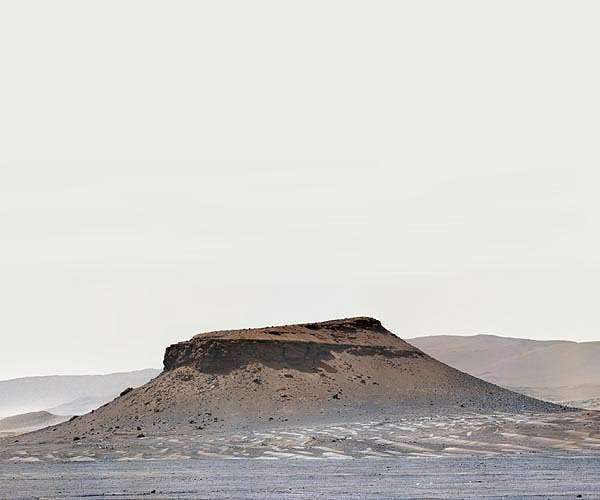
New findings from NASAs Perseverance rover have revealed evidence of wave-formed beaches and rocks altered by subsurface water in a Martian crater that once held a vast lake – considerably expanding the timeline for potential habitability at this ancient site.
In an international study led by Imperial College London, researchers uncovered that the so-called Margin unit in Marss Jezero crater preserves evidence of extensive underground interactions between rock and water, as well as the first definitive traces of an ancient shoreline.
These are compelling indicators that habitable, surface water conditions persisted in the crater (home to a large lake around 3.5 billion years ago) further back in time than previously thought.
Shorelines are habitable environments on Earth, and the carbonate minerals that form here can naturally seal in and preserve information about the ancient environment, said lead author Alex Jones, a PhD researcher in the Department of Earth Science and Engineering (ESE) at Imperial.
Our findings therefore have exciting implications for Marss past climate and habitability, while providing new insights into a geologic unit which has long had a debated origin.
From rock to beach
Deployed on Mars since 2021 to search for signs of past life, NASAs Perseverance rover spent nearly a year extensively exploring the Margin unit, a geologic unit lining the inner rim of Jezero crater between 2023 and 2024. The unit was a critical target for exploration since it is rich in carbonate minerals; these precipitate from liquid water and often trap organic molecules on Earth, making them excellent at preserving any potential biosignatures that are present in the environment.
Before Perseverances arrival, the origin of the unit was contested – some scientists proposed that it formed as a sedimentary deposit along the edge of the ancient Jezero lake, while others argued it was an igneous rock later altered by water.
The study, published in JGR Planets, analysed a multitude of high-resolution outcrop and grain-scale images captured by Perseverances cameras to confirm that both hypotheses are in fact true to some degree.
It showed that much of the units structure and grain-scale texture is consistent with an altered igneous rock, likely formed from a large magma chamber or lava lake in the crater. After it cooled and solidified, crystals of olivine within the unit were heavily altered by circulating carbon dioxide-rich subsurface water, transforming into iron- and magnesium-carbonates. These findings therefore offer exciting evidence of sustained water-rock activity deep beneath the surface.
This transformation, which builds on recently published work we also contributed to, indicates that water circulated below the surface of the Margin unit, altering the rock over vast timescales, said study author Professor Sanjeev Gupta of Imperials Department of Earth Science and Engineering. On Earth, this kind of subsurface hydrothermal environment is known to support microbial life.
Revealing the shoreline
Perhaps the most intriguing discovery lay in the lower-elevation regions of the Margin unit. Here, the team identified clearly layered sandstones containing rounded, sand-sized grains of olivine and carbonate. These sedimentary rocks have structures that are textbook indicators of waves acting in a shoreline environment.
We are looking at what was once a beach, said Jones, who carried out the work during the first year of his PhD, with Professor Gupta and Dr Rob Barnes, a Research Associate in the Department. The waves of the Jezero lake eroded and reworked the local, igneous bedrock, rounding the grains and depositing them as a sandy layer along the shore.
He added: The fact that this ancient beach sits underneath the Jezero river delta also tells us that the calm lake conditions that are hospitable for life existed here even earlier than we previously thought.
Extending the habitability window at Jezero
The evidence of water-rich conditions extending further back into the history of Jezero crater builds on Jones recent work which found evidence of a comparatively young, perched lake at Jezero crater.
The international study, led by the group at ESE, investigated a series of rocks (called the Bright Angel formation) in the upstream reaches of the dried-up river valley which once fed water into the former Jezero lake.
Surprisingly, rather than the sandy or gravelly deposits typically left behind by rivers, the team found thick layers of mudstone: evidence that this part of the valley was once underwater. Their work suggests that billions of years ago, the valley was blocked, forming a dammed lake upstream.
Both these studies drew on crucial skills that Jones first gained from his undergraduate degree in the Department, including geologic mapping, sedimentology, stratigraphy and igneous petrology.
This fittingly showcases how our core teaching is exploited on real space missions that are striving to answer some of lifes most fundamental and pertinent questions, said Professor Gupta.
Return to Earth
Now, three core samples collected by Perseverance from the Margin unit, and one from the Bright Angel formation, are awaiting return to Earth by the forthcoming Mars Sample Return mission. Laboratory analyses of these samples will allow scientists to precisely date igneous and sedimentary events at the crater, decode the climate conditions from carbonate chemistry, and search for signs of any potential biosignatures preserved in the samples.
These findings show that the history of water in Jezero crater was far more complex in both time and space than we imagined, said Jones, who is also a student collaborator on NASAs Mars 2020 mission.
Jezero crater continues to prove it is the ideal place to investigate past habitability on Mars, and to help answer the question of whether life ever emerged.
Research Report:A Fluvio-Lacustrine Environment Preserved in the Jezero Crater Inlet Channel, Neretva Vallis, Mars