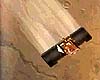
Flight controllers for NASA's Mars Odyssey spacecraft sent commands overnight to raise the spacecraft up out of the atmosphere and conclude the aerobraking phase of the mission.
At 12:18 a.m. Pacific time Jan. 11, Odyssey fired its small thrusters for 244 seconds, changing its speed by 20 meters per second (45 miles per hour) and raising its orbit by 85 kilometers (53 miles). The closest point in Odyssey's orbit, called the periapsis, is now 201 kilometers (125 miles) above the surface of Mars.
The farthest point in the orbit, called the apoapsis, is at an altitude of 500 kilometers (311 miles). During the next few weeks, flight controllers will refine the orbit until the spacecraft reaches its final mapping altitude, a 400-kilometer (249-mile) circular orbit.
"The successful completion of the aerobraking phase is a major milestone for the project. Aerobraking is the most complex phase of the entire mission and the team came through it without a hitch," said David A. Spencer, Odyssey's mission manager at JPL.
"During the next month, we will be reconfiguring the spacecraft to begin the science mapping mission." The science mission is expected to begin in late February.
During the aerobraking phase, Odyssey skimmed through the upper reaches of the martian atmosphere 332 times.
By using the atmosphere of Mars to slow down the spacecraft in its orbit rather than firing its engine or thrusters, Odyssey was able to save more than 200 kilograms (440 pounds) of propellant. This reduction in spacecraft weight enabled the mission to be launched on a Delta II 7925 launch vehicle, rather than a larger, more expensive launcher.
JPL manages the 2001 Mars Odyssey mission for NASA's Office of Space Science, Washington, D.C. Principal investigators at Arizona State University in Tempe, the University of Arizona in Tucson, and NASA's Johnson Space Center, Houston, Texas, operate the science instruments. Additional science investigators are located at the Russian Space Research Institute and Los Alamos National Laboratories.
Lockheed Martin Astronautics, Denver, Colo., is the prime contractor for the project, and developed and built the orbiter. Mission operations are conducted jointly from Lockheed Martin and from JPL, a division of the California Institute of Technology in Pasadena. NASA's Langley Research Center in Hampton, Va., is providing aerobraking support to JPL's navigation team during mission operations.