
"The Odyssey spacecraft is truly going to an unexplored region as it passes through the northern martian atmosphere, an area called the polar vortex," said John Smith, an Odyssey navigation team member who leads the aerobraking design at JPL.
"The Odyssey spacecraft is truly going to an unexplored region as it passes through the northern martian atmosphere, an area called the polar vortex," said John Smith, an Odyssey navigation team member who leads the aerobraking design at JPL. |
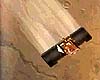
During each aerobraking pass, when the spacecraft skims the atmosphere to alter its orbit, Odyssey's closest approach, known as the periapsis, is just 103 kilometers (64 miles) above the Martian surface. Its farthest point from the planet, known as the apoapsis, is now 15,300 kilometers (9,500 miles).
"The Odyssey spacecraft is truly going to an unexplored region as it passes through the northern martian atmosphere, an area called the polar vortex," said John Smith, an Odyssey navigation team member who leads the aerobraking design at JPL.
"This experience has resulted in both a wealth of new atmospheric information as well as puzzles to be solved in daily aerobraking design activities."
The spacecraft has completed 55 passes through the martian upper atmosphere. Twelve maneuvers have been performed thus far to control the spacecraft's altitude in order to achieve the proper orbit.
During aerobraking, the high-energy neutron detector is the only science instrument taking data. It is turned off briefly during each pass through the atmosphere.
The aerobraking phase is expected to finish in late January 2002. At that point, Odyssey will be in its desired circular orbit, and the science mapping mission will begin sometime in early February.
Related Links
 Mars Odyssey Begins Aerobraking
 Pasadena - Nov 13, 2001