 |
 |
 |
 |
 |
 |
 |
 |
 |

 |
Weather Forecasting Satellite Begins Operation
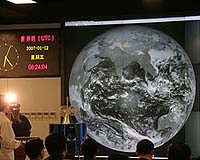
Beijing (Xinhua) Jan 15, 2007 China Meteorological Administration (CMA) received the first set of images from the recently launched Olympic weather forecasting satellite Fengyun-2D(FY-2D) on Friday afternoon. CMA Deputy director Zhang Wenjian said the geostationary orbit meteorological satellite had successfully connected with ground control and was operating normally. He said the FY-2D would form at win-star observation system with Fengyun-2C, the country's first geostationary orbit weather satellite launched in 2004. The two satellites will monitor weather changes across the Chinese territory every 15 minutes and send back images every half hour. Chief designer Li Qin said, "The satellite will provide accurate and timely information about weather changes to help us with weather forecasts during the Beijing 2008 Olympic Games, especially the opening and closing ceremonies and important contests." The FY-2D satellite was launched into the target orbit last December aboard a Long March-3A carrier rocket from the Xichang Satellite Launch Center in southwest China's Sichuan Province. The ground control system will calculate sea surface temperatures and clouds and airflow parameters from data and images sent back by the satellite, maintain statistics and provide application services. China is the third country in the world after the United States and Russia to operate both solar-synchronous meteorological satellites and geostationary orbit meteorological satellites. The solar-synchronous meteorological satellites, like the FY-1 series, are used for medium-range weather forecasting, monitoring global ecological conditions and collecting data for shipping and aviation. The geostationary orbit meteorological satellites are capable of continuously monitoring and identifying dangerous climatic conditions like typhoons and storms. Besides monitoring weather changes in China, the FY-2D will also monitor weather changes in neighboring countries. Community Email This Article Comment On This Article Related Links Weather News at TerraDaily.com Making money out of watching earth from space today Weather News at TerraDaily.com
 Ice Chess Players Race Against Thaw In Moscow
 Moscow (AFP) Jan 11, 2007
The chess pieces started disappearing from the board before the game even got going -- and it had nothing to do with the skill of the Russian and British teams playing in a video relay match on Thursday. The pieces were made of ice and both teams, playing on giant boards in Pushkinskaya Square in Moscow and Trafalgar Square in London, were given a time limit of just 30 seconds for each move, as the sculptures steadily melted. |
|
|

| The content herein, unless otherwise known to be public domain, are Copyright 1995-2006 - SpaceDaily.AFP and UPI Wire Stories are copyright Agence France-Presse and United Press International. ESA PortalReports are copyright European Space Agency. All NASA sourced material is public domain. Additionalcopyrights may apply in whole or part to other bona fide parties. Advertising does not imply endorsement,agreement or approval of any opinions, statements or information provided by SpaceDaily on any Web page published or hosted by SpaceDaily. Privacy Statement |