
MARSDAILY
Try, Try Again: Sols 3655-3656
by Alex Innanen, Atmospheric Scientist at York University
Pasadena CA (JPL) Nov 16, 2022

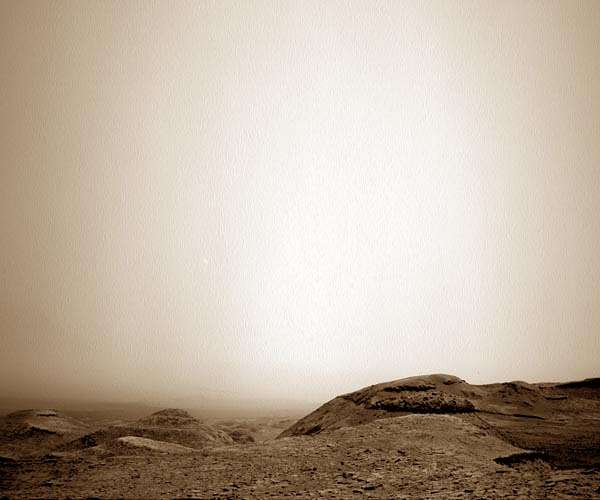
This image was taken by Right Navigation Camera onboard NASA's Mars rover Curiosity on Sol 3652. Credits: NASA/JPL-Caltech.

Yesterday we weren't able to use the arm and thus weren't able to do contact science, but a short drive got us into a better position. Unfortunately, the dust removal tool still wasn't safe to use at our location, so the team decided to make another drive to try again for contact science on the weekend. Even though the plan wasn't what we expected coming in to today, we were still able to make the most of the fantastic location we're in, and to manoeuver into a safer location.

Before the drive, we are fitting in two hours of science, packed full of ChemCam and Mastcam observations. ChemCam is doing LIBS on the target 'Caracarana' and a series of long distance mosaics of Gediz Vallis Ridge. Mastcam is joining ChemCam on Caracarana, and is documenting two bedrock targets, 'Cigana' and 'Tacari' and an area of soil scuffed by the wheel, 'Saddle Mountain.' After the drive, ChemCam is using AEGIS to autonomously select a target.

ENV is taking advantage of the great view of the crater rim and dune field, which you can see in the (slightly askew) Navcam image above. We are doing a 360 degree dust devil survey, and focusing at that view for a targeted dust devil movie. We are also taking a tau and crater rim line of sight to measure dust in the atmosphere, and a suprahorizon cloud movie.

A Scenic Stop: Sols 3653-3654
by Lauren Edgar, Planetary Geologist at USGS Astrogeology Science Center
Pasadena CA (JPL) Nov 15 - Over the weekend Curiosity made great progress towards a location that the team identified as a good imaging stop. We came in this morning and confirmed that we have arrived at the desired location, with a great vantage point looking towards Gediz Vallis ridge, as seen in the above Navcam image. Friday's blog described why we wanted to come to this spot, and today we had the chance to start acquiring those observations!

The terrain to climb up to this location was a little challenging, so unfortunately we weren't able to use the robotic arm for contact science today, but that didn't stop the team from planning a ton of great remote sensing observations (after all, that's what made us want to come to this site!). The highest priority is a large Mastcam mosaic of Gediz Vallis ridge, which we hope to use to decide where Curiosity will go next.

Then ChemCam will assess the target "Guariba" to characterize the new rocks in our workspace. Another high priority in today's plan is a large ChemCam Long Distance RMI mosaic, to get an even better view of the distant stratigraphy at Gediz Vallis ridge. We'll also acquire Mastcam stereo images to document the sedimentary structures near the rover, and a sandy trough in our workspace.

Then the rover will bump to a slightly different position to set us up for contact science in Wednesday's plan. On the second sol, Curiosity turns her eyes to the sky, with an hour of remote sensing activities to characterize atmospheric opacity and search for dust devils. I'm looking forward to seeing the results from these big mosaics and deciding where to go next!


Related Links
Curiosity Mars Science Laboratory
Mars News and Information at MarsDaily.com
Lunar Dreams and more

MARSDAILY
Gediz Vallis Ridge Rising: Sols 3650-3652
Pasadena CA (JPL) Nov 11, 2022
Curiosity is continuing to climb towards a Gediz Vallis ridge viewing spot, and we can already get a glimpse of it rising in the distance. In today's plan we will collect a large stereo Mastcam mosaic of the parts of Gediz Vallis ridge that were visible to us today, and this image combined with the ones we hope to collect from our end of drive location on Monday, will help the team decide if we want to get even closer. We're trying to understand how Gediz Vallis ridge formed, in particular what ki ... read more

Comment using your Disqus, Facebook, Google or Twitter login.

Share this article via these popular social media networks
del.icio.usdel.icio.us DiggDigg RedditReddit GoogleGoogle

MARSDAILY
LunaTwins on board Artemis I and on route to the Moon

Rocket Lab-launched CAPSTONE enters Lunar orbit

An overview of NASA's Artemis 1 mission to the Moon

NASA returning to the Moon with mega rocket launch

MARSDAILY
China launches spacecraft carrying cargo for space station

China's cargo spacecraft sets new world record

Next-generation rocket for astronauts expected in 2027

Astronauts enter China's Mengtian lab module for first time

MARSDAILY
Twin tail revealed in new Hubble image of Didymos-Dimorphos system following DART impact

SwRI experiment helps predict effects of DART impact

Largest potentially hazardous asteroid detected in eight years

Spectral evolution of a dark asteroid surface after ten years of space weathering

MARSDAILY
Mars and Jupiter moons meet

NASA studies origins of dwarf planet Haumea

NASA study suggests shallow lakes in Europa's icy crust could erupt

Sharpest Earth-based images of Europa and Ganymede reveal their icy landscape

MARSDAILY
SwRI scientists compile Cassini's unique observations of Saturn's rings

Exploring Europa possible with silicon-germanium transistor technology

Scientists depict Dragonfly landing site on Saturn moon Titan

Saturn's rings and tilt could be the product of an ancient, missing moon

MARSDAILY
China sends multirole satellite into orbit

Tenchijin develops a land surface temperature product with next level resolution and frequency

Northrop Grumman-built NOAA satellite launches with enhanced data tracking

Future terrestrial ecosystem will produce more oxygen for atmosphere

MARSDAILY
Calnetix Technologies' high-speed blower system delivered to ISS

AFRL awards contract for pioneering spacecraft in region of Moon

SmartSat CRC and NASA team up to collaborate on astronaut emergency communications

S.S. Sally Ride delivers experiments to International Space Station

MARSDAILY
"Polluted" white dwarfs show that stars and planets grow together

Early planetary migration can explain missing planets

Oldest planetary debris in our galaxy found from new study

Do you speak extra-terrestrial?