
Mars Exploration News
MARSDAILY
Tiny Mars' big impact on Earth's climate
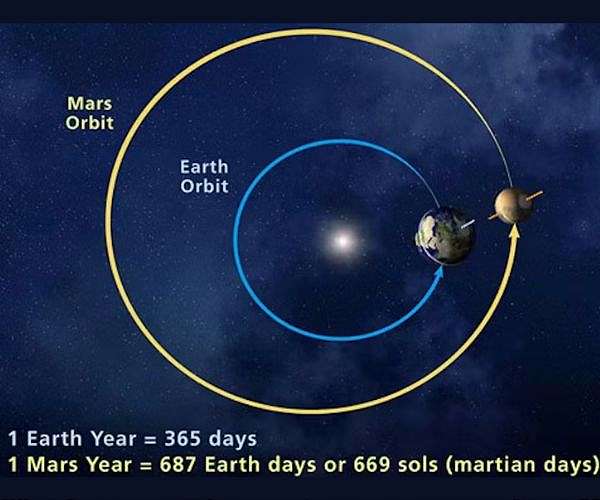
illustration only

Tiny Mars' big impact on Earth's climate

by Jules Bernstein
Riverside, CA (SPX) Jan 12, 2026

At half the size of Earth and one-tenth its mass, Mars is a featherweight as far as planets go. And yet, new research reveals the extent to which Mars is quietly tugging on Earth's orbit and shaping the cycles that drive long-term climate patterns here, including ice ages.

Stephen Kane, a professor of planetary astrophysics at UC Riverside, began this project with doubts about recent studies tying Earth's ancient climate patterns to gravitational nudges from Mars. These studies suggest that sediment layers on the ocean floor reflect climate cycles influenced by the red planet despite its distance from Earth and small size.

"I knew Mars had some effect on Earth, but I assumed it was tiny," Kane said. "I'd thought its gravitational influence would be too small to easily observe within Earth's geologic history. I kind of set out to check my own assumptions."

To do so, Kane ran computer simulations of the solar system's behavior and of the long-term variations in Earth's orbit and tilt that govern how sunlight reaches the surface over tens of thousands to millions of years.

These cycles of shifting orbit and position, called Milankovitch cycles, are central to understanding how and when ice ages begin and end. An ice age is a long period when the planet has permanent ice sheets at the poles. Earth has gone through at least five major ice ages over its 4.5-billion-year history. The most recent began around 2.6 million years ago and is still ongoing.

One Milankovitch cycle is driven mainly by the gravitational pull of Venus and Jupiter and takes 430,000 years to complete. Over that time span, Earth's path around the Sun gradually shifts from nearly circular to more elongated and then back again. This change in orbital shape affects how much solar energy reaches the planet and can influence the advance or retreat of ice sheets.

That 430,000-year cycle stayed intact in Kane's simulations, regardless of whether Mars was present. But when Mars was removed, two other major cycles, one that takes 100,000 years to complete, and another stretching 2.3 million years, disappeared entirely.

"When you remove Mars, those cycles vanish," Kane said. "And if you increase the mass of Mars, they get shorter and shorter because Mars is having a bigger effect."

These cycles affect how circular or stretched Earth's orbit is (its eccentricity), the timing of Earth's closest approach to the Sun, and the tilt of its rotational axis, (its obliquity). These influence how much sunlight different parts of the Earth receive, which in turn affects glacial cycles and long-term climate patterns. Kane's results show that Mars plays a measurable role in both.

"The closer it is to the sun, the more a planet becomes dominated by the sun's gravity. Because Mars is further from the sun, it has a larger gravitational effect on Earth than it would if it was closer. It punches above its weight," Kane said.

One of the more unexpected findings was how the mass of Mars influences the rate at which Earth's tilt changes. Earth is currently tilted at about 23.5 degrees, and that angle varies slightly over time.

"As the mass of Mars was increased in our simulations, the rate of change in Earth's tilt goes down," Kane said. "So increasing the mass of Mars has a kind of stabilizing effect on our tilt."

The paper, published in Publications of the Astronomical Society of the Pacific, not only quantifies Mars' influence on Earth's orbit, but also hints at broader implications. Kane's simulations suggest that even small outer planets in other solar systems could be quietly shaping the stability of worlds that might host life.

"When I look at other planetary systems and find an Earth-sized planet in the habitable zone, the planets further out in the system could have an effect on that Earth-like planet's climate," Kane said.

The results also raise other questions about how Earth might have evolved differently. Glacial periods caused forests to shrink and grasslands to expand in shifts that drove key evolutionary changes like walking upright, tool use, and social cooperation.

"Without Mars, Earth's orbit would be missing major climate cycles," Kane added. "What would humans and other animals even look like if Mars weren't there?"

Research Report:The Dependence of Earth Milankovitch Cycles on Martian Mass

Related Links
University of California Riverside
Mars News and Information at MarsDaily.com
Lunar Dreams and more

Subscribe Free To Our Daily Newsletters
Tweet

RELATED CONTENT
The following news reports may link to other Space Media Network websites.
MARSDAILY
Curiosity Blog, Sols 4750-4762: See You on the Other Side of the Sun
Pasadena CA (JPL) Dec 26, 2025
As we all prepare for the holiday season here on Earth, we have been planning a few last activities before Curiosity and the team of scientists and engineers take a well-deserved, extended break. This holiday season coincides with conjunction - every two years, because of their different orbits, Earth and Mars are obstructed from one another by the Sun; this one will last from Dec. 27 to Jan. 20. We do not like to send commands through the Sun in case they get scrambled, so we have been finishing up a f ... read more

MARSDAILY
Chinese astronauts hone extreme cave survival skills

Lunar spacecraft exhaust could obscure clues to origins of life

Danish Mani mission to chart lunar terrain in 3D

Origami style lunar rover wheel expands to climb steep caves

MARSDAILY
Tiangong science program delivers data surge

China tallies record launch year as lunar and asteroid plans advance

China harnesses nationwide system to drive spaceflight and satellite navigation advances

Shenzhou 21 crew complete eight hour spacewalk outside Tiangong station

MARSDAILY
Asteroid metals harden under extreme particle blasts

NSF-DOE Vera C. Rubin Observatory spots record-breaking asteroid in pre-survey observations

Micro X ray method reads ancient meteorite impact scars

ICE-CSIC leads a pioneering study on the feasibility of asteroid mining

MARSDAILY
Jupiter's moon Europa has a seafloor that may be quiet and lifeless

Uranus and Neptune may be rock rich worlds

SwRI links Uranus radiation belt mystery to solar storm driven waves

Looking inside icy moons

MARSDAILY
Titan interior study points to thick slushy ice shell instead of global ocean

Cassini study reveals organic compounds from Enceladus ocean plume

Saturn's icy moon may host a stable ocean fit for life, study finds

Unexpected discovery on Saturn's moon challenges our view on chemistry before life emerged

MARSDAILY
Nullschool launches new mobile app for popular Earth weather platform

Third COSMO-SkyMed Second Generation radar satellite enters service ramp-up

China geospatial information industry approaches 1 trillion yuan output

Alen Space begins SATMAR satellite validation over Bay of Algeciras

MARSDAILY
International Space Station crew to return early after astronaut medical issue

Second ESCAPADE spacecraft completes key trajectory fix on path to Mars

Why Space Exploration Depends on Predicting the Unpredictable

China launches twin Shijian-29 satellites to test space-target detection tech

MARSDAILY
Joint ground- and space-based observations reveal Saturn-mass rogue planet

Creating hallucination-free, psychedelic-like molecules by shining light on life's basic building blocks

ALMA views giant dusty disk in Gomezs Hamburger with signs of early giant planet formation

Giant amoeba virus ushikuvirus sheds light on how complex cells evolved

Subscribe Free To Our Daily Newsletters


The content herein, unless otherwise known to be public domain, are Copyright 1995-2024 - Space Media Network. All websites are published in Australia and are solely subject to Australian law and governed by Fair Use principals for news reporting and research purposes. AFP, UPI and IANS news wire stories are copyright Agence France-Presse, United Press International and Indo-Asia News Service. ESA news reports are copyright European Space Agency. All NASA sourced material is public domain. Additional copyrights may apply in whole or part to other bona fide parties. All articles labeled "by Staff Writers" include reports supplied to Space Media Network by industry news wires, PR agencies, corporate press officers and the like. Such articles are individually curated and edited by Space Media Network staff on the basis of the report's information value to our industry and professional readership. Advertising does not imply endorsement, agreement or approval of any opinions, statements or information provided by Space Media Network on any Web page published or hosted by Space Media Network. General Data Protection Regulation (GDPR) Statement Our advertisers use various cookies and the like to deliver the best ad banner available at one time. All network advertising suppliers have GDPR policies (Legitimate Interest) that conform with EU regulations for data collection. By using our websites you consent to cookie based advertising. If you do not agree with this then you must stop using the websites from May 25, 2018. Privacy Statement. Additional information can be found here at About Us.