
MARSDAILY
SwRI scientist helps confirm liquid water beneath Mars south polar cap
by Staff Writers
San Antonio, TX (SPX) Jan 26, 2022

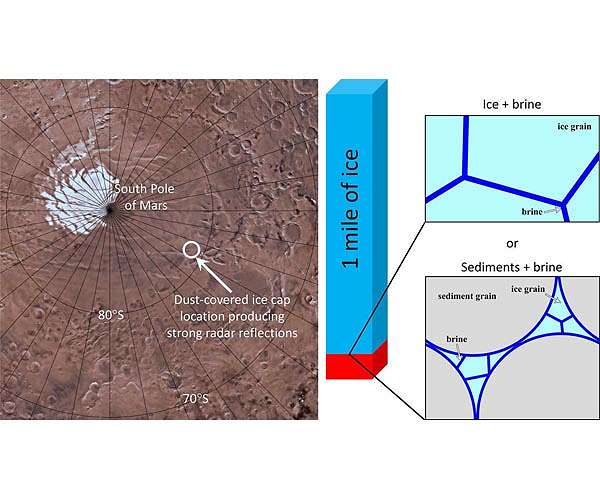
An SwRI scientist studied the antifreeze properties of exotic salts that exist on Mars, which could allow brines to remain liquid down to -75C. The studies show how a mile below the Martian south polar cap, brines between the grains of ice or sediments could produce the strong reflections detected by the radar instrument aboard ESA's Mars Express orbiter.

A Southwest Research Institute scientist measured the properties of ice-brine mixtures as cold as -145 degrees Fahrenheit to help confirm that salty water likely exists between grains of ice or sediment under the ice cap at Mars' south pole. Laboratory measurements conducted by SwRI geophysicist Dr. David Stillman support oddly bright reflections detected by the MARSIS subsurface sounding radar aboard ESA's Mars Express orbiter.

With a 130-foot antenna, MARSIS flies over the planet, bouncing radio waves over a selected area and then receiving and analyzing the echoes or reflections. Any near-surface liquid water should send a strong bright signal, whereas the radar signal for ice and rock would be much smaller.

Because conventional models assume the Mars south polar cap experiences temperatures much lower than the melting point of water, many scientists have questioned the presence of liquid water. Clay, hydrated salts and saline ices have been proposed as potential explanations for the source of the bright basal reflections. The Italian-led team investigating the proposed phenomena used previously published data, simulations and new laboratory measurements.

"Lakes of liquid water actually exist beneath glaciers in Arctic and Antarctic regions, so we have Earth analogs for finding liquid water below ice," said Stillman, a specialist in detecting water in any format - liquid, ice or absorbed - on planetary bodies and co-author of a paper describing these findings. "The exotic salts that we know exist on Mars have amazing 'antifreeze' properties allowing brines to remain liquid down to -103 degrees Fahrenheit. We studied these salts in our lab to understand how they would respond to radar."

Stillman has over a decade of experience measuring the properties of materials at cold temperatures to detect and characterize subsurface ice, unfrozen water and the potential for life throughout the solar system. For this project, Stillman measured the properties of perchlorate brines in an SwRI environmental chamber that produces near-liquid-nitrogen temperatures at Mars-like pressures.

"My Italian colleagues reached out to see if my laboratory experiment data would support the presence of liquid water beneath the Martian ice cap," Stillman said. "The research showed that we don't have to have lakes of perchlorate and chloride brines, but that these brines could exist between the grains of ice or sediments and are enough to exhibit a strong dielectric response. This is similar to how seawater saturates grains of sand at the shoreline or how flavoring permeates a slushie, but at -103 degrees Fahrenheit below a mile of ice near the South Pole of Mars."

The search for water in the cosmos is rooted in searching for potential habitability, because all known life requires water.

"In this case 'following the water' has led us to place so cold that life as we know it couldn't flourish," Stillman said. "But it's still interesting, and who knows what evolutionary paths extraterrestrial life may have taken?

Research Report: "Assessing the role of clay and salts on the origin of MARSIS basal bright reflections"


Related Links
Southwest Research Institute
Mars News and Information at MarsDaily.com
Lunar Dreams and more

MARSDAILY
Hope for present-day Martian groundwater dries up
Austin XT (SPX) Jan 25, 2022
Liquid water previously detected under Mars' ice-covered south pole is probably just a dusty mirage, according to a new study of the red planet led by researchers at The University of Texas at Austin. Scientists in 2018 had thought they were looking at liquid water when they saw bright radar reflections under the polar cap. However, the new study published Jan. 24 in the journal Geophysical Research Letters found that the reflections matched those of volcanic plains found all over the red planet's ... read more

Comment using your Disqus, Facebook, Google or Twitter login.

Share this article via these popular social media networks
del.icio.usdel.icio.us DiggDigg RedditReddit GoogleGoogle

MARSDAILY
NASA's HERMES mission passes key milestone, moves toward launch

China, Russia to start building lunar research station by 2026

A VIPER in the Sand

Israel Signs Artemis Accords

MARSDAILY
China Focus: China to explore lunar polar regions, mulling human landing: white paper

China to boost satellite services, space technology application: white paper

China Focus: China to explore space science more: white paper

China to improve space debris monitoring: white paper

MARSDAILY
Why are comet heads green - but not their tails?

NASA asteroid tracking system now capable of full sky search

Solar Orbiter catches a second comet by the tail

Looking Up at the Asteroids in the Neighborhood

MARSDAILY
Oxygen ions in Jupiter's innermost radiation belts

Ocean Physics Explain Cyclones on Jupiter

Looking Back, Looking Forward To New Horizons

Testing radar to peer into Jupiter's moons

MARSDAILY
SwRI scientist uncovers evidence for an internal ocean in small Saturn moon

MARSDAILY
Satellogic completes transaction to become publicly traded company

China launches L-SAR 01A satellite for land observing

ESA supports the White House on greenhouse gas monitoring

Particles formed in boreal forests affect clouds in the troposphere

MARSDAILY
New ISS National Laboratory tool expands visibility of ISS-related educational resources

Caltech names Laurie Leshin Director of JPL

US issues visa to Russian ISS cosmonaut

NASA provides updated International Space Station Transition Plan

MARSDAILY
Exoplanet has Earth-like layered atmosphere made of titanium gas

Extreme exoplanet has a complex and exotic atmosphere

What the rise of oxygen on early Earth tells us about life on other planets

A planetary dynamical crime scene at 14 Herculis