
MARSDAILY
Status Update on NASA's MAVEN Spacecraft
by Nancy Jones for GSFC News
Greenbelt MD (SPX) May 20, 2022

I'm back.

On February 22, 2022, NASA's MAVEN spacecraft went into safe mode when the spacecraft's Inertial Measurement Units (IMUs) began exhibiting anomalous behavior. The spacecraft is currently out of safe mode, stable and in Earth-nadir mode, pointing its high gain antenna toward Earth to facilitate high-rate communications.

In this configuration, however, MAVEN cannot perform communications relays for other spacecraft on Mars and is performing only limited science observations. The mission team began science instrument recovery on April 20.

Safe mode began when the IMUs, navigation instruments that sense the spacecraft's rotation and control the pointing of the orbiter's antenna and science instruments, exhibited anomalies when turning on after a power cycle.

MAVEN stayed in safe mode until April 19 when the mission team switched the spacecraft to rely on stellar navigation instead of the IMUs, which is known as "all stellar" mode.

All MAVEN's science instruments are currently online, but not all of them have been able to take data while the high gain antenna is restricted to pointing toward Earth.

The team is currently working to finish checkouts of "all stellar" mode to enable the spacecraft to operate in other orientations prior to resuming nominal science and relay operations by the end of the month.


Related Links
MAVEN
Mars News and Information at MarsDaily.com
Lunar Dreams and more

MARSDAILY
Physicists explain how type of aurora on Mars is formed
Iowa City IA (SPX) May 19, 2022
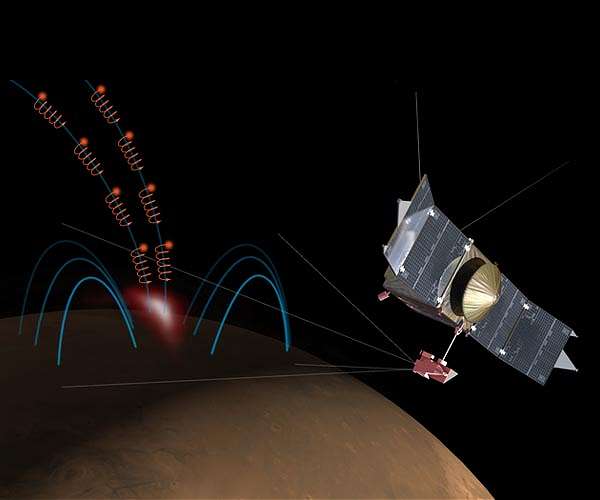
Physicists led by the University of Iowa have learned how a type of aurora on Mars is formed. In a new study, the physicists studied discrete aurora, a light-in-the-sky display that occurs mostly during the night in the red planet's southern hemisphere. While scientists have known about discrete aurora on Mars-which also occur on Earth-they did not know how they formed. That's because Mars does not have a global magnetic field like Earth, which is a main trigger for aurora, also called the northern and ... read more

Comment using your Disqus, Facebook, Google or Twitter login.

Share this article via these popular social media networks
del.icio.usdel.icio.us DiggDigg RedditReddit GoogleGoogle

MARSDAILY
Fly me to the Moon: US, Japan aim for lunar landing

President Biden: NASA to Welcome Japanese Astronaut Aboard Gateway

Astronauts may one day drink water from ancient moon volcanoes

NASA Seeks Input on Moon to Mars Objectives, Comments Due May 31

MARSDAILY
Researchers start planting space-bred seeds returned by Shenzhou-13

New cargo spacecraft being built

The beginning of a multi-spacecraft exploration in Martian space by China, the US and Europe

Tianwen-1 mission marks first year on Mars

MARSDAILY
Dwarf planet Ceres was formed in coldest zone of Solar System and thrust into Asteroid Belt

Asteroid treasure in the Hubble archive

'Spot the difference' to help reveal Rosetta image secrets

NASA's Psyche starts processing at Kennedy

MARSDAILY
Traveling to the centre of planet Uranus

Juno captures moon shadow on Jupiter

Greenland Ice, Jupiter Moon Share Similar Feature

Search for life on Jupiter moon Europa bolstered by new study

MARSDAILY
Scientists model landscape formation on Titan, revealing an Earth-like alien world

On icy moon Enceladus, expansion cracks let inner ocean boil out

MARSDAILY
Polar Ice and Snow monitoring mission CRISTAL on track

It's a kind of MAGIC

Satellogic and UP42 team up to offer rapid monitoring capabilities

Satellites and drones can help save pollinators

MARSDAILY
Engineers investigating Voyager 1 telemetry data

Blue Origin delays next flight over technical issues

Boeing's Starliner faces one more challenge as it returns to Earth

Soil, sutures, and climate modeling among investigations riding SpaceX CRS-25 Dragon to ISS

MARSDAILY
AI reveals unsuspected math underlying search for exoplanets

Planets of binary stars as possible homes for alien life

Seeing through the fog-pinpointing young stars and their protoplanetary disks

The search for how life on Earth transformed from simple to complex