Drilling campaigns force us to sit and stop, whilst the "Ubajara" drill sample is analyzed. This takes a week or two, depending on the types of analysis that CheMin and SAM chose to do. This might sound like we are sitting quietly, just waiting but drill campaigns are furiously busy and "power hungry."
CheMin planned the first part of their analysis on Wednesday, and today, they added a second set of analysis, integrating over the drilled "Ubajara" sample. SAM will do a "preconditioning" activity, which sets SAM up for analysis next week. These activities are power intensive, which constrains what GEO and ENV can fit into the plan.
Often, we leave a workspace with regret – there are only so many hours in a given day, and even though a given sol (day) on Mars is longer than one on Earth, we almost always identify more targets than we can possibly fit in! So GEO is taking the opportunity here to analyze everything that ChemCam can reach.
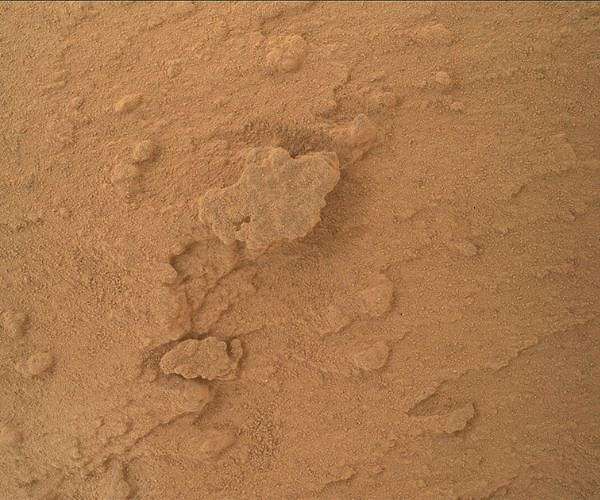
Today's plan focuses on small raised resistant features. Earlier this week, APXS analysed a really small nodule feature at "Ilha Grande," shown in the accompanying MAHLI image and there was interest in analyzing this target with ChemCam's LIBS instrument, which is well suited to hitting these types of targets. ChemCam will use LIBS on Ilha Grande and a nearby larger mass of similar material ("Tucuma") (which was too rough to analyze with APXS as it posed a danger to the instrument) in this plan.
The raised features are so small (Ilha Grande is 1 cm at its widest point) that they are hard to target with any great confidence, so targeting this early in our Ubajara stop will allow them to be refined and repeated if necessary. Mastcam will also image both ChemCam targets.
In parallel to the GEO themed part of the plan, the ENV group will also uplink several environmental activities. Mastcam will take two change detection images. These are typically done when we are stopped in a place for a few days.
Taking images at the same time of day on a number of consecutive days allows us to see how much sediment is moving in our workspace, giving us an idea of wind directions and strengths. Navcam will also look for indirect evidence of winds, through "dust devil" movies which can also tell us about wind direction and strength.
Mastcam will take a "crater rim extinction" image and a full tau measurement, to measure dust both within the crater and overhead in the atmosphere, whilst Navcam will survey clouds above us. The ENV portion of the plan is rounded out by REMS and DAN activities, looking at temperatures (REMS) and potential traces of hydrogen (DAN).
Full Caption
Using an onboard focusing process, the Mars Hand Lens Imager (MAHLI) aboard NASA's Mars rover Curiosity created this product by merging two to eight images previously taken by the MAHLI, located on the turret at the end of the rover's robotic arm.
Curiosity performed the merge on May 7, 2023, Sol 3821 of the Mars Science Laboratory Mission, at 10:13:20 UTC. The focus motor count position was 13913. This number indicates the lens position of the first image that was merged.
The onboard focus merge is sometimes performed on images acquired the same sol as the merge, and sometimes uses pictures obtained on an earlier sol. Focus merging is a method to make a composite of images of the same target acquired at different focus positions to bring all (or, as many as possible) features into focus in a single image.
Because the MAHLI focus merge is performed on Mars, it also serves as a means to reduce the number of images sent back to Earth. Each focus merge produces two images: a color, best-focus product and a black-and-white image that scientists can use to estimate focus position for each element of the best focus product. Thus, up to eight images can be merged, reducing the number of images returned to Earth to two.