
MARSDAILY
Shocking Spherules!
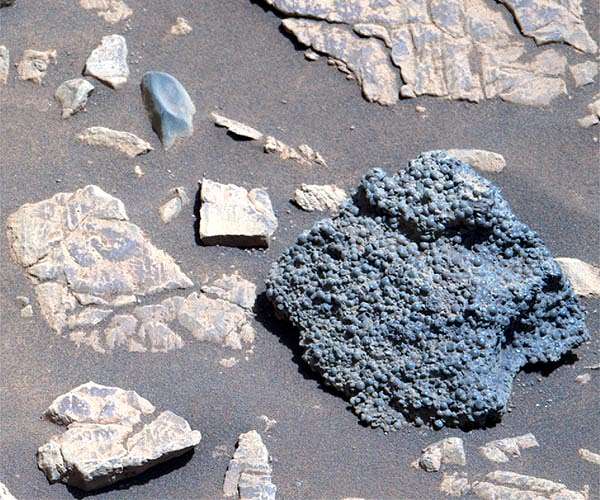
NASA's Mars Perseverance rover acquired this image of the "St. Pauls Bay" target (the dark-toned float block in the right of the view) using its Left Mastcam-Z camera, one of a pair of cameras located high on the rover's remote-sensing mast. Perseverance acquired this image on March 13, 2025 - sol 1444, or Martian day 1,444 of the Mars 2020 mission - at the local mean solar time of 11:57:49.
Shocking Spherules!
by Alex Jones, Ph.D. candidate at Imperial College London
Pasadena CA (JPL) Mar 24, 2025
Last week the Perseverance Science Team were astonished by a strange rock comprised of hundreds of millimeter-sized spheres... and the team are now working hard to understand their origin. It has now been two weeks since Perseverance arrived at Broom Point, situated at the lower slopes of the Witch Hazel Hill area, on the Jezero crater rim. Here, a series of light- and dark- toned bands were visible from orbit, and just last week the rover successfully abraded and sampled one of the light-toned beds. It was from this sampling workspace where Perseverance spied a very strange texture in a nearby rock...

The rock, named "St. Pauls Bay" by the team, appeared to be comprised of hundreds of millimeter-sized, dark gray spheres. Some of these occurred as more elongate, elliptical shapes, while others possessed angular edges, perhaps representing broken spherule fragments. Some spheres even possessed tiny pinholes! What quirk of geology could produce these strange shapes?

This isn't the first time strange spheres have been spotted on Mars. In 2004, the Mars Exploration Rover Opportunity spotted so-called, "Martian Blueberries" at Meridiani Planum, and since then, the Curiosity rover has observed spherules in the rocks of Yellowknife Bay at Gale crater. Just a few months ago, Perseverance itself also spied popcorn-like textures in sedimentary rocks exposed in the Jezero crater inlet channel, Neretva Vallis. In each of these cases, the spherules were interpreted as concretions, features that formed by interaction with groundwater circulating through pore spaces in the rock. Not all spherules form this way, however. They also form on Earth by rapid cooling of molten rock droplets formed in a volcanic eruption, for instance, or by the condensation of rock vaporized by a meteorite impact.

Each of these formation mechanisms would have vastly different implications for the evolution of these rocks, so the team is working hard to determine their context and origin. St. Pauls Bay, however, was float rock - a term used by geologists to describe something that is not in-place. The team are now working to link the spherule-rich texture observed at St. Pauls Bay to the wider stratigraphy at Witch Hazel Hill, and initial observations have provided tantalizing indications that it could be linked to one of the dark-toned layers identified by the team from orbit. Placing these features in geologic context will be critical for understanding their origin, and determining their significance for the geological history of the Jezero crater rim and beyond!

Related Links
Perseverance Mission Updates
Mars News and Information at MarsDaily.com
Lunar Dreams and more

Tweet

MARSDAILY
Navigating a Slanted River
Pasadena CA (SPX) Mar 14, 2025
Perseverance is hard at work on Mars, overcoming obstacles for scientific exploration! Just a few sols after successfully sealing the challenging Green Gardens core, Perseverance roved on to the Broom Point workspace to collect another sample called Main River. Broom Point is situated a few hundred meters down-slope from where Green Gardens was collected, and the Science Team chose to explore this area because orbiter images show some intriguing, alternating light and dark layers. Upon reaching th ... read more

MARSDAILY
JAXA adopts Spirent lunar navigation simulation to advance Moon missions

South Pole Aitken Basin impact dated to early Moon history by Chang'e 6 samples

Firefly taps Honeybee Robotics to deliver rover for 2028 Moon dome mission

Chang'e-6 samples pinpoint moon's oldest crater to 4.25 billion years ago

MARSDAILY
China's Galactic Energy expands Yunyao satellite network with successful launch

Shenzhou XIX astronauts complete third spacewalk outside Tiangong

Hong Kong spearheads lunar robotics initiative for national space program

Joint initiatives to propel China's commercial space industry forward

MARSDAILY
Meteorite origins mapped to regions of asteroid belt

New Modeling Assesses Age of Next Target Asteroid for NASA's Lucy

UAE Space Agency advances asteroid exploration mission with design milestone

Hera asteroid mission captures images of Mars moon Deimos

MARSDAILY
NASA's Hubble Telescope May Have Uncovered a Triple System in the Kuiper Belt

NASA's Europa Clipper Leverages Mars for Critical Gravity Assist

Oort cloud resembles a galaxy, new study finds

The PI's Perspective: A New Mission Update for the New Year

MARSDAILY
Tidal energy data aids SwRI scientists in unraveling Titan's composition and orbital shifts

SwRI experiments validate theories about Titan's atmospheric sustainability

MARSDAILY
Biomass satellite to lift off aboard Vega C in late April

Planet collaborates with ESA to advance Greek satellite services

ICEYE expands satellite fleet with latest launch and unveils advanced Gen4 imaging system

Pixxel satellites deliver groundbreaking hyperspectral imaging milestone

MARSDAILY
Delft and Brown researchers unveil ultrathin sails for laser propulsion in space

NRL imager begins solar wind observations aboard NASA PUNCH mission

US imposes trade restrictions on dozens of entities with eye on China

ISRO advances space tech with SPADEX undocking and cryogenic engine milestone

MARSDAILY
China sends regenerative flatworms to orbit for biological research

Were large soda lakes the cradle of life

Fluorescent caves could explain how life persists in extraterrestrial environments

Super Earth uncovered by tandem space observations