
MARSDAILY
Searching for Frost at Jezero Crater
by Matthew Brand | SuperCam/ChemCam Engineer - LANL
Los Alamos NM (SPX) Sep 13, 2022

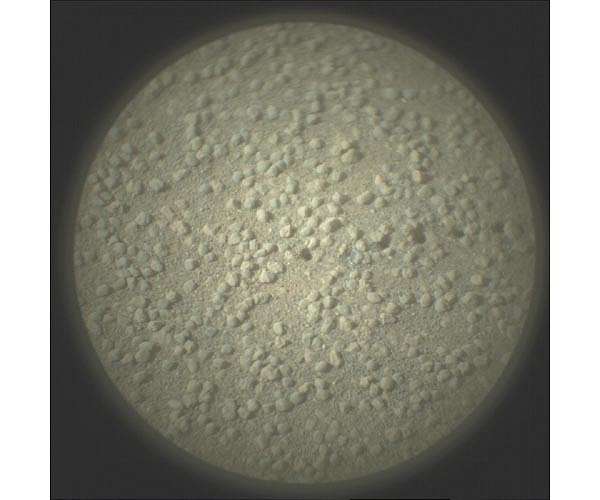
Mars Perseverance Sol 546 - SuperCam Camera: This SuperCam Remote Micro-Imager (RMI) image shows the Red Mountain target, which was analyzed on September 2nd (sol 546) as part of a campaign to detect frost at Jezero Crater. The small 'pits' seen in the center of the image were created by LIBS laser shots.

We've all walked outside on a cold morning and seen frost on the grass, but you might be surprised to know that frost can also form on Mars! Several missions have searched for frost including Opportunity and most recently Curiosity with its REMS and ChemCam instruments. This week, Perseverance followed in its siblings' footsteps by searching for frost at Jezero Crater using its MEDA and SuperCam instruments. The presence of frost could have important implications for our study of the geology and water cycle of Jezero Crater and Mars as a whole.

Frost forms when the ground temperature gets below the frost point. The frost point is the temperature below which water vapor in the air can turn directly into solid ice on the ground. The frost point changes based on the humidity of the air. Perseverance's Mars Environmental Dynamics Analyzer (MEDA) instrument collects temperature and humidity data, allowing us to predict which sols have the best conditions for frost formation. Once conditions permit frost formation, SuperCam steps in.

SuperCam utilizes several remote-sensing techniques to study the geology of nearby rocks. We use two techniques to detect frost: Laser Induced Breakdown Spectroscopy (LIBS) and Raman spectroscopy. Both involve 'zapping' nearby rocks with a high-powered laser and analyzing the reflected light.

LIBS uses a focused red (1064nm) laser which generates a tiny amount of hot plasma on the rock, while Raman uses a softer green (532nm) laser which merely simulates the molecules on the surface of the rock. LIBS spectra reveal hints about the rock's elemental composition while Raman spectra reveal hints about the rock's mineralogical composition. In addition, a microphone records each LIBS shot to analyze the hardness of the rock at different depths.

Now is the perfect time to search for frost since it's the peak of winter at Jezero Crater. Last week I helped plan our first SuperCam frost detection activity which consisted of two observations on a nearby soil target. The first, named Red Mountain, occurred in the afternoon of sol 546 (September 2nd) when frost wasn't expected.

The second, named Snowy Mountain, occurred at dawn on sol 548 (September 4th) when conditions could foster frost formation. If frost exists on the Snowy Mountain target, we should detect hydrogen in the LIBS spectra and O-H bonds in the Raman spectra in greater quantities than in the Red Mountain spectra. We're also listening for a soft acoustic signal in the first LIBS shot of Snowy Mountain which could indicate a frost layer as thin as ~10 microns.

I'm excited to see how our frost campaign shapes our understanding of Jezero Crater and beyond!


Related Links
Perseverance Mars 2020
Mars News and Information at MarsDaily.com
Lunar Dreams and more

MARSDAILY
Glaciers flowed on ancient Mars, but slowly
Nantes, France (SPX) Sep 08, 2022
The weight and grinding movement of glaciers has carved distinctive valleys and fjords into Earth's surface. Because Mars lacks similar landscapes, researchers believed ancient ice masses on the Red Planet must have been frozen firmly to the ground. New research suggests they were not stuck in place, but just moved very slowly. Motion is part of the definition of a glacier. On Earth, meltwater gathers below glaciers and ice sheets, lubricating the downhill slide of these rivers of ice. The new stu ... read more

Comment using your Disqus, Facebook, Google or Twitter login.

Share this article via these popular social media networks
del.icio.usdel.icio.us DiggDigg RedditReddit GoogleGoogle

MARSDAILY
Communications restored with CAPSTONE in latest update

NASA's CAPSTONE probe suffers anomaly, put in safe mode

WVU and NASA plant the seed for STEM among youth in Plant the Moon Challenge

NASA delays launch of Artemis I rocket until Sept. 27

MARSDAILY
Taikonauts enjoy 'home-grown' meal during Mid-Autumn Festival

Rocket to carry Mengtian space lab module arrives at launch site

Duo undertake 7-hour spacewalk

Chinese scientist advocates int'l cooperation in space science

MARSDAILY
Lowell Discovery Telescope plays key role in DART planetary defense test mission

DART sets sights on asteroid target

Cornell astronomers show how terrain evolves on icy comets

Crime-scene technique identifies asteroid sites

MARSDAILY
NASA's Juno Mission Reveals Jupiter's Complex Colors

The PI's Perspective: Extending Exploration and Making Distant Discoveries

Uranus to begin reversing path across the night sky on Wednesday

Underwater snow gives clues about Europa's icy shell

MARSDAILY
Saturn's rings and tilt could be the product of an ancient, missing moon

Long lost moon could have been responsible for Saturn's rings

Lowell Observatory points telescopes at Saturn during closest annual approach

SwRI researcher shows how elliptical craters could shed light on age of Saturn's moons

MARSDAILY
Taking the dazzle out of CryoSat yields a first

Planet Partners with Taylor Geospatial Institute to leverage data food security and more

World's first satellite with both SAR and Optical Payloads will revolutionize geospatial imaging

Proposed Tandem4EO constellation will combine radar and optical imaging for Europe

MARSDAILY
Space seeds thrive at the United Nations Campus

ISS National Lab Research Announcement Focused on Technology Advancement is Open

Redwire and Sodern team up to market the Exquisite-Class Eagle Eye Star Tracker

ESA astronaut Samantha Cristoforetti becomes first European female ISS commander

MARSDAILY
It's a planet: new evidence of baby planet in the making

Study: Astronomers risk misinterpreting planetary signals in James Webb data

A thousand days of CHEOPS

Surprise finding suggests 'water worlds' are more common than we thought