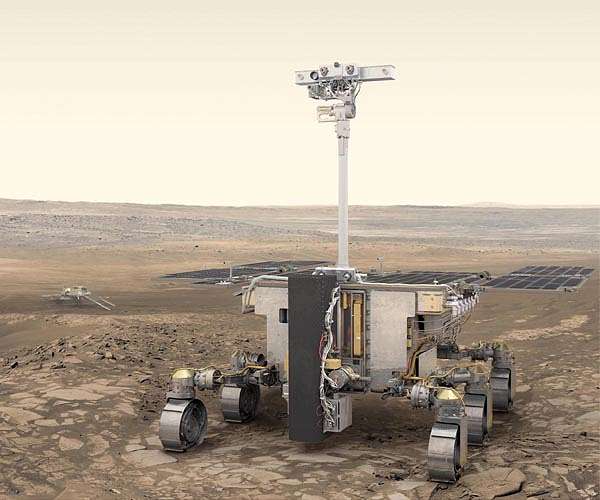
The ExoMars rover Rosalind Franklin, scheduled to launch in 2022, is tasked with hunting for past life on the Red Planet.
Most of the rover's scientific probing will be focused on the first six inches of Mars' crust, but the spacecraft will also be programmed to identify, sample and analyze meteorites strewn across the Martian surface.
Mission scientists unveiled the rover's meteorite-hunting instruments on Friday morning at this year's virtual National Astronomy Meeting.
To properly program the meteorite-hunting abilities of Rosalind Franklin's instrument suite, scientists and engineers utilized the vast meteorite collection at the Natural History Museum in London.
Meteorites at the museum helped engineers train and test the ability of rover's multispectral imaging PanCam instrument to distinguish geochemical signatures unique to foreign rocks.
Though looking for rocks in a sea of rocks may sound like a daunting task, past Martian rovers have been surprisingly successful at locating meteorites without trying.
Rosalind Franklin will make a point of sniffing out meteorites in order to contextualize the rover's primary scientific observations.
While meteorites are unlikely to feature signs of ancient life, they may have delivered the organic matter necessary for microbial life to emerge billions of years ago.
Analysis of the meteorite composition can also help scientists study climate weathering rates and water-rock interactions on Mars, providing clues to ancient climate conditions on the Red Planet.
"Meteorites act as a witness plate across geological time," Sara Motaghian, a doctoral student at NHM and Imperial College London who aided the research, said in a press release.
"Generally, the surfaces of Mars we are exploring are incredibly ancient, meaning there have been billions of years for the surface to accumulate these meteorites and lock in information from across Mars' past," Motaghian said.
In addition to training the PanCam instrument to recognize spectral signatures unique to meteorites, scientists also tested pattern recognition techniques for the types of extreme weathering found on the surface of meteorites.