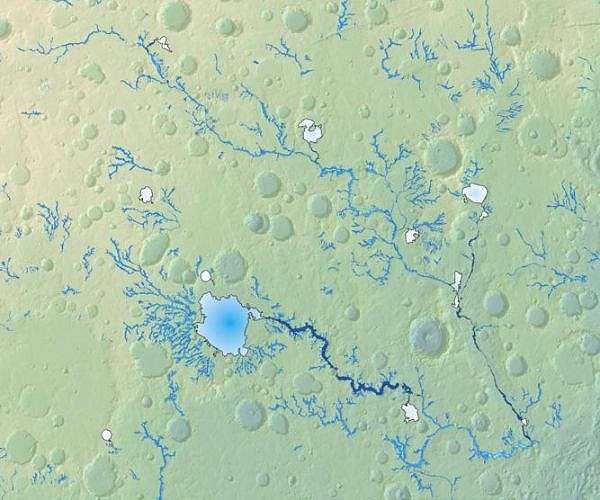
Billions of years ago, rainfall on Mars fed rivers that cut valleys, overtopped crater rims and carved canyons, with some flows likely reaching a northern ocean basin on the planet.
Researchers at The University of Texas at Austin have now organized these fluvial features into large drainage systems, producing the first global inventory of major Martian river basins and identifying 16 large-scale river systems where long-lived surface water would have been most likely to support habitable conditions.
Co-author Timothy A. Goudge, an assistant professor in the UT Jackson School of Geosciences Department of Earth and Planetary Sciences, noted that scientists have recognized Martian rivers for years but had not previously quantified how extensively they formed connected drainage networks at the planetary scale. Postdoctoral fellow Abdallah S. Zaki and Goudge combined earlier global datasets of valley networks, lakes, rivers, canyons and sediment deposits, then traced the contributing areas to delineate entire drainage systems and determine their size.
From this synthesis, the team identified 19 major clusters of fluvial features, 16 of which form connected watersheds with drainage areas of at least 100,000 square kilometers, a threshold commonly used on Earth to define large basins. Zaki, who led the work, explained that they applied a simple mapping approach, linking previously cataloged features into coherent catchments.
On Earth, there are 91 large watersheds meeting or exceeding 100,000 square kilometers, including the Amazon River basin at about 6.2 million square kilometers and Texas' Colorado River basin at roughly 103,300 square kilometers, just above the large-basin cutoff. Large drainage systems on Earth efficiently move nutrients through river networks, which supports ecosystems with high biological diversity and, in cases such as the Indus River basin, has coincided with early centers of human civilization.
The researchers point out that Mars, which lacks plate tectonics, shows far fewer large drainage systems than Earth, where tectonic uplift builds mountains and varied topography that promote extensive, interconnected river networks. Even so, they calculate that large Martian drainage systems occupy only about 5% of the mapped ancient surface yet account for roughly 42% of the total sediment volume eroded by rivers.
Because river-transported sediment stores nutrients and preserves evidence of water – rock interactions, Zaki argues that these large basins are prime locations for future searches for signs of past life, provided scientists can locate where the eroded material was ultimately deposited. He noted that longer flow paths increase opportunities for chemical reactions between water and rock, which could enhance the likelihood that any biosignatures would be recorded in the sedimentary record.
Outside the large systems, most of Mars is covered by what the team describes as a mosaic of smaller drainage basins, each of which may once have hosted localized habitable environments. However, the 16 mapped large watersheds integrate long-duration fluvial activity and sediment transport and are therefore highlighted as efficient starting points for future mission planning focused on habitability.
Goudge emphasized that defining these large drainage systems provides a framework for choosing high-priority landing sites and orbital survey targets when designing missions to search for evidence of past life on Mars. Jackson School Department Chair Danny Stockli described the work, which also includes co-author and professor David Mohrig, as advancing understanding of Martian surface evolution and ancient hydrologic processes.
Research Report:Large drainage systems produced half of Mars' ancient river sediment