In science fiction movies and television shows, real-life locations on Earth, such as California's Redwood National Forest and the Sahara Desert, have long been used to represent alien worlds. But recently, in a Star Trek-style twist, a group of scientists, including researchers at the Laboratory for Atmospheric and Space Physics (LASP) at the University of Colorado Boulder, have been using a planet in our own backyard-Mars-to help characterize and identify habitable, Earth-like planets in other solar systems.
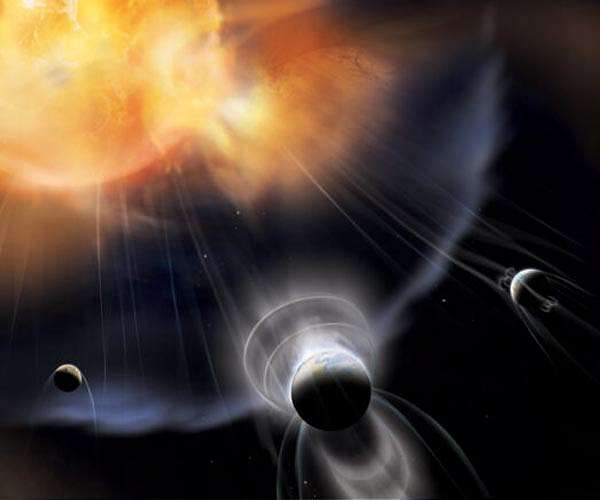
An international multi-disciplinary team of modelers, observational scientists and theoreticians from three science disciplines-space physics, planetary sciences and astrophysics-has been working synergistically to extrapolate their current understanding of Mars to determine which planets beyond Earth's solar system are most likely to host life. The answer hinges on the exoplanets' atmospheres-and what it takes for each planet to retain those atmospheres, including Mars if it were circling a different star.
One example the team is studying is the case of "Exoplanet Mars" orbiting a dim, class-M star, which is only about 4% as bright as our sun and nearly 3,000 degrees Celsius cooler. This research will provide a better understanding of how long a planet like Mars could retain an atmosphere if it orbited this smaller, cooler, but more active star. The preliminary results indicate the rate at which Exoplanet Mars would lose its atmosphere would be larger than what the real-world planet has experienced.
"Mars is a remarkable natural experiment that demonstrates how its atmosphere and, therefore, its habitability can be affected by the properties of both the planet and the star it orbits," said David Brain, a planetary researcher at LASP and the team's leader. The challenge, he added, is assembling the expertise, the observations and the model results to understand the relative importance of each property, with the goal of making predictions about the habitability of individual planets orbiting other stars.
This multi-disciplinary, cutting-edge approach is made possible by the new Magnetic fields, Atmosphere, and the Connection to Habitability (MACH) NASA DRIVE Science Center, which Brain leads. DRIVE Science Centers (DSC) are part of NASA's integrated multi-agency initiative to address grand challenge goals.
"Our center has brought together experts from many scientific disciplines to collaboratively address big-picture questions like the habitability of alien planets," said Brain.
Organizing scientists from many different disciplines is not always easy. Brain said the team members have had to learn how to communicate more effectively and figure out how to meld models developed by scientists in disciplines that had diverged from each other in recent decades.
"Together we are figuring out which physics are important to include and how to link models together, while making sure team members feel heard and are inclusive in the process," explained Brain.
The importance of this work was highlighted just a few weeks ago, when the National Academies of Sciences, Engineering, and Medicine named "Pathways to Habitable Worlds" as one of the three key focus areas for future research in its "Pathways to Discovery in Astronomy and Astrophysics for the 2020s" (Astro2020) report.
"The fact that the astronomy and astrophysics community has highlighted this topic for the next decade is very exciting and speaks to the significance of our work," said Brain.
David Brain will be presenting some of the MACH team's preliminary results this week during the AGU Fall Meeting 2021 in New Orleans.
The international MACH DSC team include researchers from LASP and CU Boulder, University of Massachusetts, University of Kansas, NASA Goddard Space Flight Center, University of New Hampshire, LATMOS, University of California, Los Angeles, Sonoma State University, SRI International, University of Tokyo, University Leiden, Swedish Institute for Space Physics, Tohoku University and the University of Illinois.