
Mars Exploration News
MARSDAILY
Sandblasting winds sculpt Mars landscape
illustration only

Sandblasting winds sculpt Mars landscape

by Robert Schreiber
Berlin, Germany (SPX) Jan 08, 2026

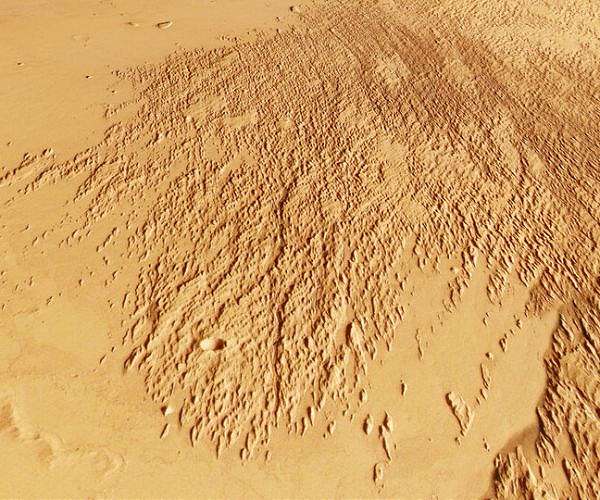
Martian winds lift sand grains into the air and drive them across the surface, where they erode soft sedimentary layers and gradually carve elongated grooves and ridges near the planet's equator. The remaining ridges, mounds, or columns, known as yardangs, stand above the surrounding terrain and often extend for tens of kilometres in the direction of the prevailing winds.

In northern Eumenides Dorsum, the yardangs share a common orientation that reflects a dominant wind direction sweeping in from the south-east and curving across a region roughly comparable in size to Belgium. These landforms occupy the northern end of the Eumenides Dorsum mountains, which lie just east of the Tharsis volcanic rise and form part of the dust-rich Medusae Fossae Formation identified in earlier Mars Express observations.

The area also contains a relatively fresh impact crater whose raised rim and extensive, wavy-edged ejecta blanket stand out against the wind-sculpted terrain. Material thrown out during the impact settled around the crater, forming a broad apron that interacts with nearby yardangs and helps scientists reconstruct the sequence of erosional and impact events in this sector of Mars.

A third key feature is a zone of so-called platy flow, located below and beside the main group of yardangs. This terrain resembles broken ice floes on terrestrial seas: as lava once advanced across the area, its surface crust solidified while molten rock continued to move beneath, breaking the crust into discrete plates that were carried along like rafts.

The yardangs border this platy flow terrain and also appear to sit on top of it, indicating that wind erosion operating on sedimentary deposits postdates the emplacement and cooling of the lava. This superposition relationship provides a relative timeline, with volcanism shaping the surface first and aeolian processes subsequently reworking it over long periods.

Mars Express acquired these data with its High Resolution Stereo Camera (HRSC), one of eight instruments carried by the orbiter. Since entering Mars orbit in 2003, Mars Express has returned colour, stereo, and high-resolution coverage of many martian landscapes, enabling detailed geological reconstructions of regions such as Eumenides Dorsum and the Medusae Fossae Formation.

The HRSC instrument was developed and is operated by the German Aerospace Center (DLR), which also carries out systematic data processing at its Institute of Space Research in Berlin-Adlershof. Researchers in the Planetary Science and Remote Sensing group at Freie Universitat Berlin used these processed data to generate derived products, including bird's-eye views and topographic maps of the northern Eumenides Dorsum region.

Related Links
European Space Agency Mars Express mission
Mars News and Information at MarsDaily.com
Lunar Dreams and more

Subscribe Free To Our Daily Newsletters
Tweet

RELATED CONTENT
The following news reports may link to other Space Media Network websites.
MARSDAILY
Martian fractures reveal ancient forces and icy flows
Paris, France (SPX) Aug 08, 2025
In a new release from the European Space Agency, Mars Express has revisited the western end of Acheron Fossae, a striking system of deep fissures on Mars shaped by ancient geological upheaval and later sculpted by ice-rich flows. The orbiter's High Resolution Stereo Camera first captured this area in April 2004, just months into its mission. These latest images reveal the faulted terrain's horst and graben pattern, where raised and lowered blocks formed as molten material rose beneath the crust ov ... read more

MARSDAILY
Chinese astronauts hone extreme cave survival skills

Lunar spacecraft exhaust could obscure clues to origins of life

Danish Mani mission to chart lunar terrain in 3D

Origami style lunar rover wheel expands to climb steep caves

MARSDAILY
China harnesses nationwide system to drive spaceflight and satellite navigation advances

Shenzhou 21 crew complete eight hour spacewalk outside Tiangong station

Foreign satellites ride Kinetica 1 on new CAS Space mission

Experts at Hainan symposium call for stronger global space partnership

MARSDAILY
NSF-DOE Vera C. Rubin Observatory spots record-breaking asteroid in pre-survey observations

Micro X ray method reads ancient meteorite impact scars

ICE-CSIC leads a pioneering study on the feasibility of asteroid mining

OSIRIS-APEX spacecraft completes Earth flyby on its journey to explore Apophis

MARSDAILY
Jupiter's moon Europa has a seafloor that may be quiet and lifeless

Uranus and Neptune may be rock rich worlds

SwRI links Uranus radiation belt mystery to solar storm driven waves

Looking inside icy moons

MARSDAILY
Titan interior study points to thick slushy ice shell instead of global ocean

Cassini study reveals organic compounds from Enceladus ocean plume

Saturn's icy moon may host a stable ocean fit for life, study finds

Unexpected discovery on Saturn's moon challenges our view on chemistry before life emerged

MARSDAILY
Nullschool launches new mobile app for popular Earth weather platform

NASA Earth science faces rollback as Mission to Planet Earth era winds down

OPERA satellite data sharpens US crop and water management

Under CERES watch Earth radiation budget record reaches 25 years

MARSDAILY
Second ESCAPADE spacecraft completes key trajectory fix on path to Mars

China launches twin Shijian-29 satellites to test space-target detection tech

ESA reaches new benchmark in autonomous formation flying

Overseas scholars drawn to China's scientific clout, funding

MARSDAILY
Deep Arctic gas hydrate mounds host ultra deep cold seep ecosystem

Joint ground- and space-based observations reveal Saturn-mass rogue planet

ALMA views giant dusty disk in Gomezs Hamburger with signs of early giant planet formation

We finally know how the most common types of planets are created

Subscribe Free To Our Daily Newsletters


The content herein, unless otherwise known to be public domain, are Copyright 1995-2024 - Space Media Network. All websites are published in Australia and are solely subject to Australian law and governed by Fair Use principals for news reporting and research purposes. AFP, UPI and IANS news wire stories are copyright Agence France-Presse, United Press International and Indo-Asia News Service. ESA news reports are copyright European Space Agency. All NASA sourced material is public domain. Additional copyrights may apply in whole or part to other bona fide parties. All articles labeled "by Staff Writers" include reports supplied to Space Media Network by industry news wires, PR agencies, corporate press officers and the like. Such articles are individually curated and edited by Space Media Network staff on the basis of the report's information value to our industry and professional readership. Advertising does not imply endorsement, agreement or approval of any opinions, statements or information provided by Space Media Network on any Web page published or hosted by Space Media Network. General Data Protection Regulation (GDPR) Statement Our advertisers use various cookies and the like to deliver the best ad banner available at one time. All network advertising suppliers have GDPR policies (Legitimate Interest) that conform with EU regulations for data collection. By using our websites you consent to cookie based advertising. If you do not agree with this then you must stop using the websites from May 25, 2018. Privacy Statement. Additional information can be found here at About Us.