
MARSDAILY
Reading the ripples at observation mountain
by Denise Buckner, Student Collaborator at University of Florida
Pasadena CA (JPL) Nov 23, 2022

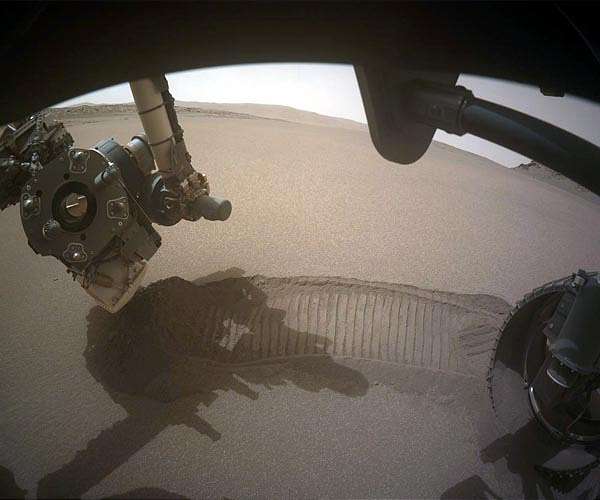
Examining Regolith on Sol 599: Perseverance looks down at the subsurface of a regolith pile at Observation Mountain, after using its wheel to "scuff" and overturn the pile. Regolith is the sandy, dusty, loose material that covers the Martian surface, made up of small rock fragments.

After spending over 600 sols (days on Mars) exploring the diverse geologic environment of Jezero Crater, collecting drilled rock cores (and one atmospheric sample) along the way, Perseverance recently spent some time parked near a large sand ripple named "Observation Mountain," with sights set on something widespread yet unique. Regolith is the sandy, dusty, loose material covering much of the Martian surface, and is made up of many small rock fragments - some of which are sourced from across the planet.

Billions of years ago, lakes, rivers, and oceans flowed across Mars, but today, wind is the dominant force shaping the geologic landscape. Over time, rock breaks up into smaller pieces, then wind can carry and tumble those pieces long distances, depositing them in new locations, and even building ripples and massive dunes. Regolith is important for providing insight into the global and local Martian landscape, all in a single "grab bag."

Perseverance is equipped with a special bit to collect a sample of regolith for eventual return to Earth! The Mars 2020 science and engineering teams have spent the last week studying a large ripple at the base of the Jezero Delta that is a candidate for future regolith sampling.

Hazcams, Navcams, and Mastcam-Z provided images that helped scientists choose which ripple to target, SuperCam and SHERLOC used their laser spectrometers to assess the mineralogy of regolith in the workspace, and PIXL queried the elemental composition of these rock fragments.

The rover planners even used a "scuff" maneuver to scoot the wheel over a regolith pile, moving surface material out of the way so each of the instruments could take a look at rock fragments in the lower part of the regolith pile. So far, these observations have yielded important information about regolith on Mars, and the team is looking forward to collecting a grab bag sample and returning it to Earth, where scientists can continue studying this hodgepodge of Martian minerals right here at home!


Related Links
Perseverance Mars 2020
Mars News and Information at MarsDaily.com
Lunar Dreams and more

MARSDAILY
Perseverance investigates intriguing Martian bedrock
Pasadena CA (JPL) Nov 18, 2022
NASA's Perseverance Mars rover has begun exploring an area the science team calls "Yori Pass" near the base of Jezero Crater's ancient river delta. They've been eager to explore the region for several months after spotting a rock similar to one Perseverance collected samples from in July. The feature is so tantalizing to the scientists because it is sandstone, which is composed of fine grains that have been carried from elsewhere by water before settling and forming stone. Perseverance's samples a ... read more

Comment using your Disqus, Facebook, Google or Twitter login.

Share this article via these popular social media networks
del.icio.usdel.icio.us DiggDigg RedditReddit GoogleGoogle

MARSDAILY
NASA Orion capsule reaches farthest distance from Earth in lunar orbit

CAPSTONE forges new path for NASA's future Artemis lunar mission

Orion Star Trackers, Reaction Control Thrusters Tested: Artemis I Flight Day 12

Orion surpasses Apollo 13 record distance from Earth: Flight Day 11

MARSDAILY
Space belongs to humanity, come share it with China

China to provide training for foreign astronauts

China to launch Shenzhou XV on Tuesday

China recruits new reserve astronauts, open to those from Hong Kong, Macao

MARSDAILY
New research reveals space debris, invisible meteors and near-Earth asteroids

NASA program predicted impact of small asteroid over Ontario, Canada

Twin tail revealed in new Hubble image of Didymos-Dimorphos system following DART impact

The sixth asteroid impact we saw coming

MARSDAILY
NASA's Europa Clipper gets its wheels for traveling in deep space

Mars and Jupiter moons meet

NASA studies origins of dwarf planet Haumea

NASA study suggests shallow lakes in Europa's icy crust could erupt

MARSDAILY
SwRI scientists compile Cassini's unique observations of Saturn's rings

Exploring Europa possible with silicon-germanium transistor technology

Scientists depict Dragonfly landing site on Saturn moon Titan

Saturn's rings and tilt could be the product of an ancient, missing moon

MARSDAILY
Locked and loaded

NASA satellite precipitation data combined with Air Force weather system

NOAA's GOES-U completes thermal vacuum testing

Dabeeo partners with Maxar to expand the global satellite data analysis market

MARSDAILY
SpaceX resupply cargo capsule docks with International Space Station

Japan space agency says research team tampered with ISS experiment

NASA temporarily loses communication with Orion spacecraft

Gravitics raises $20M in bid to build next-generation space station modules

MARSDAILY
NASA's Webb reveals an exoplanet atmosphere as never seen before

Many planets could have atmospheres rich in helium, study finds

Detected: sulfur compound created by photochemistry in exoplanet atmosphere

Milestone for JWST exoplanet observations: atmosphere properties in more detail than ever before