
MARSDAILY
Preserved dune fields offer insights into Martian history
by Staff Writers
Tucson AZ (SPX) Oct 07, 2020

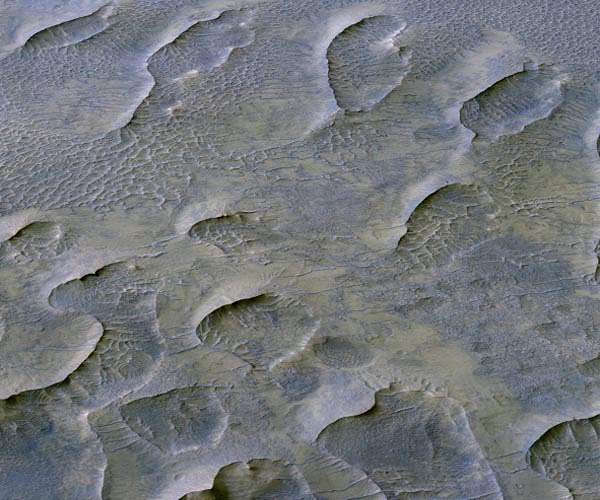
Wind-driven sand dunes are common on modern Mars and the presence of certain sedimentary rock layers indicates these landforms occurred there in the past. This oblique color view from NASA's HiRISE instrument shows a lithified field of sand dunes within Melas Chasma, Valles Marineris. The large degree of preserved morphology for many of these paleo-dunes reveals important information regarding the acting wind regime and climate prior to their cementation. Credit: NASA/JPL/University of Arizona.

The discovery of Martian dune fields largely preserved in the rock record for up to a billion years offers new insights on past climatic conditions on Mars.

Mapping extensive sedimentary rock deposits in the Valles Marineris region of Mars show clear evidence for preserved lithification and burial of dune fields, a paper by Planetary Science Institute Research Scientist Matthew Chojnacki says.

While modern sand dunes and other wind formed features are common on the surface of Mars and other terrestrial planets, typically most of the deposits are worn away by erosion. The dune fields studied in the paper are approximately 1 billion years old, Chojnacki said.

He is lead author on "Ancient Martian Aeolian Sand Dune Deposits Recorded in the Stratigraphy of Valles Marineris and Implications for Past Climates", that appears in Journal of Geophysical Research Planets.

"We identified and mapped extensive dune fields in the canyons of Valles Marineris which show clear evidence for lithification and burial. This level of preservation is rare for terrestrial sand dunes due to ongoing erosion and tectonics," Chojnacki said.

"Based on the dune deposit's relationships to other geologic units and modern erosion rates we estimate these to be roughly a billion years old. Because of the duneforms' size and spatial arrangements, which are not that much different to modern equivalents, we suggest that the climate and atmospheric pressure to have been similar to that of contemporary Mars."

Surface erosion and landscape evolution are greatly different on Earth and Mars. "Water and tectonics that constantly reshape the surface of Earth are not currently a factor on Mars, thus there is an opportunity to learn from the geologic record of the red planet," Chojnacki said.

"The ancient dune fields found within Valles Marineris, with their complex variety of landform shapes, degree of preservation, and context, reveal the richness of regional geology. These results inform us that wind-driven sand transport, deposition, and lithification have occurred throughout much of Mars' recent history and illustrate how landscape evolution there greatly differs compared to that of Earth."

Research paper


Related Links
Planetary Science Institute
Mars News and Information at MarsDaily.com
Lunar Dreams and more

MARSDAILY
Global storms on Mars launch dust towers into the sky
Pasadena CA (JPL) Nov 27, 2019
Dust storms are common on Mars. But every decade or so, something unpredictable happens: A series of runaway storms breaks out, covering the entire planet in a dusty haze. Last year, a fleet of NASA spacecraft got a detailed look at the life cycle of the 2018 global dust storm that ended the Opportunity rover's mission. And while scientists are still puzzling over the data, two papers recently shed new light on a phenomenon observed within the storm: dust towers, or concentrated clouds of dust tha ... read more

Comment using your Disqus, Facebook, Google or Twitter login.

Share this article via these popular social media networks
del.icio.usdel.icio.us DiggDigg RedditReddit GoogleGoogle

MARSDAILY
A roadmap for science on the moon

NASA needs new funding by February for 2024 moon landing, administrator says

Simulations give clues to atmospheric loss from Moon's origin

Japan aiming to send hopping spacecraft fuelled by lunar water to Moon

MARSDAILY
Eighteen new astronauts chosen for China's space station mission

NASA chief warns Congress about Chinese space station

China's new carrier rocket available for public view

China sends nine satellites into orbit by sea launch

MARSDAILY
Second Alignment Plane of Solar System Discovered

GMV to carry out the development phase of the GNC system to guide the HERA mission

NASA's OSIRIS-REx Begins its Countdown to TAG

US probe to touch down on asteroid Bennu on October 20

MARSDAILY
SwRI study describes discovery of close binary trans-Neptunian object

JPL meets unique challenge, delivers radar hardware for Jupiter Mission

Astronomers characterize Uranian moons using new imaging analysis

Jupiter's moons could be warming each other

MARSDAILY
Titan's lakes can stratify like those on Earth

New chronology of the Saturn System

MARSDAILY
China sends two environmental monitoring satellites into space

Satellite use AI to process EO imagery in-flight

Monitoring trucks and trade from space

Satellogic announces global consortium of geospatial imagery

MARSDAILY
Russia to launch two new modules to Space Station in April, September 2021

Astronauts close to finding source of air leak at Space Station

NASA science and cargo on route to ISS on Northrop Grumman Resupply Mission

Russian Cosmonauts to test new system extracting water from urine on ISS

MARSDAILY
First direct observation of exoplanet Beta Pictoris c

Is there other life in the universe

Exoplanet hunter snares 'extreme' superhot world

Recipe is different, But Titan has ingredients for life