
MARSDAILY
Phoenix's Red Planet Selfie
Phoenix By Phoenix - July 2008
Phoenix's Red Planet Selfie
by Staff Writers
Pasadena CA (JPL) Aug 11, 2023
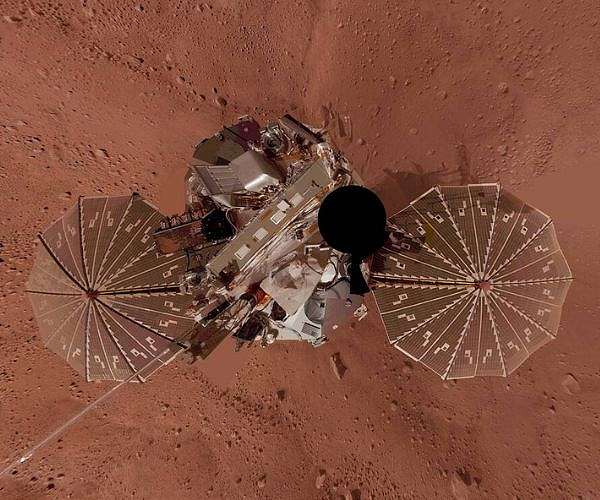
NASA's Mars Phoenix Lander gathered images of itself for this selfie from June 5 through July 12, 2008, with its Surface Stereo Imager (SSI). This mosaic is made up of more than 100 different SSI pointings, with images taken through three different filters at each pointing. 15 years ago in August 2008, Phoenix completed its three-month mission studying Martian ice, soil, and atmosphere.

The goals of the Phoenix Mars Lander were to study the history of water in the Martian arctic, search for evidence of a habitable zone, and assess the biological potential of the ice-soil boundary. More broadly, the lander was designed to determine whether life ever existed on Mars, characterize the climate and geology of the Red Planet, and to help prepare for future human exploration of its surface.

Phoenix sampled Martian dirt for ice, and two months later, scientists confirmed that there is water on Mars. In addition, study of another soil sample suggested that the soil was composed of salts and other chemicals such as perchlorate, sodium, magnesium, chloride, and potassium.

The lander went into safe mode on Oct. 28, 2008, due to insufficient sunlight and poor weather conditions; Martian winter had come. During safe mode, activities that weren't critical were suspended while the spacecraft awaited instructions from mission control. There was daily communication with the lander from Oct. 30 to Nov. 2 but no signals were received after Nov. 2, 2008, and the mission ended.

Related Links
Phoenix at NASA
Mars News and Information at MarsDaily.com
Lunar Dreams and more

Tweet

MARSDAILY
InSight study finds Mars is spinning faster
Pasadena CA (JPL) Aug 08, 2023
Data sent by the spacecraft before it retired last December has provided new details about how fast the planet rotates and how much it wobbles. Scientists have made the most precise measurements ever of Mars' rotation, for the first time detecting how the planet wobbles due to the "sloshing" of its molten metal core. The findings, detailed in a recent Nature paper, rely on data from NASA's InSight Mars lander, which operated for four years before running out of power during its extended mission in Decem ... read more

MARSDAILY
A Framework for Optimized, Integrated Lunar Infrastructure

NASA's Lunar Trailblazer gets final payload water hunt

Chandrayaan-3 nears landing with successful orbital adjustments

NASA may delay crewed lunar landing beyond Artemis 3 mission

MARSDAILY
China to launch "Innovation X Scientific Flight" program, applications open worldwide

Scientists reveal blueprint of China's lunar water-ice probe mission

Shenzhou 15 crew share memorable moments from Tiangong Station mission

China's Space Station Opens Doors to Global Scientific Community

MARSDAILY
Hera's mini-radar will probe asteroid's heart

NASA's $985 million Psyche mission to all-metal asteroid nears liftoff

Winchcombe meteorite is helping us to understand more about asteroids

A Banner Year For The Perseid Meteor Shower

MARSDAILY
NASA's Europa probe gets a hotline to Earth

All Eyes on the Ice Giants

Hundred-year storms? That's how long they last on Saturn.

Looking for Light with New Horizons

MARSDAILY
Studying rivers from worlds away

Saturn's Rings shine in Webb's observations of Gas Giant

Key building block for life found at Saturn's moon Enceladus

MARSDAILY
GHGSat taps Spire Global for four more 16U CubeSats

HALO investigates transport of polluted air masses over the Pacific Ocean

Global collaboration leads to new discoveries in lightning research

NASA TechRise Student Challenge tests experiments in stratosphere

MARSDAILY
Indian lunar lander splits from propulsion module in key step

NASA challenges students to fly Earth and Space experiments

Virgin Galactic rockets its first tourist passengers into space

Embracing the future we need

MARSDAILY
Watch an exoplanet's 17-year journey around its star

Exoplanet surveyor Ariel passes major milestone

The oldest and fastest evolving moss in the world might not survive climate change

Chemical contamination on International Space Station is out of this world