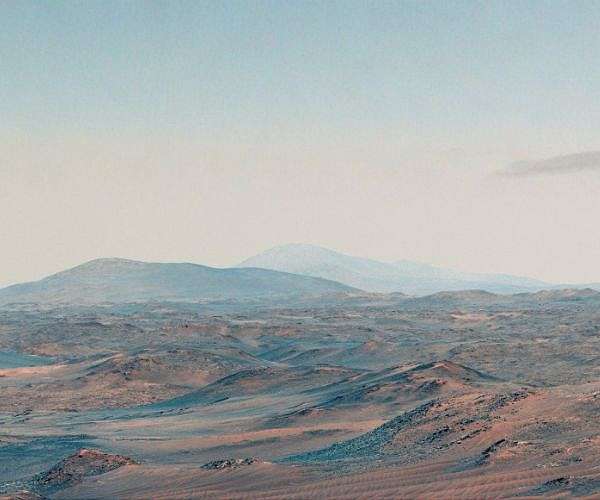
After nearly five years operating inside Mars Jezero Crater, NASA's Perseverance rover has logged almost 25 miles (40 kilometers) of driving while engineers certify that its mobility hardware and other subsystems can keep working for many more years.
Built and operated by NASA's Jet Propulsion Laboratory in Southern California, Perseverance is following up the long-running Curiosity rover and was designed from the outset for extended missions on the Martian surface. JPL teams have been running parallel tests of flight-spare hardware on Earth, recently confirming that the rotary actuators that steer and drive the rover's six wheels should perform optimally for at least another 37 miles (60 kilometers), with comparable brake testing in progress.
Over the past two years, engineers have evaluated almost every major subsystem and concluded that Perseverance can operate through at least 2031 if supported. "These tests show the rover is in excellent shape," said Perseverance's deputy project manager, Steve Lee of JPL, who presented the results at the American Geophysical Union's annual meeting, describing how the systems can sustain a long-term campaign to examine this region of Mars.
Perseverance is traversing Jezero Crater, a former lake and river system, where it is collecting rock cores judged to be strong candidates for a future Mars Sample Return campaign. In September, the mission team reported that a core from a rock dubbed "Cheyava Falls" contains a potential fingerprint of past microbial life, underscoring the scientific value of the rover's sampling strategy.
The rover carries six primary science instruments and more autonomous navigation capability than any previous Mars rover. A recently published paper in IEEE Transactions on Field Robotics describes an autonomous planning system called Enhanced Autonomous Navigation, or ENav, which scans terrain up to 50 feet (15 meters) ahead, selects safe routes, and commands the wheels to follow paths that avoid hazards.
Mission planners at JPL still script Perseverance's daily activities, but once a drive begins the rover must react on its own to rocks, slopes, and sand. Earlier Mars rovers could adjust to obstacles only over shorter distances and tended to slow down when approaching clusters of hazards, whereas ENav evaluates the terrain at the level of individual wheels, weighs route trade-offs, and respects "keep-in" and "keep-out" zones set by engineers.
"More than 90% of Perseverance's journey has relied on autonomous driving, making it possible to quickly collect a diverse range of samples," said JPL autonomy researcher Hiro Ono, the paper's lead author, who added that long-range autonomy will become more important as crewed missions push farther across the Moon and Mars. The combination of robust hardware and ENav software has already enabled record single-day drives, including a 1,350.7-foot (411.7-meter) traverse on June 19, 2025.
New results published in Science focus on the "Margin Unit," a geological zone along the inner edge of Jezero Crater where Perseverance collected three rock cores. Researchers think these samples will help reconstruct how ancient rocks from Mars deep interior interacted with water and the atmosphere, creating conditions that could support life.
Between September 2023 and November 2024, Perseverance climbed 1,312 feet (400 meters) through the Margin Unit, targeting rocks enriched in olivine. Because crystals can lock in details of the environment at the moment they form, scientists treat these minerals as timekeepers that record conditions inside the planet.
Jezero and its surroundings contain major deposits of olivine, which forms at high temperatures, usually at depth, and offers a window into Mars interior processes. The team concludes that the Margin Unit's olivine likely formed in a magmatic intrusion, where rising magma pushed into subsurface layers and cooled into igneous rock before later erosion exposed it at the surface to interact with lake water and a carbon dioxide-rich atmosphere.
Those interactions produced carbonate minerals that can both trap evidence of past life and store information about how the Martian atmosphere evolved. "This combination of olivine and carbonate was a major factor in the choice to land at Jezero Crater," said paper lead author and Perseverance science team member Ken Williford of the Blue Marble Space Institute of Science in Seattle, noting that the minerals are strong recorders of planetary evolution and habitability.
Together, the olivine and carbonate assemblages document how rock, water, and atmosphere exchanged material over time within Jezero. At the base of the Margin Unit, olivine shows signatures of alteration by water where it would have been submerged, while higher up the section the same mineral displays textures typical of magma chambers, such as crystallization features and fewer markers of water-driven change.
As Perseverance drives on toward the Lac de Charmes region, mission scientists expect to recover additional olivine-rich cores and compare them directly with the Margin Unit samples. That comparison should refine timelines for intrusive magmatism, aqueous alteration, and atmospheric evolution in this sector of Mars as the rover continues its long-distance campaign.