
MARSDAILY
Pausing to take in the view: Sols 3710-3711
by Kristen Bennett | Planetary Geologist - USGS Astrogeology
Pasadena CA (JPL) Jan 12, 2023

illustration only

At this point in the mission, the team is very good at responding to tactical surprises. Today, we did not receive the necessary downlink to proceed with the nominal plan. Fortunately, we received enough downlink to know that the last plan finished successfully and the rover is safe. All we need to do is wait for the missing data and keep going!

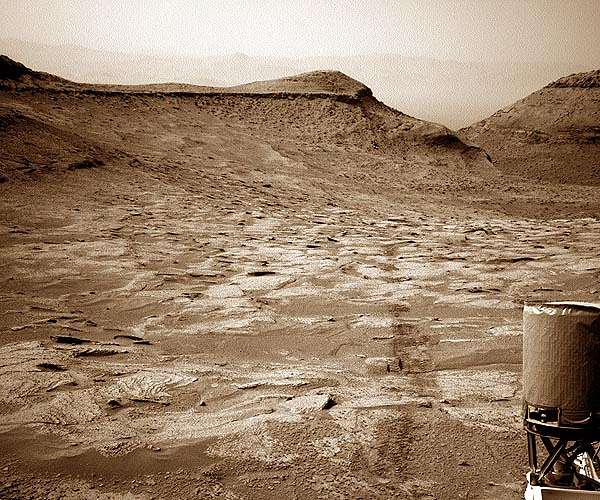
We have enough images to look at the terrain that is in the distance, but not enough to see what is in front of the rover right now. This means we cannot do contact science or drive, but we can take in the view with plenty of long distance images in today's plan.

Several Mastcam mosaics are included in this two sol plan. First, Mastcam is characterizing some distant terrain at the base of Chenapau that we expect to drive to soon. There is also a Mastcam mosaic that covers Amapa from a different angle. The plan also includes the "Tupaquim" and "Uaiu" mosaics, which both target features that are exposed below the marker band. Tupaquim targets dark-toned bands, and Uaiu targets potentially wavy layers.

The two ChemCam LIBS observations occur a little closer to the rover on targets "Iracoume" and "Moreiru." These targets are to characterize the closest bedrock that is visible in the images that were downlinked. The plan also includes two long distance RMIs: one on the flank of Chenapau and another on the marker band.


Related Links
Curiosity Mars Science Laboratory
Mars News and Information at MarsDaily.com
Lunar Dreams and more

MARSDAILY
In search of a new marker band drill site: Sols 3708-3709
Pasadena CA (JPL) Jan 12, 2023
We continue to characterize the Marker Band and the bedrock just below it, with the aim of understanding the origin of the Marker Band. For today's two-sol plan, in an area below the Marker Band, we planned early morning APXS and MAHLI (Touch and Go) on the brushed target "Jenipapo," similar to the flattest material in the accompanying Mastcam image. Mastcam will acquire some multi-spectral imaging on the same target, and on the target "Pau Baru," seen in the upper right of the Mastcam image. This ... read more

Comment using your Disqus, Facebook, Google or Twitter login.

Share this article via these popular social media networks
del.icio.usdel.icio.us DiggDigg RedditReddit GoogleGoogle

MARSDAILY
Lunar Flashlight team assessing spacecraft's propulsion system

Light-based tech could inspire Moon navigation and next-gen farming

Researches on Chang'e 5 lunar samples gain fruitful results

Mounting the first human mission to the Lunar South Pole

MARSDAILY
China to launch 200-plus spacecraft in 2023

China's space industry hits new heights

China's first private sector 2023 rocket launch up, up and away

First rocket launch of the New Year leaves Wenchang for space

MARSDAILY
Hera's time of trial

Seven kilo Antarctica meteorite found

How was the solar system formed? The Ryugu asteroid is helping us learn

Newly discovered green comet expected to whiz by Earth

MARSDAILY
Tumultuous migration on the edge of the Hot Neptune Desert

SwRI scientists find evidence for magnetic reconnection between Ganymede and Jupiter

SwRI delivers innovative instrument for NASA's Europa Clipper mission

PSI Io Input/Output observatory discovers large volcanic outburst on Jupiter's moon Io

MARSDAILY
Webb Space Telescope, Keck team up to study Saturn's moon Titan

MARSDAILY
Geotail operations come to an end after 30 years

Sidus Space expands commercial data distribution through SkyWatch deal

Capella Space raises $60M to expand satellite imaging capacity

New study shows 'self-cleaning' of marine atmosphere

MARSDAILY
Zero-Covid left in dust as Chinese revellers fuel travel boom

Crop seeds, microbial strains tested in China's two space missions unveiled

US, Japan sign Space Collaboration Agreement at NASA Headquarters

RIT scientists help rediscover earliest known star map using multispectral imaging

MARSDAILY
New small laser device can help detect signs of life on other planets

NASA's Webb confirms its first exoplanet

How do rocky planets really form

Distant star's dimming was likely a 'dusty' companion getting in the way, astronomers say