
MARSDAILY
Out of Pebble Purgatory
by Avi Okon | Sampling Operations Deputy Lead - NASA/JPL
Pasadena CA (JPL) Jan 28, 2022

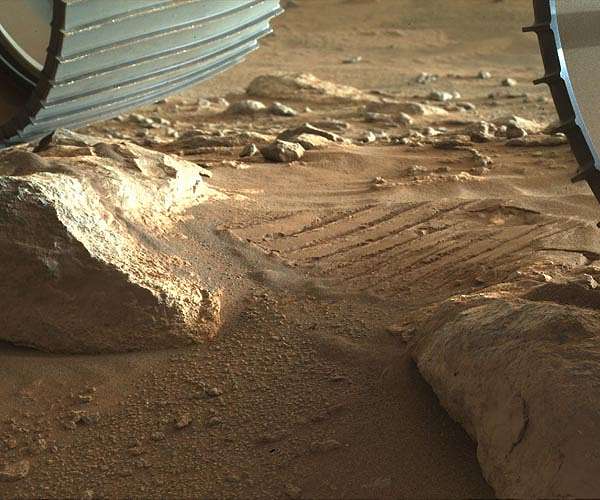
Mars Perseverance Sol 330 - WATSON Camera: NASA's Mars Perseverance rover acquired this image using its SHERLOC WATSON camera, located on the turret at the end of the rover's robotic arm. This image was acquired on Jan. 23, 2022 (Sol 330) at the local mean solar time of 16:50:41. Credits: NASA/JPL-Caltech. Download image "

The final two pebbles hitching a ride aboard our rover's bit carousel are gone but not forgotten. I'll give you the latest on why they are gone and then tell you why we are not forgetting them - or the two other pebbles that made our first month of 2022 a busy one.

We had more than a suspicion the rocks had departed the Perseverance rover on Sunday when imagery of the bit carousel came down after a short 16-foot (5 meter) drive to a nearby rocky outcrop. That drive, which took place on the previous sol, was designed to get us to a small rocky outcrop that would place the rover at an angle that could be beneficial for ejecting the pebbles.

To be thorough (because we Mars missions like to be), we did a full rotation of the bit carousel in both directions, with the rover oriented in a 13.2-degree roll to the left, and we found nothing hindering its progress. We also ran the rover's percussion drill to induce vibration, hoping to shake any possible remaining debris free from the bit holder. Finally, we docked the drill to the bit carousel and dropped off the bit.

With this last step we are happy to announce our sampling system is up and running and ready to go, which is a good thing, since we're going to use it right away. The science team wants another sample from the rock they call "Issole," so we drove the 16 feet (5 meters) back and are now in the process of collecting one. Our Twitter feed @NASAPersevere will update you on that progress.

Perseverance Playbook
As you know, Perseverance is the first sample caching mission on the Red Planet. We did a great deal of testing before we got there, but Mars is Mars. The place is cold, unpaved, far away (about 205 million miles [330 million km] today), and with unexplored, sometimes uncooperative stuff over every hill and around just about every boulder. And that lack of cooperation sometimes extends to the rocks our science team wants to sample.

Those of you who have been following us - and we appreciate it! - know that our first attempt to core a rock was less than satisfying, with the sample crumbling before we could collect it. But we learned a lot from rock target "Roubion,"and we modified our playbook to understand better how to collect samples - and from which rocks.

This new "pebbles in bit carousel" affair has also allowed us to make additions to our sampling playbook. If we encounter a similar scenario down the Martian road, we should be able to get back on track more quickly - which is good, because Jezero Crater is simply amazing and I can't wait to see what awaits us on the other side of the next hill.


Related Links
Perseverance Mars 2020
Mars News and Information at MarsDaily.com
Lunar Dreams and more

MARSDAILY
How to Retain a Core
Pasadena CA (JPL) Jan 25, 2022
Have you ever wondered how a coring bit grabs and holds onto a rock core? As we drill, the bit teeth cut a 27mm diameter circle in the rock and leave the 13mm diameter center intact. As we dig deeper, that cylinder of rock is fed into the sample tube that was loaded inside the bit. When the drill reaches its target depth, typically 66mm, the core is fully inside the sample tube but may still be attached to the rock at the very bottom. We need to: Snap the core ... read more

Comment using your Disqus, Facebook, Google or Twitter login.

Share this article via these popular social media networks
del.icio.usdel.icio.us DiggDigg RedditReddit GoogleGoogle

MARSDAILY
NASA's HERMES mission passes key milestone, moves toward launch

China, Russia to start building lunar research station by 2026

A VIPER in the Sand

Israel Signs Artemis Accords

MARSDAILY
China Focus: China to explore lunar polar regions, mulling human landing: white paper

China to boost satellite services, space technology application: white paper

China Focus: China to explore space science more: white paper

China to improve space debris monitoring: white paper

MARSDAILY
Why are comet heads green - but not their tails?

NASA asteroid tracking system now capable of full sky search

Solar Orbiter catches a second comet by the tail

Looking Up at the Asteroids in the Neighborhood

MARSDAILY
Oxygen ions in Jupiter's innermost radiation belts

Ocean Physics Explain Cyclones on Jupiter

Looking Back, Looking Forward To New Horizons

Testing radar to peer into Jupiter's moons

MARSDAILY
SwRI scientist uncovers evidence for an internal ocean in small Saturn moon

MARSDAILY
Satellogic completes transaction to become publicly traded company

China launches L-SAR 01A satellite for land observing

ESA supports the White House on greenhouse gas monitoring

Particles formed in boreal forests affect clouds in the troposphere

MARSDAILY
New ISS National Laboratory tool expands visibility of ISS-related educational resources

Caltech names Laurie Leshin Director of JPL

US issues visa to Russian ISS cosmonaut

NASA provides updated International Space Station Transition Plan

MARSDAILY
Exoplanet has Earth-like layered atmosphere made of titanium gas

Extreme exoplanet has a complex and exotic atmosphere

What the rise of oxygen on early Earth tells us about life on other planets

A planetary dynamical crime scene at 14 Herculis