
MARSDAILY
New research sheds light on when Mars may have had water
by Staff Writers
Los Alamos NM (SPX) Aug 26, 2022

"Finding these igneous rocks in the bed of an ancient lake on Mars was quite a surprise. One would have expected lakebed sediments, but it shows that Mars' history is more complicated than expected, including lava flows in this ancient site," said Roger Wiens, principal investigator on the SuperCam instrument.

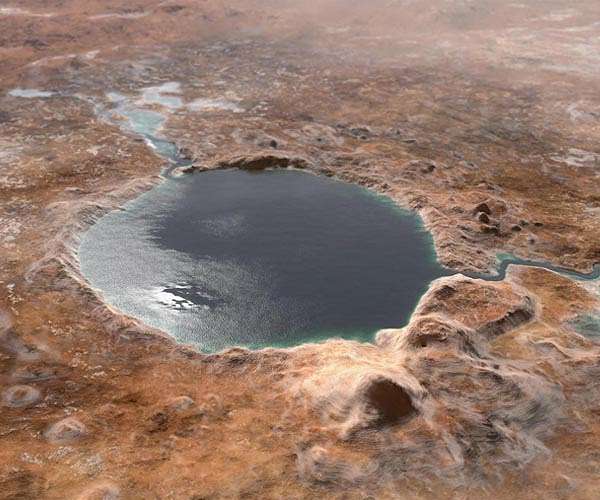
Scientists on NASA's Perseverance mission made a surprising discovery about the composition of rock in Jezero Crater, one that will help them get a better idea of when water existed on Mars, and ultimately, help them understand if the red planet was ever habitable to microbial life.

"The SuperCam instrument suite of remote chemical and mineralogical tools on the Perseverance rover has made some exciting new detailed observations regarding Jezero Crater's history that could not be fully understood before landing," said Sam Clegg, deputy principal investigator for SuperCam. "This exciting new data will really help us better understand when the crater held water, and it also gives us insight into Mars' climate history."

The new research, published (Aug. 25) in Science Advances, shows that Jezero Crater is largely made up of igneous rock, rather than sedimentary rock.

The crater where Perseverance landed in 2021 held water billions of years ago. For that reason, scientists predicted that rock in the area would be sedimentary, formed over time from settled mud, which would be the case for lakebeds on Earth. But to their surprise, they found that rock in Jezero is igneous, which is formed by volcanic magma.

Igneous rock is easier to date and could give researchers a more accurate way to estimate when Mars had water.

The rock analysis was done by SuperCam, a Los Alamos National Laboratory-designed instrument. SuperCam uses a focused infrared laser beam to remove dust and material from rock surfaces in a technique called laser-induced breakdown spectroscopy (LIBS). The energy burst from each five-nanosecond pulse creates a flash; its optical spectrum (specific colors) reveals the elemental chemistry of targets up to about 25 feet away.

"Finding these igneous rocks in the bed of an ancient lake on Mars was quite a surprise. One would have expected lakebed sediments, but it shows that Mars' history is more complicated than expected, including lava flows in this ancient site," said Roger Wiens, principal investigator on the SuperCam instrument.

Research Report:Compositionally and density stratified igneous terrain in Jezero crater, Mars


Related Links
Los Alamos National Laboratory
Mars News and Information at MarsDaily.com
Lunar Dreams and more

MARSDAILY
New water map of Mars will prove invaluable for future exploration
Paris (ESA) Aug 23, 2022
A new map of Mars is changing the way we think about the planet's watery past, and showing where we should land in the future. The map shows mineral deposits across the planet and has been painstakingly created over the last decade using data from ESA's Mars Express Observatoire pour la Mineralogie, l'Eau, les Glaces et l'Activite (OMEGA) instrument and NASA's Mars Reconnaissance Orbiter Compact Reconnaissance Imaging Spectrometer for Mars (CRISM) instrument. Specifically, the map shows the ... read more

Comment using your Disqus, Facebook, Google or Twitter login.

Share this article via these popular social media networks
del.icio.usdel.icio.us DiggDigg RedditReddit GoogleGoogle

MARSDAILY
Thermophysical properties of lunar farside regolith with in-situ temperature measurement by Chang'E-4

UCL team maps moon's surface for NASA missions

Chang'e-5 reveals an intermediate stage in space weathering process of lunar soils

Where to land on the Moon?

MARSDAILY
Plant growth in China's space lab in good condition

Energy particle detector helps Shenzhou-14 crew conduct EVAs

Chinese scientist advocates int'l cooperation in space science

China's Shenzhou-14 astronauts carry out spacewalk

MARSDAILY
Cornell astronomers show how terrain evolves on icy comets

Crime-scene technique identifies asteroid sites

After NASA's asteroid impact, ESA's Hera comes next

DART team confirms orbit of targeted asteroid

MARSDAILY
NASA's Juno Mission Reveals Jupiter's Complex Colors

The PI's Perspective: Extending Exploration and Making Distant Discoveries

Uranus to begin reversing path across the night sky on Wednesday

Underwater snow gives clues about Europa's icy shell

MARSDAILY
Lowell Observatory points telescopes at Saturn during closest annual approach

SwRI researcher shows how elliptical craters could shed light on age of Saturn's moons

MARSDAILY
Accenture invests in hyperspectral satellite company Pixxel to monitor Earth's health

AIR releases upgraded remote sensing monitoring and forecasting system of vegetation pests and diseases

BlackSky awarded NASA contract to advance Earth Science research

Long March successfully deploys Beijing 3B satellite

MARSDAILY
US should end ISS collaboration with Russia

Boeing eyes February for space capsule's first crewed flight

NASA awards contract to demonstrate trash compacting system for ISS

NASA repairs issue with Voyager 1 space probe

MARSDAILY
Webb Telescope takes its first-ever direct image of an exoplanet

VLBA produces first full 3-D view of binary star-planet system

Webb takes its first exoplanet image

UVA joins Artemis missions to seek traces of extraterrestrial life