
MARSDAILY
NASA's Mars Reconnaissance Orbiter Undergoes Memory Update
by Staff Writers
Pasadena CA (JPL) Feb 20, 2020

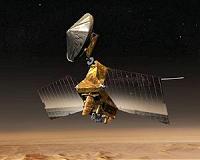
File illustration of MRO

From Feb. 17 to Feb. 29, 2020, NASA's Mars Reconnaissance Orbiter (MRO) will go on hiatus from its science mission and its relay operations while engineers on Earth conduct long-distance maintenance. During the hiatus, other orbiters will relay data from the Mars Curiosity rover and Mars InSight lander to Earth.

The maintenance work involves updating battery parameters in the spacecraft's flash memory - a rare step that's been done only twice before in the orbiter's 15 years of flight. This special update is necessary because it was recently determined that the battery parameters in flash were out of date and if used, would not charge MRO's batteries to the desired levels.

In addition to the battery parameters, engineers will use this opportunity to update planetary position tables that also reside in flash. The spacecraft will go into a precautionary standby mode, called safe mode, three times over the course of the update. It will also swap from its primary computer, called its Side-A computer, to its redundant one, called Side-B.

Mars Reconnaisance Orbiter launched in 2005 and arrived at the Red Planet on March 10, 2006. Since then, the spacecraft has returned 371 terabits of data. Long-lived spacecraft need to guard against failures of aging hardware and the effects of the harsh space environment, such as damage from cosmic rays.

Whenever a spacecraft detects a technical issue, there's a series of actions it can take, including swapping to a redundant side of its electronics or rebooting its computer. Success in those cases depends upon restoring an uncorrupted, up-to-date version of an operating system with its parameter files from flash memory. To guard against corruption of the flash memory itself, multiple copies of essential parameters are stored onboard.

To keep both of the redundant computers up to date, engineers will update the flash on the Side-A computer first and then command a Side-A reboot to ensure that the flash memory was properly updated. Once they confirm the changes have taken effect, they'll swap to Side-B and repeat the process.

After validation of the memory updates, MRO will return to its science and relay-support activities. With this update, the mission will be poised to continue operations well into the next decade.


Related Links
Mars Reconnaissance Orbiter
Mars News and Information at MarsDaily.com
Lunar Dreams and more

MARSDAILY
MRO HiRISE camera views InSight and Curiosity on Mars
Pasadena CA (JPL) Oct 17, 2019
The HiRISE camera on NASA's Mars Reconnaissance Orbiter recently sent home eye-catching views of the agency's InSight lander and its Curiosity rover. HiRISE has been monitoring InSight's landing site in the Elysium Planitia region of the Red Planet for changes to the surface, such as dust-devil tracks. Taken on Sept. 23, 2019, at an altitude of 169 miles (272 kilometers) above the surface, the new image is NASA's best view yet of InSight from space. It clearly shows the two circular solar panels o ... read more

Comment using your Disqus, Facebook, Google or Twitter login.

Share this article via these popular social media networks
del.icio.usdel.icio.us DiggDigg RedditReddit GoogleGoogle

MARSDAILY
China's Chang'e-4 probe resumes work for 15th lunar day

NASA selects university teams to build technologies for the Moon's darkest areas

Vice President, Administrator visit NASA Langley for Artemis Update

NASA awards contract to launch Lunar CubeSat

MARSDAILY
China's Yuanwang-5 sails to Pacific Ocean for space monitoring mission

Construction of China's space station begins with start of LM-5B launch campaign

China Prepares to Launch Unknown Satellite Aboard Long March 7A Rocket

China's Long March-5B carrier rocket arrives at launch site

MARSDAILY
First research results on the 'spectacular meteorite fall' of Flensburg

How to deflect an asteroid

OSIRIS-REx Osprey Flyover

Leiden astronomers discover potential near-earth objects

MARSDAILY
TRIDENT Mission Concept Selected by NASA's Discovery Program

Findings from Juno Update Jupiter Water Mystery

One Step Closer to the Edge of the Solar System

A close-up of Arrokoth reveals how planetary building blocks were constructed

MARSDAILY
New SwRI models reveal inner complexity of Saturn moon

Huygens landing spin mystery solved

Final images from Cassini spacecraft

How Enceladus got its stripes

MARSDAILY
Verifying forecasts for major stratospheric sudden warmings

The atmosphere as global sensor

Ball Aerospace-built Geostationary Air Quality Instrument Launches Successfully

NASA prepares for new science flights above coastal Louisiana

MARSDAILY
Mike Pence Says US to Return Astronauts to Space Using American-Built Rockets Before Summer

Russia's Tikhonov May Be Replaced as Chief of Soyuz MS-16 ISS Mission Over Injury - Source

Adidas, Delta Faucet prep research projects for International Space Station

New adventures in beds and baths for spaceflight

MARSDAILY
New technologies, strategies expanding search for extraterrestrial life

Sub-Neptune sized planet validated with the habitable-zone planet finder

Planet on edge of destruction in 18-hour year frenzy

LOFAR pioneers new way to study exoplanet environments