
MARSDAILY
NASA's Mars 2020 gets HD eyes
by Staff Writers
Pasadena CA (JPL) Jun 02, 2019

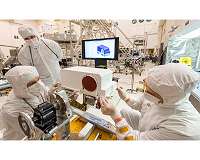
In this picture - taken on May 23, 2019, in the Spacecraft Assembly Facility's High Bay 1 clean room at the Jet Propulsion Laboratory in Pasadena, California - engineers re-install the cover to the remote sensing mast (RSM) head after integration of two Mastcam-Z high-definition cameras that will go on the Mars 2020 rover. Credit: NASA/JPL-Caltech

One of the first operations the Mars 2020 rover will perform after touching down on the Red Planet's Jezero Crater on Feb. 18, 2021, will be to raise its remote sensing mast (RSM), which carries important optics and instrumentation.

In this picture - taken on May 23, 2019, in the Spacecraft Assembly Facility's High Bay 1 clean room at the Jet Propulsion Laboratory in Pasadena, California - engineers re-install the cover to the RSM head after integration of two Mastcam-Z high-definition cameras.

Visible below the red lens cover is the left Mastcam-Z camera (with the "Remove Before Flight" labels); support equipment blocks the right Mastcam-Z from view. The RSM and its twin cameras will be installed on the rover's deck the week of June 3, 2019.

Mastcam-Z is a multispectral, stereoscopic imaging instrument that will enhance the Mars 2020 rover's driving and core-sampling capabilities. It will also enable science team members to observe textural, mineralogical, structural and morphologic details in rocks and sediment at any location within the rover's field of view, helping them piece together the planet's geologic history.

"Mastcam-Z will be the first Mars color camera that can zoom, enabling 3D images at unprecedented resolution," said Mastcam-Z Principal Investigator Jim Bell of Arizona State University in Tempe.

"With a resolution of three-hundredths of an inch [0.8 millimeters] in front of the rover and less than one-and-a-half inches [38 millimeters] from over 330 feet [100 meters] away - Mastcam-Z images will play a key role in selecting the best possible samples to return from Jezero Crater."

Mastcam Z's capabilities are not the only firsts of the mission. Mars 2020 will be the first spacecraft in the history of planetary exploration with the ability to accurately retarget its point of touchdown during the landing sequence.

And the rover carries a sample-caching system that will collect Martian rock and soil samples and store them on the planet's surface for retrieval and return to Earth by subsequent missions.

Mars 2020 will launch from Cape Canaveral Air Force Station in Florida in July of 2020.

JPL is building and will manage operations of the Mars 2020 rover for the NASA Science Mission Directorate at the agency's headquarters in Washington.

If you want to send your name to Mars with NASA's 2020 mission, you can do so from now until Sept. 30, 2019. Add your name to the list and obtain a souvenir boarding pass to Mars here.


Related Links
Mars 2020
Mars News and Information at MarsDaily.com
Lunar Dreams and more

MARSDAILY
NASA photo showcases landing site for Mars 2020
Washington UPI) May 28, 2019
A new photo captured by NASA's Mars Reconnaissance Orbiter and shared online this week features the landing site for the space agency's Mars 2020 mission. The Mars 2020 rover, scheduled to launch next year, is expected to land in the Jezero Crater, located in a region of Mars known as the Syrtis Major quadrangle. The crater is thought to have once been filled with water, and its watery history is visible in the sedimentary formations that texture its interior surface, as well as its oute ... read more

Comment using your Disqus, Facebook, Google or Twitter login.

Share this article via these popular social media networks
del.icio.usdel.icio.us DiggDigg RedditReddit GoogleGoogle

MARSDAILY
'A long ride': 50 years ago, a dress rehearsal for the Moon landing

US and Japan partner on future moon mission

China's Chang'e-4 probe resumes work for sixth lunar day

Moon mission leader leaves NASA after 45 days

MARSDAILY
Yaogan-33 launch fails in north China, Possible debris recovered in Laos

China develops new-generation rockets for upcoming missions

China's satellite navigation industry sees rapid development

China's Yuanwang-7 departs for space monitoring missions

MARSDAILY
GomSpace to design world's first stand-alone nanosatellite asteroid rendezvous mission

Oldest meteorite collection on Earth found in one of the driest places

Curtin planetary scientist unravels mystery of Egyptian desert glass

A family of comets reopens the debate about the origin of Earth's water

MARSDAILY
On Pluto the Winter is approaching, and the atmosphere is vanishing into frost

Neptune's moon Triton fosters rare icy union

Juno Finds Changes in Jupiter's Magnetic Field

Gas insulation could be protecting an ocean inside Pluto

MARSDAILY
Researchers find ice feature on Saturn's giant moon

Giant planets and big data: What deep learning reveals about Saturn's storms

Deep learning takes Saturn by storm

NASA's Cassini Reveals Surprises with Titan's Lakes

MARSDAILY
NASA studies Atmosphere by forming artificial night-time clouds over Marshall Islands

First ICESat-2 Global Data Released: Ice, Forests and More

New Studies Increase Confidence in NASA's Measure of Earth's Temperature

NASA-Supported Monitoring Network Assesses Ozone Layer Threats

MARSDAILY
NASA Navigation Tech Shows Timing Really Is Everything

Russian cosmonauts remove a towel that spent 10 years on surface of ISS

Cosmonauts complete spacewalk at International Space Station

IAF ties up with ISRO for manned mission crew selection

MARSDAILY
ExoMars orbiter prepares for Rosalind Franklin

The 'forbidden' planet has been found in the 'Neptunian Desert'

Features that could be used to detect life-friendly climates on other worlds

Meteor magnets in outer space