
MARSDAILY
NASA's InSight Records Monster Quake on Mars
by Staff Writers
Pasadena CA (JPL) May 10, 2022

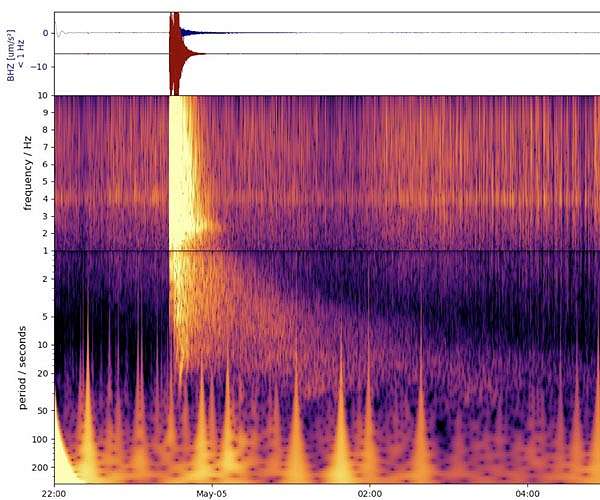
This spectrogram shows the largest quake ever detected on another planet.

NASA's InSight Mars lander has detected the largest quake ever observed on another planet: an estimated magnitude 5 temblor that occurred on May 4, 2022, the 1,222nd Martian day, or sol, of the mission. This adds to the catalog of more than 1,313 quakes InSight has detected since landing on Mars in November 2018. The largest previously recorded quake was an estimated magnitude 4.2 detected Aug. 25, 2021.

InSight was sent to Mars with a highly sensitive seismometer, provided by France's Centre National d'Etudes Spatiales (CNES), to study the deep interior of the planet. As seismic waves pass through or reflect off material in Mars' crust, mantle, and core, they change in ways that seismologists can study to determine the depth and composition of these layers. What scientists learn about the structure of Mars can help them better understand the formation of all rocky worlds, including Earth and its Moon.

A magnitude 5 quake is a medium-size quake compared to those felt on Earth, but it's close to the upper limit of what scientists hoped to see on Mars during InSight's mission. The science team will need to study this new quake further before being able to provide details such as its location, the nature of its source, and what it might tell us about the interior of Mars.

"Since we set our seismometer down in December 2018, we've been waiting for 'the big one,'" said Bruce Banerdt, InSight's principal investigator at NASA's Jet Propulsion Laboratory in Southern California, which leads the mission. "This quake is sure to provide a view into the planet like no other. Scientists will be analyzing this data to learn new things about Mars for years to come."

The large quake comes as InSight is facing new challenges with its solar panels, which power the mission. As InSight's location on Mars enters winter, there's more dust in the air, reducing available sunlight. On May 7, 2022, the lander's available energy fell just below the limit that triggers safe mode, where the spacecraft suspends all but the most essential functions. This reaction is designed to protect the lander and may occur again as available power slowly decreases.

After the lander completed its prime mission at the end of 2020, meeting its original science goals, NASA extended the mission through December 2022.


Related Links
InSight
Mars News and Information at MarsDaily.com
Lunar Dreams and more

MARSDAILY
Two largest Marsquakes to date recorded from planet's far side
Albany CA (SPX) Apr 26, 2022
The seismometer placed on Mars by NASA's InSight lander has recorded its two largest seismic events to date: a magnitude 4.2 and a magnitude 4.1 marsquake. The pair are the first recorded events to occur on the planet's far side from the lander and are five times stronger than the previous largest event recorded. Seismic wave data from the events could help researchers learn more about the interior layers of Mars, particularly its core-mantle boundary, researchers from InSight's Marsquake Service ... read more

Comment using your Disqus, Facebook, Google or Twitter login.

Share this article via these popular social media networks
del.icio.usdel.icio.us DiggDigg RedditReddit GoogleGoogle

MARSDAILY
Powering the moon: Sandia researchers design microgrid for future lunar base

Chinese scientists find potential in lunar soil to generate oxygen and fuel

China releases Chang'e-5 payloads' scientific datasets

Lunar soil has the potential to generate oxygen and fuel

MARSDAILY
China's cargo craft docks with space station combination

China prepares to launch Tianzhou-4 cargo spacecraft

China launches the Tianzhou 4 cargo spacecraft

China launches Jilin-1 commercial satellites

MARSDAILY
Scientists find DNA's code for life in meteorites

Asteroid treasure in the Hubble archive

'Spot the difference' to help reveal Rosetta image secrets

NASA's Psyche starts processing at Kennedy

MARSDAILY
Traveling to the centre of planet Uranus

Juno captures moon shadow on Jupiter

Greenland Ice, Jupiter Moon Share Similar Feature

Search for life on Jupiter moon Europa bolstered by new study

MARSDAILY
Scientists model landscape formation on Titan, revealing an Earth-like alien world

On icy moon Enceladus, expansion cracks let inner ocean boil out

MARSDAILY
Identifying global poverty from space

Earth from Orbit: NOAA Debuts First Imagery from GOES-18

Recommendation algorithms that power Amazon, Netflix can improve satellite imagery, too

Confirmed: Atmospheric helium levels are rising

MARSDAILY
Relations on ISS not changed following Russia's Invasion of Ukraine

Ariel Ekblaw on building beautiful architecture in space

Students compete to improve everyday life on the Space Station

Blue Origin NS-21 to fly six customer astronauts

MARSDAILY
Planet-forming disks evolve in surprisingly similar ways

Experiments measure freezing point of extraterrestrial oceans to aid search for life

Researchers reveal the origin story for carbon-12, a building block for life

SwRI-led team finds younger exoplanets better candidates when looking for other Earths