
MARSDAILY
NASA's Curiosity Mars Rover Finds a Clay Cache
by Staff Writers
Pasadena CA (JPL) May 30, 2019

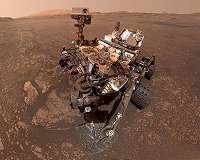
Curiosity took this picture of the Mars Science Lab on on May 12, 2019 (the 2,405th Martian day, or sol, of the mission). To the lower-left of the rover are its two recent drill holes, at targets called "Aberlady" and "Kilmarie."

NASA's Curiosity rover has confirmed that the region on Mars it's exploring, called the "clay-bearing unit," is well deserving of its name. Two samples the rover recently drilled at rock targets called "Aberlady" and "Kilmarie" have revealed the highest amounts of clay minerals ever found during the mission.

Both drill targets appear in a new selfie taken by the rover on May 12, 2019, the 2,405th Martian day, or sol, of the mission.

This clay-enriched region, located on the side of lower Mount Sharp, stood out to NASA orbiters before Curiosity landed in 2012. Clay often forms in water, which is essential for life; Curiosity is exploring Mount Sharp to see if it had the conditions to support life billions of years ago.

The rover's mineralogy instrument, called CheMin (Chemistry and Mineralogy), provided the first analyses of rock samples drilled in the clay-bearing unit. CheMin also found very little hematite, an iron oxide mineral that was abundant just to the north, on Vera Rubin Ridge.

Other than proof that there was a significant amount of water once in Gale Crater, what these new findings mean for the region is still up for debate. It's likely that the rocks in the area formed as layers of mud in ancient lakes - something Curiosity also found lower on Mount Sharp. Water interacted with sediment over time, leaving an abundance of clay in the rocks there.

Cameras (Navcams) to snap images of drifting clouds on May 7 and May 12, 2019, sols 2400 and 2405. They're likely water-ice clouds about 19 miles (31 kilometers) above the surface.

The mission's team has been trying to coordinate cloud observations with NASA's InSight lander, located about 373 miles (600 kilometers) away, which recently took its own cloud images. Capturing the same clouds from two vantage points can help scientists calculate their altitude.

+ Additional cloud images are available at JPL - scroll down.


Related Links
Curiosity Mars Rover
Mars News and Information at MarsDaily.com
Lunar Dreams and more

MARSDAILY
Massive Martian ice discovery opens a window into red planet's history
Austin TX (SPX) May 23, 2019
Newly discovered layers of ice buried a mile beneath Mars' north pole are the remnants of ancient polar ice sheets and could be one of the largest water reservoirs on the planet, according to scientists at The University of Texas at Austin and the University of Arizona. The team made the discovery using measurements gathered by the Shallow Radar (SHARAD) on NASA's Mars Reconnaissance Orbiter (MRO). SHARAD emits radar waves that can penetrate up to a mile and a half beneath the surface of Mars. ... read more

Comment using your Disqus, Facebook, Google or Twitter login.

Share this article via these popular social media networks
del.icio.usdel.icio.us DiggDigg RedditReddit GoogleGoogle

MARSDAILY
NASA Awards Artemis Contract for Lunar Gateway Power, Propulsion

'A long ride': 50 years ago, a dress rehearsal for the Moon landing

Moon mission leader leaves NASA after 45 days

Water formation on the moon demonstrated by UH Manoa scientists

MARSDAILY
Yaogan-33 launch fails in north China, Possible debris recovered in Laos

China develops new-generation rockets for upcoming missions

China's satellite navigation industry sees rapid development

China's Yuanwang-7 departs for space monitoring missions

MARSDAILY
Curtin planetary scientist unravels mystery of Egyptian desert glass

GomSpace to design world's first stand-alone nanosatellite asteroid rendezvous mission

A family of comets reopens the debate about the origin of Earth's water

Oldest meteorite collection on Earth found in one of the driest places

MARSDAILY
On Pluto the Winter is approaching, and the atmosphere is vanishing into frost

Juno Finds Changes in Jupiter's Magnetic Field

Neptune's moon Triton fosters rare icy union

Gas insulation could be protecting an ocean inside Pluto

MARSDAILY
Researchers find ice feature on Saturn's giant moon

Giant planets and big data: What deep learning reveals about Saturn's storms

Deep learning takes Saturn by storm

NASA's Cassini Reveals Surprises with Titan's Lakes

MARSDAILY
More detailed picture of Earth's mantle

Illegal ozone-depleting gases traced to China: study

New Studies Increase Confidence in NASA's Measure of Earth's Temperature

NASA-Supported Monitoring Network Assesses Ozone Layer Threats

MARSDAILY
Wandering Earth: rocket scientist explains how we could move our planet

China's tech 'Long March' could be road to nowhere

NASA Prepares for Future Moon Exploration with International Undersea Crew

NASA Selects Studies for Future Space Communications and Services

MARSDAILY
Meteor magnets in outer space

Detecting bacteria in space

Features that could be used to detect life-friendly climates on other worlds

Microbes Exhibit Survival Skills in Ethiopia's Mars-like Wonderland