
MARSDAILY
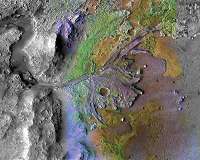
NASA photo showcases landing site for Mars 2020
by Brooks Hays
Washington UPI) May 28, 2019

A new photo captured by NASA's Mars Reconnaissance Orbiter and shared online this week features the landing site for the space agency's Mars 2020 mission.

The Mars 2020 rover, scheduled to launch next year, is expected to land in the Jezero Crater, located in a region of Mars known as the Syrtis Major quadrangle.

The crater is thought to have once been filled with water, and its watery history is visible in the sedimentary formations that texture its interior surface, as well as its outer contours. The new MRO image showcases the remnants of an ancient delta where in-flowing rivers once entered, bringing water and sediment.

Channeling patterns move both to and from Jezero Crater, and in the MRO photo, fans and deltas

can be seen extending out from many of the channels.

"Examination of spectral data acquired from orbit show that some of these sediments have minerals that indicate chemical alteration by water," NASA said. "Here in Jezero Crater delta, sediments contain clays and carbonates."

NASA regularly relies on MRO to scout potential landing spots. As the latest MRO image makes clear, the Mars 2020 rover -- and its impressive suite of instruments -- will have plenty of interesting sedimentary structures to investigate. The rover's scientific mission will help scientists better understand Mars' watery past.

Earlier this year, NASA Administrator Jim Bridenstine detailed the agency's plans for visiting the moon and Mars.

"For the first time, we are going to cache samples on Mars," he said. "For the first time, we are going to fly a helicopter on another world with the Mars Helicopter."


Related Links
Mars News and Information at MarsDaily.com
Lunar Dreams and more

MARSDAILY
NASA's Mars 2020 Mission Drops in on Death Valley
Pasadena CA (JPL) May 27, 2019
On a test flight in Death Valley, California, anAirbus helicopter carried an engineering model of the Lander Vision System (LVS) that will help guide NASA's next Mars mission to a safe touchdown on the Red Planet. During the flight - one in a series - the helicopter (which is not part of the mission and was used just for testing) and its two-person crew flew a pre-planned sequence of maneuvers while LVS collected and analyzed imagery of the barren, mountainous terrain below. LVS is an integr ... read more

Comment using your Disqus, Facebook, Google or Twitter login.

Share this article via these popular social media networks
del.icio.usdel.icio.us DiggDigg RedditReddit GoogleGoogle

MARSDAILY
NASA Awards Artemis Contract for Lunar Gateway Power, Propulsion

Moon mission leader leaves NASA after 45 days

Water formation on the moon demonstrated by UH Manoa scientists

NASA unveils schedule for 'Artemis' 2024 Moon mission

MARSDAILY
China develops new-generation rockets for upcoming missions

China's satellite navigation industry sees rapid development

China's Yuanwang-7 departs for space monitoring missions

China's tracking ship Yuanwang-2 starts new mission after retirement

MARSDAILY
Curtin planetary scientist unravels mystery of Egyptian desert glass

GomSpace to design world's first stand-alone nanosatellite asteroid rendezvous mission

A family of comets reopens the debate about the origin of Earth's water

Oldest meteorite collection on Earth found in one of the driest places

MARSDAILY
On Pluto the Winter is approaching, and the atmosphere is vanishing into frost

Juno Finds Changes in Jupiter's Magnetic Field

Neptune's moon Triton fosters rare icy union

Gas insulation could be protecting an ocean inside Pluto

MARSDAILY
Researchers find ice feature on Saturn's giant moon

Giant planets and big data: What deep learning reveals about Saturn's storms

Deep learning takes Saturn by storm

NASA's Cassini Reveals Surprises with Titan's Lakes

MARSDAILY
More detailed picture of Earth's mantle

Illegal ozone-depleting gases traced to China: study

NASA-Supported Monitoring Network Assesses Ozone Layer Threats

Mission control 'saves science'

MARSDAILY
Wandering Earth: rocket scientist explains how we could move our planet

China's tech 'Long March' could be road to nowhere

NASA Prepares for Future Moon Exploration with International Undersea Crew

NASA Selects Studies for Future Space Communications and Services

MARSDAILY
Detecting bacteria in space

Microbes Exhibit Survival Skills in Ethiopia's Mars-like Wonderland

Ammonium fertilized early life on earth

New method to find small exoplanets