
MARSDAILY
NASA explains strange stringy object photographed by Perseverance rover
by Doug Cunningham
Washington DC (UPI) Aug 12, 2021

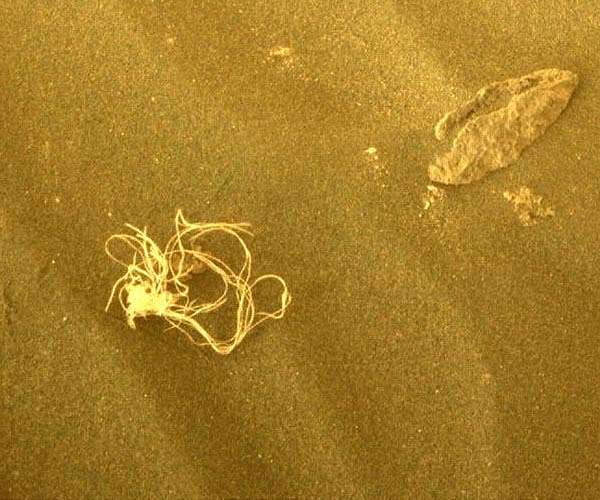
One photo taken recently by NASA's Perseverance rover on Mars showed an unusual noodle-like object lying on the surface of the Red Planet, but scientists have an explanation.

The photo was taken on July 12 and depicted what looked like a tangled web of string in the lower right corner. The image led some to question what the object is, particularly when a photo taken four days later revealed that it had disappeared.

Last week, scientists at NASA cleared the air about what's in the photo.

They said the object was a bundle of string that came off the spacecraft when it landed in February 2021. When the rover made its Martian landing using a sky-crane, some hardware was discarded.

The mission's Ingenuity helicopter also sent other detailed photos that show some of the other discarded items, including a parachute.

When the rover captured the same area three days later on July 15, the stringy material was gone. Photo courtesy NASA

As for the stringy object in the photo, NASA said it's Dacron netting that was part of the rover's descent stage when it landed on Mars more than a year ago.

Officials said that some debris was found more than a mile away from the landing zone, in an area called Hogwallow Flats. That's where the stringy material was photographed by Perseverance.

"So far, we've seen shiny pieces of thermal blanket material, Dacron netting material that is also used in thermal blankets, and a stringlike material that we conclude to be a likely piece of shredded Dacron netting," NASA scientist Justin Maki wrote in the blog post.

The space agency noted that the debris was likely blown across the Martian surface by wind over the course of several days or weeks to the Hogwallow Flats area.

"It is possible that the energy from the sky-crane crash may have first ejected the material into the air before it settled down in the Hogwallow Flats region," Maki wrote.

"And some of the smaller pieces may have been expelled from the crash ballistically. But it appears that the material was simply blown by the wind over the course of several days or weeks."

NASA said that it will monitor potential sources of contamination from debris to ensure the integrity of samples collected during space missions.


Related Links
Mars News and Information at MarsDaily.com
Lunar Dreams and more

MARSDAILY
WVU space robotics research helps Mars rovers find their footing
Morgantown WV (SPX) Aug 12, 2022
West Virginia University scientists have developed a way for extraplanetary rovers to use nonvisual information to maneuver over treacherous terrain. This research aims to prevent losses like that of the Martian exploration rover Spirit, which ceased communications after its wheels became trapped in invisibly shifting sands in 2010. Space roboticist Cagri Kilic, a Statler College of Engineering postdoctoral research fellow in the Department of Mechanical and Aerospace Engineeringat the WVU Navigat ... read more

Comment using your Disqus, Facebook, Google or Twitter login.

Share this article via these popular social media networks
del.icio.usdel.icio.us DiggDigg RedditReddit GoogleGoogle

MARSDAILY
A special Moon snap

Astroport Space Technologies awarded 2nd NASA for lunar construction

Terran Orbital delivers LunIR to Cape Canaveral for Artemis 1 launch

Artemis I to launch first-of-a-kind deep space biology mission

MARSDAILY
Shenzhou XIV astronauts to conduct their first spacewalk in coming days

Harvest from heavenly breeding

Chinese space-tracking ship docks at Sri Lanka's Hambantota port

Chinese commercial carrier rocket Smart Dragon-3 completes ground tests

MARSDAILY
Dust grains older than our sun found in Asteroid Ryugu samples

NASA's Lucy team discovers moon around asteroid Polymele

Space mission shows Earth's water may be from asteroids

Meteorite provides record of asteroids "spitting out" pebbles

MARSDAILY
Underwater snow gives clues about Europa's icy shell

Why Jupiter doesn't have rings like Saturn

You can help scientists study the atmosphere on Jupiter

SwRI scientists identify a possible source for Charon's red cap

MARSDAILY
Lowell Observatory points telescopes at Saturn during closest annual approach

SwRI researcher shows how elliptical craters could shed light on age of Saturn's moons

MARSDAILY
The Lacuna Space water monitoring system

Launch Schedule for 3rd StriX-1 SAR satellite

Landsat 9 operations to transition from NASA to US Geological Survey

Fleet Space' Exosphere Earth Scanning Technology tested at lithium exploration site

MARSDAILY
Russian spacewalk cut short due to issue with suit

US should end ISS collaboration with Russia

Voyager logs 45 years in space as NASA's longest mission to date

Track NASA's Artemis I mission in real time

MARSDAILY
Brightest stars in the night sky can strip Neptune-sized planets to their rocky cores

Scientists detect newborn planet that could be forming moons

A cosmic tango points to a violent and chaotic past for distant exoplanet

New research on the emergence of the first complex cells challenges orthodoxy