
MARSDAILY
NASA begins recruitment for long-duration Mars Mission Analog Study
by Staff Writers
Washington DC (SPX) Aug 06, 2021

stock image only

As NASA ventures farther into the cosmos, the astronaut experience will change. In preparation for the real-life challenges of future missions to Mars, NASA will study how highly motivated individuals respond under the rigor of a long-duration, ground-based simulation.

NASA is now accepting applications for participation as a crew member during the first one-year analog mission in a habitat that will simulate stressors of deep space, set to begin in Fall 2022.

Known as Crew Health and Performance Exploration Analog (CHAPEA), the series of missions includes three one-year Mars surface simulations based at NASA's Johnson Space Center. The analogs will support research to develop methods and technologies to prevent and resolve potential problems on future human spaceflight missions to the Moon and Mars.

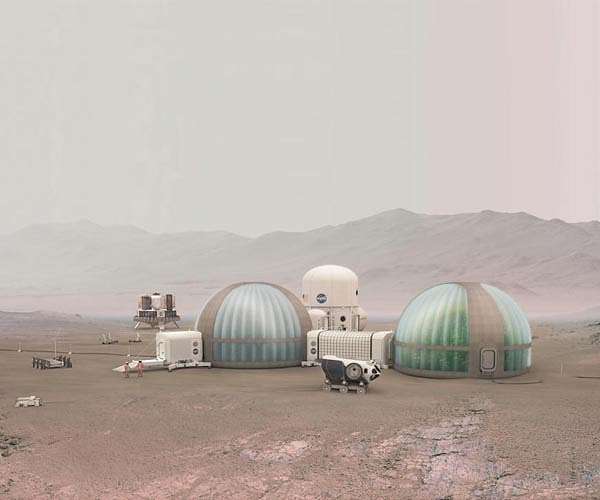
Each mission will consist of four crew members in a 1,700-square-foot 3D-printed habitation module, called Mars Dune Alpha. The habitat will simulate the challenges of a mission on Mars, including resource limitations, equipment failure, communication delays, and other environmental stressors. Crew tasks may include simulated spacewalks, scientific research, use of virtual reality and robotic controls, and exchanging communications. The results will provide important scientific data to validate systems and develop solutions.

NASA is looking for healthy, motivated U.S. citizens or permanent residents who are non-smokers, age 30 to 55 years old, and proficient in English for effective communication between crew and mission control. Crew selection will follow standard NASA criteria for astronaut candidate applicants.

A master's degree in a STEM field such as engineering, mathematics, or biological, physical or computer science from an accredited institution with at least two years of professional STEM experience or a minimum of one thousand hours piloting an aircraft is required. Candidates who have completed two years of work toward a doctoral program in STEM, or completed a medical degree, or a test pilot program will also be considered. Additionally, with four years of professional experience, applicants who have completed military officer training or a Bachelor of Science in a STEM field may be considered.

If you have a strong desire for unique, rewarding adventures and are interested in contributing to NASA's work in preparing for the first human journey to Mars, click here to learn more and apply. Compensation for participating in the mission is available. More information will be provided during the candidate screening process.


Related Links
Crew Health and Performance Exploration Analog (CHAPEA)
Mars News and Information at MarsDaily.com
Lunar Dreams and more

MARSDAILY
Scientists don spacesuits to explore Hawaiian lava tubes as if they were on Mars
Munich, Germany (SPX) Apr 29, 2021
Imagine trying to pick up a pebble or scrape microbes off a cave wall in a bulky spacesuit with puffy gloves on, under a time constraint because you don't want to run out of oxygen. That's what the analog astronauts do daily at the HI-SEAS moonbase habitat in Hawaii as they prepare for future missions to the moon and Mars, says Michaela Musilova of the International MoonBase Alliance (IMA) and director of HI-SEAS, the Hawaii Space Exploration Analog and Simulation. Musilova will present the latest ... read more

Comment using your Disqus, Facebook, Google or Twitter login.

Share this article via these popular social media networks
del.icio.usdel.icio.us DiggDigg RedditReddit GoogleGoogle

MARSDAILY
NASA identifies likely locations of the early molten Moon's deep secrets

Lunar samples solve mystery of the moon's supposed magnetic shield

Advanced Space passes preparatory test for pathfinder mission to the moon

CAPSTONE's cubesat prepares for Lunar mission

MARSDAILY
Tianhe astronauts use free time to watch ping-pong and exercise

Shanxi company helps astronauts keep fit in space

China's space propaganda blitz endures at slick new planetarium

How Chinese astronauts stay healthy in space

MARSDAILY
Hi-res measurements of asteroid surface temperatures obtained from Earth

Lucy boxed to go

Perfect for the Perseid Meteor Shower

SwRI team zeroes in on source of the impactor that wiped out the dinosaurs

MARSDAILY
Juno joins Japan's Hisaki satellite and Keck Observatory to solve "energy crisis" on Jupiter

A few steps closer to Europa: spacecraft hardware makes headway

Hubble finds first evidence of water vapor on Ganymede

NASA Awards Launch Services Contract for the Europa Clipper Mission

MARSDAILY
Dragonfly mission to Titan announces big science goals

Icequakes likely rumble along geyser-spitting fractures in Saturn's icy moon Enceladus

Methane in the plumes of Saturn's moon Enceladus: Possible signs of life?

Glenn researchers study new, futuristic concept to explore Titan

MARSDAILY
Gearing up for third Sentinel-2 satellite

India to launch earth observation satellite GISAT-1/EOS-3 on August 12

Stanford researchers use artificial intelligence to unlock extreme weather mysteries

Ball Aerospace completes preliminary design review of NOAA's Space Weather Satellite

MARSDAILY
Space station mishap caused orbiting lab to rotate 1 1/2 times, NASA says

Northrop Grumman set to launch 16th cargo delivery mission to ISS

Boeing Starliner launch delayed indefinitely

Virgin Galactic restarting space tickets from $450,000

MARSDAILY
New ESO observations show rocky exoplanet has just half the mass of Venus

Did nature or nurture shape the Milky Way's most common planets

Astronomers find evidence of possible life-sustaining planet

Small force, big effect: How the planets could influence the sun