 |
 |
 |
 |
 |
 |
 |
 |
 |

 |
Miniature Worlds In The Making
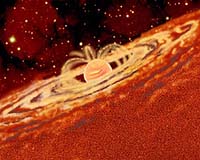
Cambridge, UK (SPX) Nov 26, 2007 New research led by a University of St Andrews astronomer has found evidence for what might be the raw material for the beginning of shrunken versions of our Solar System - miniature worlds in the making. In their study Dr Alexander Scholz, SUPA Advanced Fellow at the University of St Andrews, and Professor Ray Jayawardhana, from the University of Toronto, challenge the assumption that other planetary systems in the Universe would necessarily look like our own Solar System. The astronomers have found that the birthplaces of planets exist not only around young stars but also around planemos (short for planetary mass objects) that are not much larger or heavier than Jupiter. This may imply the existence of miniature Solar Systems with a central object having only about 1% of the mass of the Sun. The finding may expand our knowledge of where to look for planets beyond our Solar System, some of which might be capable of supporting life. Since their discovery in 2000, the nature and origin of the enigmatic planemos has been a hot topic - are they tiny stars or giant planets, kicked out from a young planetary system? The new study now suggests that the former scenario is much more likely. In a paper to be published in the Astrophysical Journal (Letters) Dr Scholz and Professor Jayawardhana used the Spitzer Space Telescope to observe 18 planemos in a star cluster in Orion that is about 3 million years old. At that age many young stars are still surrounded by disks of dust and gas which may evolve into planetary systems. The dust in these disks 'glows' in the infrared wavelength range and can therefore be seen with infrared cameras. The new observations show that about one third of the planemos are also surrounded by dusty disks, thus these relatively small objects seem to have a star-like infancy. Evidence for a star-like formation of planemos has been presented previously by other teams but the new observations constitute the first systematic survey and push our knowledge of planemos into new territory. "The results demonstrate that long-lived dusty disks, the nurseries of planets, are commonly found even around extremely low-mass objects. This could indicate that planetary systems may form even when the central 'star' is not a star, but a planemo. Imagine a Solar System where planets encircle an object which itself is not much larger than a planet," explains Dr Scholz. Although the new findings have not settled the origins of planemos Dr Scholz and Professor Jayawardhana believe the results bring us one step closer. "How puny an object could nature produce in the same way that it made our Sun? That's the big question motivating our research. The answer will tell us a lot about the star formation process as well as about the true diversity of planetary systems out there," said Professor Jayawardhana. Community Email This Article Comment On This Article Related Links Lands Beyond Beyond - extra solar planets - news and science Life Beyond Earth
 Planets Forming In Pleiades Star Cluster
 Los Angeles CA (SPX) Nov 16, 2007
Rocky terrestrial planets, perhaps like Earth, Mars or Venus, appear to be forming or to have recently formed around a star in the Pleiades ("seven sisters") star cluster, the result of "monster collisions" of planets or planetary embryos. Astronomers using the Gemini Observatory in Hawaii and the Spitzer Space Telescope report their findings in an upcoming issue of the Astrophysical Journal, the premier journal in astronomy. |
|
|

| The content herein, unless otherwise known to be public domain, are Copyright 1995-2007 - SpaceDaily.AFP and UPI Wire Stories are copyright Agence France-Presse and United Press International. ESA Portal Reports are copyright European Space Agency. All NASA sourced material is public domain. Additional copyrights may apply in whole or part to other bona fide parties. Advertising does not imply endorsement,agreement or approval of any opinions, statements or information provided by SpaceDaily on any Web page published or hosted by SpaceDaily. Privacy Statement |