
Mars Exploration News
MARSDAILY
Martian sound study models acoustic signals in Jezero crater
illustration only

Martian sound study models acoustic signals in Jezero crater

by Clarence Oxford
Los Angeles CA (SPX) Dec 05, 2025

Acoustic signals have been important markers during NASA's Mars missions. Measurements of sound can provide information both about Mars itself - such as turbulence in its atmosphere, changes in its temperature, and its surface conditions - and about the movement of the Mars rovers.

Using these sound measurements to the best extent possible requires an accurate understanding of how sound propagates on Mars. Charlie Zheng, a professor of mechanical and aerospace engineering at Utah State University, and his doctoral student Hayden Baird, who is partially sponsored by the Utah Space Grant Consortium Graduate Fellowship, will present their work simulating sound propagation on Mars Thursday, Dec. 4, at 8:25 a.m. HST as part of the Sixth Joint Meeting of the Acoustical Society of America and Acoustical Society of Japan, running Dec. 1-5 in in Honolulu, Hawaii.

"We expect that the study will provide deeper insight into weather and terrain effects on acoustic propagation in environments that are not easily measured," said Zheng. "The Martian environment is obviously one of them."

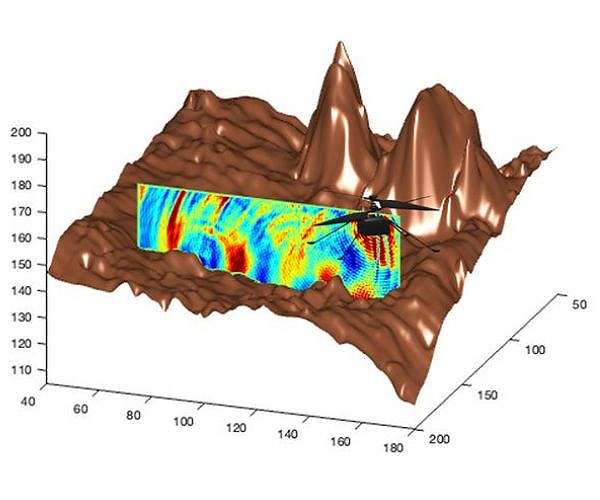
Baird and Zheng's work uses NASA's measurements of the atmospheric conditions and terrain on Mars, most of which have been previously modeled at meter-scale resolutions. They also had access to decades of data about the red planet's atmospheric composition and properties, as well as seismic studies that measure the ground porosity - all factors that play into how sound propagates.

"The setup of the simulation model used in this study relies heavily on previous results from multiple scientific disciplines," said Baird.

Focusing on the Jezero crater, the 2021 landing and exploration site of NASA's Perseverance rover and its attached Ingenuity helicopter, the researchers simulated how sound moves through and scatters off the region's complex terrains, whether it comes from a moving or stationary source. This will help them understand how other atmospheres compare to our own.

The researchers hope their model will help identify signals and patterns that indicate specific Martian atmospheric events. In the longer term, it may even help with sensor designs for future missions to other planets or moons to study atmospheric conditions.

"This study is a beginning to dive into many potential areas of planetary research," said Zheng.

Related Links
Acoustical Society of America
Mars News and Information at MarsDaily.com
Lunar Dreams and more

Subscribe Free To Our Daily Newsletters
Tweet

RELATED CONTENT
The following news reports may link to other Space Media Network websites.
MARSDAILY
NASA twin spacecraft depart Earth orbit to begin Mars mission
Los Angeles CA (SPX) Nov 14, 2025
NASA's ESCAPADE mission has initiated its journey as two identical spacecraft, designed to study Mars' magnetosphere, separated and deployed from Blue Origin's New Glenn upper stage. Both probes will spend the next year in a unique Earth-bound orbit before executing a trans-Mars injection burn in November 2026, employing the Oberth Effect to maximize mission fuel efficiency. The paired orbiters, engineered by Rocket Lab and overseen by UC Berkeley, mark the first Mars science effort to place two c ... read more

MARSDAILY
Congress warned that the U.S. faces a new space race with China

Astrobotic lunar surface sensor to track cislunar traffic and security

NASA backs dust tolerant wireless power links for Moon and Mars vehicles

Lunar dust model highlights risks for spacecraft and future moon base projects

MARSDAILY
China supports private space firms to expand global reach

Wenchang spaceport hits record cadence with double-digit launches in 2025

China consolidates new commercial space regulator and industry roadmap

Beijing space lab targets orbital data centers for AI era

MARSDAILY
OSIRIS-APEX spacecraft completes Earth flyby on its journey to explore Apophis

40 000 near-Earth asteroids discovered!

Lunar impactor Theia originated near Earth and Sun analysis reveals

ESA pinpoints 3I/ATLAS's path with data from Mars

MARSDAILY
SwRI links Uranus radiation belt mystery to solar storm driven waves

Looking inside icy moons

Saturn moon mission planning shifts to flower constellation theory

Could these wacky warm Jupiters help astronomers solve the planet formation puzzle?

MARSDAILY
Cassini study reveals organic compounds from Enceladus ocean plume

Saturn's icy moon may host a stable ocean fit for life, study finds

Unexpected discovery on Saturn's moon challenges our view on chemistry before life emerged

Cassini proves complex chemistry in Enceladus ocean

MARSDAILY
Sentinel-5 debuts images of atmospheric gases

Outage Prevention from Orbit: Why Utilities Are Turning to Satellites and Geospatial Analytics

Italian Earth observation fleet gains eight new IRIDE satellites

Gilat wins 10 million dollar order for transportable direct downlink earth observation system

MARSDAILY
NASA extends ISS National Lab management contract through 2030

Micro nano robots aim to cut carbon buildup in closed life support systems

Space station reaches new record with all docking ports in use

Trump NASA nominee aims to beat China in new Moon race

MARSDAILY
Supernova mixing traced as source of key life elements

SwRI opens NOUR lab to track chemical pathways from nebulae to planetary systems

TRAPPIST 1 flares mapped to probe planetary habitability

Gels may have given early Earth chemistry a place to organize into life

Subscribe Free To Our Daily Newsletters


The content herein, unless otherwise known to be public domain, are Copyright 1995-2024 - Space Media Network. All websites are published in Australia and are solely subject to Australian law and governed by Fair Use principals for news reporting and research purposes. AFP, UPI and IANS news wire stories are copyright Agence France-Presse, United Press International and Indo-Asia News Service. ESA news reports are copyright European Space Agency. All NASA sourced material is public domain. Additional copyrights may apply in whole or part to other bona fide parties. All articles labeled "by Staff Writers" include reports supplied to Space Media Network by industry news wires, PR agencies, corporate press officers and the like. Such articles are individually curated and edited by Space Media Network staff on the basis of the report's information value to our industry and professional readership. Advertising does not imply endorsement, agreement or approval of any opinions, statements or information provided by Space Media Network on any Web page published or hosted by Space Media Network. General Data Protection Regulation (GDPR) Statement Our advertisers use various cookies and the like to deliver the best ad banner available at one time. All network advertising suppliers have GDPR policies (Legitimate Interest) that conform with EU regulations for data collection. By using our websites you consent to cookie based advertising. If you do not agree with this then you must stop using the websites from May 25, 2018. Privacy Statement. Additional information can be found here at About Us.