
MARSDAILY
Martian snow is dusty, could potentially melt, new study shows
by Karin Valentine for ASU News
Tempe AZ (SPX) Aug 24, 2021

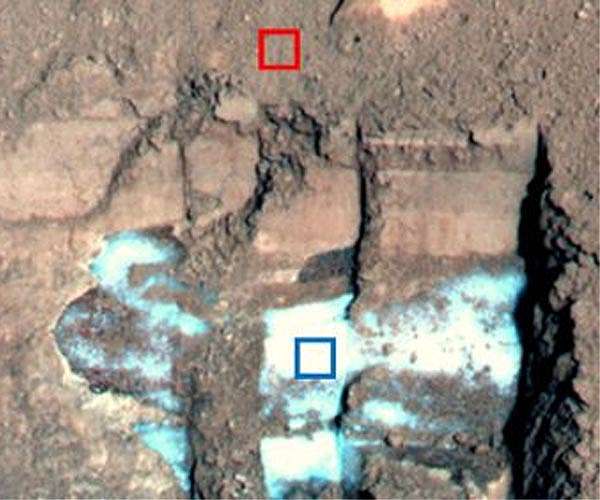
Dusty snow dug up by NASA's Phoenix Mars Lander, a few centimeters below the surface. The blue box represents ice and the red box represents soil. Credit: NASA/JPL-Caltech/University of Arizona/Texas A and M University.

Over the last two decades, scientists have found ice in many locations on Mars. Most Martian ice has been observed from orbital satellites like NASA's Mars Reconnaissance Orbiter. But determining the grain size and dust content of the ice from that far above the surface is challenging. And those aspects of the ice are crucial in helping scientists determine how old the ice is and how it was deposited.

So planetary scientists Aditya Khuller and Philip Christensen of Arizona State University, with Stephen Warren, an Earth ice and snow expert from the University of Washington, developed a new approach to determine how dusty Mars ice really is.

By combining data from NASA's Phoenix Mars Lander and Mars Reconnaissance Orbiter with computer simulations used to predict snow and glacier ice brightness on Earth, they were able to successfully match the brightness of Martian ice and determine its dust content. Their results have been recently published in AGU's Journal of Geophysical Research: Planets.

Mars is a dusty planet, so much of its ice is also dusty and much darker than fresh snow we might see on Earth. The dustier the ice is, the darker and thus warmer the ice gets, which can affect both its stability and evolution through time. Under certain conditions, this might also mean that the ice could melt on Mars.

"There is a chance that this dusty and dark ice might melt a few centimeters down," Khuller said. "And any subsurface liquid water produced from melting will be protected from evaporating in Mars' wispy atmosphere by the overlying blanket of ice."

Based on their simulations, they predict that the ice dug up by the Phoenix Mars Lander formed by dusty snowfall, sometime over the last million years, similar to other ice deposits found previously across the mid-latitudes of Mars.

"It is widely believed that Mars has experienced multiple ice ages throughout its history, and it looks like the ice being exposed throughout the mid-latitudes of Mars is a remnant of this ancient dusty snowfall," Khuller said.

For next steps, the team hopes to further analyze ice exposures on Mars, assess if the ice could actually melt, and learn more about Mars' climate history.

"We are working on developing improved computer simulations of Martian ice to study how it evolves over time, and whether it might melt to form liquid water," Khuller said. "The results from this study will be integral to our work because knowing how dark the ice is directly influences how warm it gets."


Related Links
Arizona State University
Mars News and Information at MarsDaily.com
Lunar Dreams and more

MARSDAILY
Trio of orbiters shows small dust storms help dry out Mars
Greenbelt MD (SPX) Aug 17, 2021
By combining observations from three international spacecraft at Mars, scientists were able to show that regional dust storms play a huge role in drying out the Red Planet. Dust storms heat up higher altitudes of the cold Martian atmosphere, preventing water vapor from freezing as usual and allowing it to reach farther up. In the higher reaches of Mars, where the atmosphere is sparse, water molecules are left vulnerable to ultraviolet radiation, which breaks them up into their lighter components o ... read more

Comment using your Disqus, Facebook, Google or Twitter login.

Share this article via these popular social media networks
del.icio.usdel.icio.us DiggDigg RedditReddit GoogleGoogle

MARSDAILY
A 'True' Blue Moon occurs this weekend

Firefly Aerospace selects Redwire as key mission partner in 2023 Lunar lander mission

Xplore receives USAF contract to develop a commercial navigation and timing service for cislunar space

NASA awards grants in Break the Ice Lunar Challenge

MARSDAILY
China's astronauts make spacewalk to upgrade robotic arm

Chinese astronauts out of spacecraft for second time EVA

Chinese astronauts to conduct extravehicular activities for second time

Mars mission outcomes to advance space research

MARSDAILY
Solar System's fastest-orbiting asteroid discovered

Comet Atlas may have been a blast from the past

NASA Mission to Asteroid Psyche one year out from launch

Fizzing sodium could explain Asteroid Phaethon's comet-like activity

MARSDAILY
A few steps closer to Europa: spacecraft hardware makes headway

Juno joins Japan's Hisaki satellite and Keck Observatory to solve "energy crisis" on Jupiter

Hubble finds first evidence of water vapor on Ganymede

NASA Awards Launch Services Contract for the Europa Clipper Mission

MARSDAILY
Saturn makes waves in its own rings

Dragonfly mission to Titan announces big science goals

Icequakes likely rumble along geyser-spitting fractures in Saturn's icy moon Enceladus

Methane in the plumes of Saturn's moon Enceladus: Possible signs of life?

MARSDAILY
Europe's Vega rocket blasts off with Airbus observation satellite

Further evidence of 200 million-year cycle for Earth's magnetic field

BRICS to set up remote-sensing satellite network

Leak and destroy: On the hunt for climate killing gas

MARSDAILY
NASA faces new criticism, possible congressional hearing over spacesuit delays

US still interested in possibility of having astronauts fly on board Soyuz: Roscosmos

Roscosmos planning to send another two space tourists into orbit

NASA tests ways to reduce stress in plants growing in space

MARSDAILY
Did nature or nurture shape the Milky Way's most common planets

New ESO observations show rocky exoplanet has just half the mass of Venus

Small force, big effect: How the planets could influence the sun

Astronomers find evidence of possible life-sustaining planet