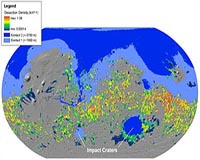
A global Mars map depicting the dissection density of valley networks, in realtion to the hypothesized northern ocean.
A global Mars map depicting the dissection density of valley networks, in realtion to the hypothesized northern ocean. |
Debate has raged for decades over whether Martian valleys resulted from water erosion -- caused by humidity and rainfall -- or through groundwater-sapping erosion, which can happen in cold and dry conditions.
The comparative lack of river networks on the Martian surface supported theories that rain was unlikely, but mapping based on topographic data from NASA satellites has found that the valley network is at least twice as extensive as previously estimated.
The shape and distribution of the valleys is even more telling, and makes it "hard to imagine" that they could have been caused by anything but rainfall, said co-author Wei Luo, a geography professor at Northern Illinois University.
The valleys are deeper and more common in the areas closest to the coast of what scientists believe was once a vast northern ocean.
This indicates that they were caused by erosion from clouds which formed over the ocean and dumped the bulk of their rain on the windward side of the mountains, he said.
"Once we looked at the global distribution (of the valley network) we found there is a limit on the southern end of it and most of the concentrated, high density area is close to the hypothesized northern ocean boundary," Luo said in a telephone interview.
"We calculated the estimated depths of the valleys and we see that they get shallower as you go north to south."
Rain, said Luo, "would be mostly restricted to the area over the ocean and to the land surfaces in the immediate vicinity, which correlates with the belt-like pattern of valley dissection seen in our new map.
"The southernmost regions of Mars, located farthest from the water reservoir, would get little rainfall and would develop no valleys."
The study appears in the Journal of Geophysical Research.
Luo is co-author of the report along with Tomasz Stepinski, a staff scientist at the Lunar and Planetary Institute in Houston, Texas.
Share This Article With Planet Earth
 del.icio.us del.icio.us |
 Digg Digg |
 Reddit Reddit |
 YahooMyWeb YahooMyWeb |
 Google Google |
 Facebook Facebook |

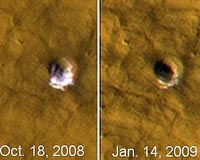 Scientists See Water Ice In Fresh Craters On Mars
| The content herein, unless otherwise known to be public domain, are Copyright 1995-2009 - SpaceDaily. AFP and UPI Wire Stories are copyright Agence France-Presse and United Press International. ESA Portal Reports are copyright European Space Agency. All NASA sourced material is public domain. Additional copyrights may apply in whole or part to other bona fide parties. Advertising does not imply endorsement,agreement or approval of any opinions, statements or information provided by SpaceDaily on any Web page published or hosted by SpaceDaily. Privacy Statement |