
MARSDAILY
Mars rover sees hints of past life in latest rock samples
by AFP Staff Writers
Washington (AFP) Sept 15, 2022

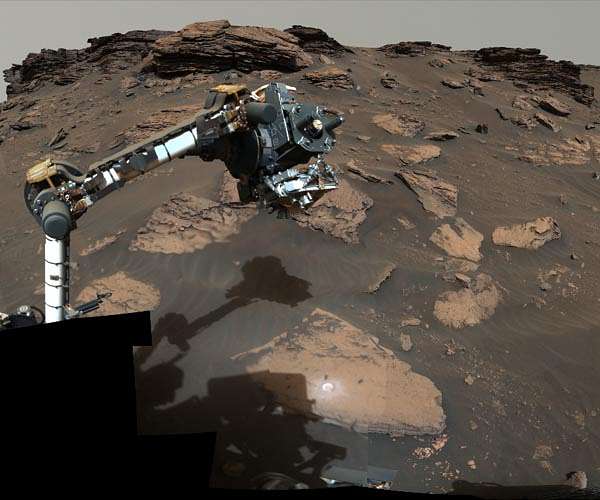
NASA's Perseverance rover puts its robotic arm to work around a rocky outcrop called "Skinner Ridge" in Mars' Jezero Crater. Composed of multiple images, this mosaic shows layered sedimentary rocks in the face of a cliff in the delta, as well as one of the locations where the rover abraded a circular patch to analyze a rock's composition.

NASA's Perseverance Mars rover has detected its highest concentrations yet of organic molecules, in a potential signal of ancient microbes that scientists are eager to confirm when the rock samples are eventually brought to Earth.

While organic matter has been found on the Red Planet before, the new discovery is seen as especially promising because it came from an area where sediment and salts were deposited into a lake -- conditions where life could have arisen.

"It is very fair to say that these are going to be, these already are, the most valuable rock samples that have ever been collected," David Shuster, a Perseverance return sample scientist, told reporters during a briefing.

Organic molecules -- compounds made primarily of carbon that usually include hydrogen and oxygen, but also at times other elements -- are not always created by biological processes.

Further analysis and conclusions will have to wait for the Mars Sample Return mission -- a collaboration between NASA and the European Space Agency (ESA) to bring back the rocks that is set for 2033.

Nicknamed Percy, the rover landed on Mars' Jezero Crater in February 2021, tasked with caching samples that may contain signs of ancient life, as well as characterizing the planet's geology and past climate.

The delta it is exploring formed 3.5 billion years ago. The rover is currently there investigating sedimentary rocks, which came about from particles of various sizes settling in the then watery environment.

Percy cored two samples from a rock called "Wildcat Ridge," which is about three feet (one meter) wide, and on July 20 abraded some of its surface so it could be analyzed with an instrument called SHERLOC that uses ultraviolet light.

The results showed a class of organic molecules called aromatics, which play a key role in biochemistry.

"This is a treasure hunt for potential signs of life on another planet," NASA astrobiologist Sunanda Sharma said.

"Organic matter is a clue and we're getting stronger and stronger clues...I personally find these results so moving because it feels like we're in the right place, with the right tools, at a very pivotal moment."

There have been other tantalizing clues about the possibility of life on Mars before, including repeated detections of methane by Perseverance's predecessor, Curiosity.

While methane is a digestive byproduct of microbes here on Earth, it can also be generated by geothermal reactions where no biology is at play.


Related Links
Mars News and Information at MarsDaily.com
Lunar Dreams and more

MARSDAILY
NASA details plans to bring back Mars rock samples
Washington (AFP) July 27, 2022
NASA plans to bring 30 Martian rock samples back to Earth in 2033, the agency said Wednesday - and is sending two small helicopters to help the mission. The Perseverance rover, which landed on Mars in February 2021, has so far collected 11 samples as part of its hunt for signatures of ancient life. But bringing them back for detailed lab study on Earth is proving to be a highly complex task. Up until now, NASA was planning on sending another rover to Mars to pick up the samples from Perseve ... read more

Comment using your Disqus, Facebook, Google or Twitter login.

Share this article via these popular social media networks
del.icio.usdel.icio.us DiggDigg RedditReddit GoogleGoogle

MARSDAILY
NASA's CAPSTONE probe suffers anomaly, put in safe mode

NASA delays launch of Artemis I rocket until Sept. 27

NASA pursues astronaut Lunar Landers for future Artemis missions

Study looks at how water got on the moon

MARSDAILY
Shenzhou astronauts carry out second spacewalk

Taikonauts enjoy 'home-grown' meal during Mid-Autumn Festival

Rocket to carry Mengtian space lab module arrives at launch site

Duo undertake 7-hour spacewalk

MARSDAILY
Lowell Discovery Telescope plays key role in DART planetary defense test mission

DART sets sights on asteroid target

Cornell astronomers show how terrain evolves on icy comets

Crime-scene technique identifies asteroid sites

MARSDAILY
Jupiter to reach opposition, closest approach to Earth in 70 years

NASA's Juno Mission Reveals Jupiter's Complex Colors

The PI's Perspective: Extending Exploration and Making Distant Discoveries

Uranus to begin reversing path across the night sky on Wednesday

MARSDAILY
Saturn's rings and tilt could be the product of an ancient, missing moon

Long lost moon could have been responsible for Saturn's rings

Lowell Observatory points telescopes at Saturn during closest annual approach

SwRI researcher shows how elliptical craters could shed light on age of Saturn's moons

MARSDAILY
Planet Partners with Taylor Geospatial Institute to leverage data food security and more

World's first satellite with both SAR and Optical Payloads will revolutionize geospatial imaging

Proposed Tandem4EO constellation will combine radar and optical imaging for Europe

Atmospheric scientists study under-researched role of clouds in regulating Earth's temperature

MARSDAILY
Space archaeologists's offer first consultancy firm for orbital habitats

ISS National Lab Research Announcement Focused on Technology Advancement is Open

ESA astronaut Samantha Cristoforetti becomes first European female ISS commander

LeoLabs awarded contract from US Dept of Commerce to support space traffic management prototype

MARSDAILY
Quest to uncover intricacies of exoplanet atmospheres reaches important milestone

Researchers pioneer new technique that could help determine habitability of planets

It's a planet: new evidence of baby planet in the making

Study: Astronomers risk misinterpreting planetary signals in James Webb data