
MARSDAILY
Mars rocks collected by Perseverance boost case for ancient life
by AFP Staff Writers
Washington (AFP) Sept 10, 2021

NASA's Perseverance Mars rover has now collected two rock samples, with signs that they were in contact with water for a long period of time boosting the case for ancient life on the Red Planet.

"It looks like our first rocks reveal a potentially habitable sustained environment," said Ken Farley, project scientist for the mission, in a statement Friday. "It's a big deal that the water was there for a long time."

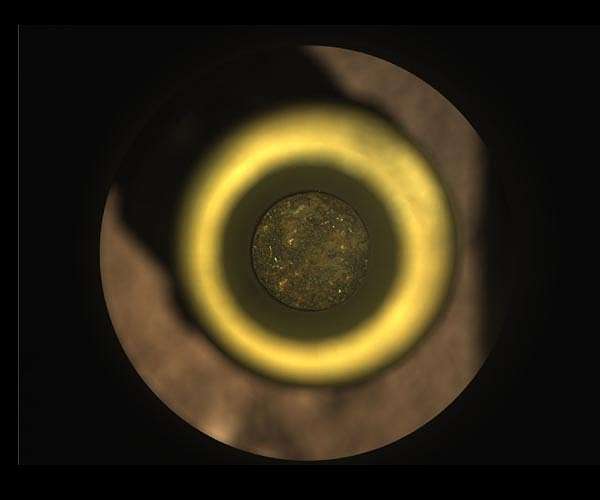
The six-wheeled robot collected its first sample, dubbed "Montdenier" on September 6, and its second, "Montagnac" from the same rock on September 8.

Both samples, slightly wider than a pencil in diameter and about six centimeters long, are now stored in sealed tubes in the rover's interior.

A first attempt at collecting a sample in early August failed after the rock proved too crumbly to withstand Perseverance's drill.

The rover has been operating in a region known as the Jezero Crater, just north of the equator and home to a lake 3.5 billion years ago, when conditions on Mars were much warmer and wetter than today.

The rock that provided the first samples was found to be basaltic in composition and likely the product of lava flows.

Volcanic rocks contain crystalline minerals that are helpful in radiometric dating.

This in turn could help scientists build up a picture of the area's geological history, such as when the crater formed, when the lake appeared and disappeared, and how climate changed over time.

"An interesting thing about these rocks as well is that they show signs for sustained interaction with groundwater," NASA geologist Katie Stack Morgan told a press conference.

The scientists already knew the crater was home to a lake, but couldn't rule out the possibility that it had been a "flash in the pan" with floodwaters filling up the crater for as little as 50 years.

Now they are more certain groundwater was present for much longer.

"If these rocks experienced water for long periods of time, there may be habitable niches within these rocks that could have supported ancient microbial life," added Stack Morgan.

The salt minerals in the rock cores may have trapped tiny bubbles of ancient Martian water.

"Salts are great minerals for preserving signs of ancient life here on Earth, and we expect the same may be true for rocks on Mars," added Stack Morgan.

NASA is hoping to return the samples to Earth for in depth lab analysis in a joint mission with the European Space Agency sometime in the 2030s.


Related Links
Mars News and Information at MarsDaily.com
Lunar Dreams and more

MARSDAILY
Perseverance rover begins hunt for signs of Martian life
Pasadena CA (JPL) Jul 21, 2021
NASA's Mars 2020 Perseverance rover has begun its search for signs of ancient life on the Red Planet. Flexing its 7-foot (2-meter) mechanical arm, the rover is testing the sensitive detectors it carries, capturing their first science readings. Along with analyzing rocks using X-rays and ultraviolet light, the six-wheeled scientist will zoom in for closeups of tiny segments of rock surfaces that might show evidence of past microbial activity. Called PIXL, or Planetary Instrument for X-ray Lithochem ... read more

Comment using your Disqus, Facebook, Google or Twitter login.

Share this article via these popular social media networks
del.icio.usdel.icio.us DiggDigg RedditReddit GoogleGoogle

MARSDAILY
Dynetics selected to build NASA's sustainable lunar lander

Path set for commercial communications around the Moon

UK space company to establish link with the far side of the Moon

Curtin research shines a light on Moon's oldest geologic imprints

MARSDAILY
Chinese astronauts return to Earth after 90-day mission

China prepares to launch Tianzhou-3 cargo spacecraft

Chinese astronauts return to earth after 90-day mission

Chinese astronauts complete three-month space mission

MARSDAILY
Dino-killing asteroid set the stage for evolution of modern snakes

ESO captures best images yet of peculiar "dog-bone" asteroid

Modern snakes evolved from a few survivors of dino-killing asteroid

Diamonds in the sky

MARSDAILY
Mushballs stash away missing ammonia at Uranus and Neptune

A few steps closer to Europa: spacecraft hardware makes headway

Juno joins Japan's Hisaki satellite and Keck Observatory to solve "energy crisis" on Jupiter

Hubble finds first evidence of water vapor on Ganymede

MARSDAILY
Titan-in-a-glass experiments hint at mineral makeup of Saturn moon

Saturn makes waves in its own rings

Dragonfly mission to Titan announces big science goals

Icequakes likely rumble along geyser-spitting fractures in Saturn's icy moon Enceladus

MARSDAILY
Synspective signs launch agreement with Exolaunch to launch 3rd SAR Satellite "StriX-1" on Soyuz-2

Better weather forecasting through satellite isotope data assimilation

TROPICS pathfinder satellite produces global first light images and captures Hurricane Ida

What's going on with the ozone?

MARSDAILY
German ESA astronaut Matthias Maurer is ready for his first ISS mission - 'Cosmic Kiss'

Russian Gov't allocates $60Mln to build Soyuz for tourist flights

Dates set for Space Station change of command as Franco-German relations awarded Media prize

Simultaneous presence in space surges to historic maximum of 14 people

MARSDAILY
Observations in stellar factory indicates start of planet production

How planets may be seeded with the chemicals necessary for life

Planets form in organic soups with different ingredients

Earthlike planets in other solar systems? Look for moons