
Mars Exploration News
MARSDAILY
Mars' 'Young' Volcanoes Were More Complex Than Scientists Once Thought
illustration only

Mars' 'Young' Volcanoes Were More Complex Than Scientists Once Thought

by Kea Giles
Boulder CO USA (SPX) Feb 13, 2026

What appears to be a single volcanic eruption is often the result of complex processes operating deep beneath the surface, where magma moves, evolves, and changes over long periods of time. To fully understand how volcanoes work, scientists study the volcanic products that erupt at the surface, which can reveal the hidden magmatic systems feeding volcanic activity.

New research published recently in Geology shows that this complexity also applies to Mars. Recent high-resolution morphological observations and mineral analyses provided from orbit revealed that some of the planet's youngest volcanic systems experienced a far more intricate eruptive history than scientists once thought. Rather than forming during single, short-lived eruptions, these volcanoes were shaped by long-lasting and evolving magma systems beneath the martian surface.

An international research team, including scientists from Adam Mickiewicz University in Poznan, the School of Earth, Environment and Sustainability (SEES) at the University of Iowa, and the Lancaster Environment Centre, investigated a long-lived volcanic system located south of Pavonis Mons-one of Mars' largest volcanoes. By combining detailed surface mapping with orbital mineral data, the team reconstructed the volcanic and magmatic evolution of this system in unprecedented detail.

"Our results show that even during Mars' most recent volcanic period, magma systems beneath the surface remained active and complex," says Bartosz Pieterek of Adam Mickiewicz University. "The volcano did not erupt just once-it evolved over time as conditions in the subsurface changed."

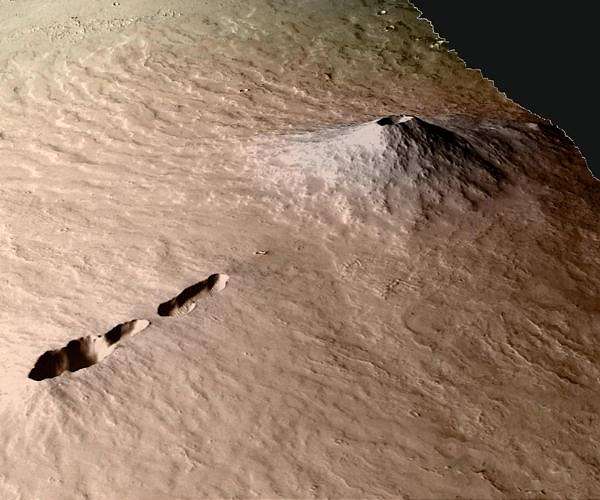
The study shows that the volcanic system developed through multiple eruptive phases, transitioning from early fissure-fed lava emplacement to later point-source activity that produced cone-forming vents. Although these lava flows appear different on the surface, they were supplied by the same underlying magma system. Each eruptive phase preserved a distinct mineral signature, allowing scientists to trace how the magma changed through time.

"These mineral differences tell us that the magma itself was evolving," Pieterek explains. "This likely reflects changes in how deep the magma originated and how long it was stored beneath the surface before erupting."

Because direct sampling of Martian volcanoes is currently not possible, studies like this provide rare insight into the structure and evolution of the planet's interior. The findings highlight how powerful orbital observations can be in revealing the hidden complexity of volcanic systems-on Mars and on other rocky planets.

Research Report: Spectral evidence for magmatic differentiation within a martian plumbing system

Related Links
University in Poznan
Mars News and Information at MarsDaily.com
Lunar Dreams and more

Subscribe Free To Our Daily Newsletters
Tweet

RELATED CONTENT
The following news reports may link to other Space Media Network websites.
MARSDAILY
ESCAPADE spacecraft capture first images while en route to Mars
Washington DC (SPX) Nov 26, 2025
About a week after liftoff, the twin spacecraft of NASA's ESCAPADE mission returned their first images as they journey away from Earth. On November 21, one of the two spacecraft used its Visible and Infrared Observation System - developed at Northern Arizona University - to photograph the edge of a solar panel. The pair of self-portraits includes a visible-light photo and an infrared image, showing the panel's surface temperature distribution. The visible-light view hints at a camera sensitivity s ... read more

MARSDAILY
First Crewed Moon Flyby In 54 Years: Artemis II

The Race Is On: Artemis, China and Musk Turn the Moon Into the Next Strategic High Ground

Chang'e-6 farside samples reshape lunar impact history

DLR plans new control center for future Moon and Mars missions

MARSDAILY
Dragon spacecraft gears up for crew 12 arrival and station science work

China prepares offshore test base for reusable liquid rocket launches

Retired EVA workhorse to guide China's next-gen spacesuit and lunar gear

Tiangong science program delivers data surge

MARSDAILY
Amino acids in Bennu asteroid hint at icy radioactive origin

ESA signs Ramses spacecraft and cubesat deals for Apophis flyby

ExLabs taps SpacePilot autonomy for Apophis asteroid mission

ExLabs and ChibaTech team up to land student CubeLanders on asteroid Apophis

MARSDAILY
Jupiter size refined by new radio mapping

Polar weather on Jupiter and Saturn hints at the planets' interior details

Europa ice delamination may deliver nutrients to hidden ocean

Birth conditions fixed water contrast on Jupiters moons

MARSDAILY
Enceladus waves shape Saturn space weather

Titan may have formed in a giant impact between ancient Saturn moons

Titan interior study points to thick slushy ice shell instead of global ocean

Cassini study reveals organic compounds from Enceladus ocean plume

MARSDAILY
Climate change speeds up destruction of key greenhouse gas

When Earth's magnetic field took its time flipping

New axis grid links complex earth data in space and time

EUMETSAT extends role in DestinE digital twin infrastructure

MARSDAILY
International crew takes off for space station

Launch to ISS pushed to Thursday over weather: NASA

NASA crew set for flight to ISS

Voyager wins NASA ISS mission management role through 2030

MARSDAILY
Debris disc oddities point to hidden outer planets

Hydrogen sulfide detected in distant gas giant exoplanets for the first time

JWST study links sulfur rich gas giants to core growth in distant HR 8799 system

Pressure driven leakage from marine snow feeds deep ocean microbes

Subscribe Free To Our Daily Newsletters


The content herein, unless otherwise known to be public domain, are Copyright 1995-2024 - Space Media Network. All websites are published in Australia and are solely subject to Australian law and governed by Fair Use principals for news reporting and research purposes. AFP, UPI and IANS news wire stories are copyright Agence France-Presse, United Press International and Indo-Asia News Service. ESA news reports are copyright European Space Agency. All NASA sourced material is public domain. Additional copyrights may apply in whole or part to other bona fide parties. All articles labeled "by Staff Writers" include reports supplied to Space Media Network by industry news wires, PR agencies, corporate press officers and the like. Such articles are individually curated and edited by Space Media Network staff on the basis of the report's information value to our industry and professional readership. Advertising does not imply endorsement, agreement or approval of any opinions, statements or information provided by Space Media Network on any Web page published or hosted by Space Media Network. General Data Protection Regulation (GDPR) Statement Our advertisers use various cookies and the like to deliver the best ad banner available at one time. All network advertising suppliers have GDPR policies (Legitimate Interest) that conform with EU regulations for data collection. By using our websites you consent to cookie based advertising. If you do not agree with this then you must stop using the websites from May 25, 2018. Privacy Statement. Additional information can be found here at About Us.