
MARSDAILY
Mars 2020 rover does biceps curls
by Staff Writers
Pasadena CA (JPL) Jul 30, 2019

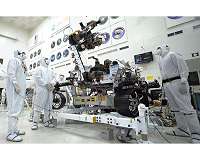
In this image, taken July 19, 2019, in the clean room of the Spacecraft Assembly Facility at JPL, the rover's 7-foot-long (2.1-meter-long) arm maneuvers its 88-pound (40-kilogram) sensor-laden turret as it moves from a deployed to a stowed configuration. See video presentation here

The robotic arm on NASA's Mars 2020 rover does not have deltoids, triceps or biceps, but it can still curl heavy weights with the best. In this time-lapse video, taken July 19, 2019, in the clean room of the Spacecraft Assembly Facility at the Jet Propulsion Laboratory in Pasadena, California, the rover's 7-foot-long (2.1-meter-long) arm handily maneuvers 88 pounds' (40 kilograms') worth of sensor-laden turret as it moves from a deployed to a stowed configuration.

The rover's arm includes five electrical motors and five joints (known as the shoulder azimuth joint, shoulder elevation joint, elbow joint, wrist joint and turret joint). The rover's turret includes HD cameras, the Scanning Habitable Environments with Raman and Luminescence for Organics and Chemicals (SHERLOC) science instrument, the Planetary Instrument for X-ray Lithochemistry (PIXL), and a percussive drill and coring mechanism.

On Mars, the arm and turret will work together, allowing the rover to work as a human geologist would: by reaching out to interesting geologic features, abrading, analyzing and even collecting them for further study via Mars 2020's Sample Caching System, which will collect samples of Martian rock and soil that will be returned to Earth by a future mission.

"This was our first opportunity to watch the arm and turret move in concert with each other, making sure that everything worked as advertised - nothing blocking or otherwise hindering smooth operation of the system," said Dave Levine, integration engineer for Mars 2020.

"Standing there, watching the arm and turret go through their motions, you can't help but marvel that the rover will be in space in less than a year from now and performing these exact movements on Mars in less than two."

Mars 2020 will launch from Cape Canaveral Air Force Station in Florida in July 2020. It will land at Jezero Crater on Feb. 18, 2021.

To submit your name to travel to Mars with NASA's 2020 mission and obtain a souvenir boarding pass to the Red Planet, go to https://go.nasa.gov/Mars2020Pass by Sept. 30, 2019.


Related Links
Mars 2020
Mars News and Information at MarsDaily.com
Lunar Dreams and more

MARSDAILY
Fueling of NASA's Mars 2020 rover power system begins
Pasadena CA (JPL) Jul 26, 2019
NASA's Associate Administrator for the Science Mission Directorate, Thomas Zurbuchen, has given the go-ahead to begin fueling the Mars 2020 rover's Multi-Mission Radioisotope Thermoelectric Generator, or MMRTG. The generator will power the rover and help keep it warm while exploring the Red Planet. "The progression of the Mars 2020 rover project is on schedule," said Zurbuchen. "The decision to begin fueling the MMRTG is another important milestone in keeping to our timetable for a July 2020 launc ... read more

Comment using your Disqus, Facebook, Google or Twitter login.

Share this article via these popular social media networks
del.icio.usdel.icio.us DiggDigg RedditReddit GoogleGoogle

MARSDAILY
The death of Neil Armstrong and a $6 million secret

Chandrayaan-2 will reach the moon by August 20, says ISRO

How to build a moon base

Polar Moon water not as invincible as expected, scientists argue

MARSDAILY
China launches first private rocket capable of carrying satellites

Chinese scientists say goodbye to Tiangong-2

China's space lab Tiangong 2 destroyed in controlled fall to earth

From Moon to Mars, Chinese space engineers rise to new challenges

MARSDAILY
What gives meteorites their shape

MASCOT Confirms What Scientists Have Long Suspected

Speeding up science on near-earth asteroids

ESA confirms asteroid will miss Earth in 2019

MARSDAILY
Jupiter's auroras powered by alternating current

Kuiper Belt Binary Orientations Support Streaming Instability Hypothesis

Study Shows How Icy Outer Solar System Satellites May Have Formed

Astronomers See "Warm" Glow of Uranus's Rings

MARSDAILY
Yale researcher has a window seat for planning NASA's Dragonfly mission

SMU's 'Titans in a jar' could answer key questions ahead of NASA's space exploration

The mission of a lifetime: a drone on Titan in 2034

Dragonfly Mission to Study Titan for Origins, Signs of Life

MARSDAILY
Commercial Space Ride Secured for NASA's New Air Pollution Sensor

Second laser boosts Aeolus power

Tracking Smoke From Fires to Improve Air Quality Forecasting

Chaos theory produces map for predicting paths of particles emitted into the atmosphere

MARSDAILY
Japan's space agency develops new filter to recycle urine

Japan's Noguchi to Be 1st Foreign Astronaut to Join New US Spacecraft Crew for ISS Mission

French inventor to hover across English Channel on 'flyboard'

US spacecraft's solar sail successfully deploys

MARSDAILY
Cold, dry planets could have a lot of hurricanes

ELSI scientists discover new chemistry that may help explain the origins of cellular life

New space discovery sheds light on how planets form

TESS mission completes first year of survey, turns to northern sky