
MARSDAILY
Mars 2020 Rover Gets Its Wheels
by Staff Writers
Pasadena CA (JPL) Jun 21, 2019

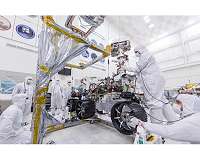
In this image, taken on June 13, 2019, engineers at JPL install the starboard legs and wheels - otherwise known as the mobility suspension - on the Mars 2020 rover.

In this image, taken on June 13, 2019, engineers at NASA's Jet Propulsion Laboratory in Pasadena, California, install the starboard legs and wheels - otherwise known as the mobility suspension - on the Mars 2020 rover. They installed the port suspension later that day.

"Now that's a Mars rover," said David Gruel, the Mars 2020 assembly, test, and launch operations manager at JPL. "With the suspension on, not only does it look like a rover, but we have almost all our big-ticket items for integration in our rearview mirror - if our rover had one."

Within the next few weeks, the team expects to install the vehicle's robotic arm, the mast-mounted SuperCam instrument and the Sample Caching System, which includes 17 separate motors and will collect samples of Martian rock and soil that will be returned to Earth by a future mission.

Both of the rover's legs (the starboard leg's black tubing can be seen above the wheels) are composed of titanium tubing formed with the same process used to make high-end bicycle frames. The wheels in this picture are engineering models and will not make the trip to Mars. They will be swapped out for flight models of the wheels sometime next year.

Made of aluminum, each of the six wheels (each 20.7 inches, or 52.5 centimeters, in diameter) features 48 grousers, or cleats, machined into its surface to provide excellent traction both in soft sand and on hard rocks. Every wheel has its own motor. The two front and two rear wheels also have individual steering motors that enable the vehicle to turn a full 360 degrees in place.

When driving over uneven terrain, the suspension system - called a "rocker-bogie" system due to its multiple pivot points and struts -maintains a relatively constant weight on each wheel and minimizes rover tilt for stability. Rover drivers avoid terrain that would cause a tilt of more than 30 degrees, but even so, the rover can withstand a 45-degree tilt in any direction without tipping over. With its suspension, the rover can also roll over rocks and other obstacles as well as through depressions the size of its wheels.

Mars 2020 will launch from Cape Canaveral Air Force Station in Florida in July of 2020. It will land at Jezero Crater on Feb. 18, 2021.

If you want to send your name to Mars with NASA's 2020 mission, you can do so until Sept. 30, 2019. Add your name to the list and obtain a souvenir boarding pass to Mars here


Related Links
Mars 2020
Mars News and Information at MarsDaily.com
Lunar Dreams and more

MARSDAILY
The Mast is raised for NASA's Mars 2020 rover
Pasadena CA (JPL) Jun 17, 2019
In this image, taken on June 5, 2019, engineers at NASA's Jet Propulsion Laboratory in Pasadena, California, take a moment after attaching the remote sensing mast to the Mars 2020 rover in the Spacecraft Assembly Facility's High Bay 1 clean room. Full integration of the mast - a process that includes installation of science instrument sensors, electrical wiring and checkout - continued into the following week, concluding on June 11. During Mars 2020's launch, interplanetary cruise, and its f ... read more

Comment using your Disqus, Facebook, Google or Twitter login.

Share this article via these popular social media networks
del.icio.usdel.icio.us DiggDigg RedditReddit GoogleGoogle

MARSDAILY
Ions Beams and Atom Smashers Expose Secrets of Moon Rocks

Politics, lack of support, funding have foiled US plans to return to moon

Apollo moon rocks help transform understanding of the universe

NASA Reflects on Legacy of LRO as Moon-Orbiting Mission Reaches 10-Year Anniversary

MARSDAILY
Luokung and Land Space to develop control system for space and ground assets

Yaogan-33 launch fails in north China, Possible debris recovered in Laos

China develops new-generation rockets for upcoming missions

China's satellite navigation industry sees rapid development

MARSDAILY
NRL researchers find insights into the formation of the solar system in ancient comet dust

Hera asteroid mission's brain to be radiation-hard and failure-proof

Ahuna Mons on Ceres: A New and Unusual Type of Volcanic Activity

Psyche Mission Has a Metal World in Its Sights

MARSDAILY
Table salt compound spotted on Europa

On Pluto the Winter is approaching, and the atmosphere is vanishing into frost

Neptune's moon Triton fosters rare icy union

Juno Finds Changes in Jupiter's Magnetic Field

MARSDAILY
Cassini reveals new sculpting in Saturn rings

Researchers find ice feature on Saturn's giant moon

Giant planets and big data: What deep learning reveals about Saturn's storms

Deep learning takes Saturn by storm

MARSDAILY
Satellite observations improve earthquake monitoring, response

TanDEM-X reveals glaciers in detail

Airbus built SEOSAT Ingenio is finished and ready for testing

SMOS joins forces with top weather forecasting system

MARSDAILY
NASA Invests $45M in US Small Businesses for Space Tech Development

With lions, elephants, Airbnb goes all-in on adventure tours

Science suffers collateral damage as US, China tensions rise

NASA renames street for 'hidden' black women mathematicians

MARSDAILY
View of the Earth in front of the Sun

Most Comprehensive Search for Radio Technosignatures

Two Earth-like Planets Discovered Near Teegarden's Star

The formative years: giant planets vs. brown dwarfs