 |
 |
 |
 |
 |
 |
 |
 |
 |

 |
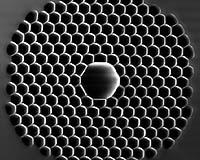
Light Is Shed On New Fibre's Potential To Change Technology
Bath, UK (SPX) Dec 11, 2007 Photonic crystal fibre's ability to create broad spectra of light, which will be the basis for important developments in technology, has been explained for the first time in an article in the leading science journal Nature-Photonics. The fibre can change a pulse of light with a narrow range of wavelengths into a spectrum hundreds of times broader and ranging from visible light to the infra-red. This is called a supercontinuum. This supercontinuum is one of the most exciting areas of applied physics today and the ability to create it easily will have a significant effect on technology. This includes telecommunications, where optical systems hundreds of times more efficient than existing types will be created because signals can be transmitted and processed at many wavelengths simultaneously. Supercontinua generated in photonic crystal fibres also help to create optical clocks which are so accurate that they lose or gain only a second every million years. Two physicists based in the US and Germany shared the Nobel Prize for Physics in 2005 for work in this area. Despite these applications, the mechanism behind supercontinuum generation has remained unclear, which has stopped physicists from being even more precise in using it. But researchers at the University of Bath have now discovered the reason for much of the broadening of the spectrum. Dr Dmitry Skryabin and Dr Andrey Gorbach, of the Centre for Photonics and Photonic Materials in the Department of Physics, found that the generation of light across the entire visible spectrum was caused by an interaction between conventional pulse of lights and what are called solitons, special light waves that maintain their shape as they travel down the fibre. The researchers found that the pulses of light sent down the fibre get struck behind the solitons as both pass down the fibre, because the solitons slow down as they move. This barrier caused by the solitons forces the light pulses to shorten their wavelength and so become bluer, just as the solitons' wavelength lengthens, becoming redder. This dual effect creates the broadened spectrum. "One of the most startling effects of the photonic crystal fibre is its ability to create a strong bright spectrum of visible and infra red light from a very brief pulse of light," said Dr Skryabin. "We have never fully understood exactly why this happens until our research showed how the pulse of light is slowed down and blocked by other activity in the fibre, forcing it to shorten its wavelength. "Until now the creation and manipulation of the supercontinua in photonic crystal fibres have been done in an ad-hoc way without knowing exactly why different effects are observed. But now we should be able to be much more precise when using it." Dr Skryabin believes that the interaction between light pulses and solitons has similarities with the way gravity acts on objects. Community Email This Article Comment On This Article Related Links Centre for Photonics and Photonic Materials Space Technology News - Applications and Research
 Major Physics Breakthrough In Understanding Supersolidity
 Edmonton, Canada (SPX) Dec 06, 2007
Physicists at the University of Alberta, in Edmonton, Alberta, Canada, have made a major advance in the understanding of what appears to be a new state of matter. Working in the highly specialized field of quantum fluids and solids, Prof. John Beamish, chair of the Department of Physics, and PhD student James Day, report their findings in a paper to be published in the science journal Nature on Wednesday, Dec. 6, 2007. |
|
|

| The content herein, unless otherwise known to be public domain, are Copyright 1995-2007 - SpaceDaily.AFP and UPI Wire Stories are copyright Agence France-Presse and United Press International. ESA Portal Reports are copyright European Space Agency. All NASA sourced material is public domain. Additional copyrights may apply in whole or part to other bona fide parties. Advertising does not imply endorsement,agreement or approval of any opinions, statements or information provided by SpaceDaily on any Web page published or hosted by SpaceDaily. Privacy Statement |