 |
 |
 |
 |
 |
 |
 |
 |
 |

 |
Humans Could Set Foot On Mars By 2020: Nasa Chief
Humans Could Set Foot On Mars By 2020: Nasa Chief
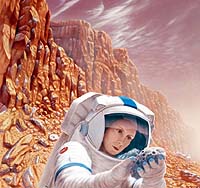
Washington (AFP) May 9, 2001 A human space explorer will be able to set foot on Mars no later than the year 2020 and visit other planets of the Solar system in the following decades, the head of the US space agency announced Wednesday. In an address reminiscent of late US president John Kennedy's 1962 speech announcing a mission to the Moon before the end of that decade, National Aeronautics and Space Agency Administrator Daniel Goldin said the United States would be able to send a man to Mars in no more that two decades. "In no less than 10 -- and if we decide to do it, it could be done in 10 -- and certainly no more than 20 years we'll start writing history again and not looking back but looking forward," Goldin told a rapt audience at George Washington University here. The announcement came as NASA's 2001 Mars Odyssey spacecraft hurtled toward the Red Planet at the speed of more than 30 kilometers per second (about 69,300 miles per hour) in a bid to scan the surface of Mars for signs of underground water. But Goldin made clear that was just one of the steps designed to prepare for piloted missions to Mars. A probe called Mars Reconnaissance Orbiter will soon be able to obtain high-resolution pictures of the planet, according to the NASA chief. "It will find the landing spots, not just for the robots but for the astronauts," said Goldin. If all goes according to plan, a US precision landing craft will then touch down on the Red Planet in 2007, while samples of the Martian surface would be brought to Earth between 2009 and 2011. Experiments aboard the International Space Station will allow US scientists to figure out ways to safely leave Earth's orbit in the next five or six years, according to the NASA chief. "Let's burn it into our brains that in our lifetimes, we will extend the reach of this human species onto other planets and to other bodies in our solar system, and build the robots that will leave our solar system to go to other stars, then ultimately to be followed by people," said Goldin. The upbeat forecast came despite at least two recent serious setback for the US Mars exploration program. In 1999, NASA lost the Mars Climate Orbiter, a space probe that disappeared without a trace as it circled the planet. Shortly afterwards, the Mars Polar Lander went silent after its scheduled touch down on the Martian surface. But Goldin said these and other failures should not deter true explorers from trying again. "In our quest to make what is envisioned real, we test, we build, we launch, we learn, we fail, and fail, and then start again and never ever worry about the criticism of failure because in failure we learn," stressed the NASA administrator. But before astronauts could set out for Mars, the United States and its partners will have to resolve some formidable technical problems, according to experts. Given the distance of the flight, a more reliable and robust spacecraft propulsion system and new robotic technologies will have to be developed, said astronaut William Shepherd. Space crews will need to learn to function more independently from mission controls because it would take radio signals 20-30 minutes to reach Earth from Mars orbit, according to Shepherd. In his view, a mission to Mars will also have to be international. "No single country has the financial resources, or the technical know-how, or even the political will to carry out a large and costly exploration program to Mars or even back to the Moon," said the astronaut. CommunityEmail This Article Comment On This Article Related Links SpaceDaily Search SpaceDaily Subscribe To SpaceDaily Express Mars News and Information at MarsDaily.com Lunar Dreams and more
 Spirit Heading To 'Home Plate'
 Pasadena CA (JPL) Jan 09, 2006
Last week Spirit completed robotic-arm work on "El Dorado." The rover used all three of its spectrometers plus the microscopic imager for readings over the New Year's weekend. |
|
|

| The content herein, unless otherwise known to be public domain, are Copyright 1995-2006 - SpaceDaily.AFP and UPI Wire Stories are copyright Agence France-Presse and United Press International. ESA PortalReports are copyright European Space Agency. All NASA sourced material is public domain. Additionalcopyrights may apply in whole or part to other bona fide parties. Advertising does not imply endorsement,agreement or approval of any opinions, statements or information provided by SpaceDaily on any Web page published or hosted by SpaceDaily. Privacy Statement |