 |
 |
 |
 |
 |
 |
 |
 |
 |

 |
Highway System Drives City Population Declines
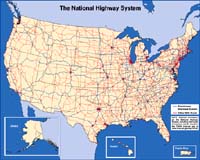
Providence RI (SPX) Jun 15, 2007 Construction of the American highway system in the late 20th century played a key role in causing population declines in central cities, according to new research by Brown University economist Nathaniel Baum-Snow published in the Quarterly Journal of Economics and available online While past studies have posited various explanations for suburbanization, such as improved telecommunications technology, city school desegregation, housing project construction, rising crime rates, and faster commuting options, Baum-Snow's paper is the first to empirically account for the relative importance of transportation improvements in causing city population declines in the United States since World War II. Using unique data, Baum-Snow demonstrates that one new highway passing through a central city reduces its population by about 18 percent. Furthermore, he asserts that rather than the observed decline of 17 percent, the nation's city populations would have grown by about 8 percent overall had the interstate highway system not been built. "The Federal Highway Act of 1944 stipulated that highways should be built primarily to serve the national defense - so, suburbanization was essentially an unintended consequence," Baum-Snow said. "Without the more than 40 thousand miles of interstate roads built by 1990, urban decentralization would have probably still taken place, but the population shift would not have been nearly as sizable." To compare rates of suburbanization in metropolitan areas that received many new highways between 1950 and 1990 to those receiving fewer during the same period, Baum-Snow created a unique data set. Using data on 139 large metropolitan areas and information from a 1947 plan of the highway system, he measured the highways as "rays" emanating from central cities - a "ray" is defined as a segment of road that connects the central business district of the central city with the region outside the central city. "The estimates put forth in this paper are certainly relevant and applicable to current transportation infrastructure planning in urban areas in developing countries including China and India," said Baum-Snow. "Urban transportation planners should consider that building a highway system through urban areas has the potential to dramatically change where people choose to live and how much land is developed." Baum-Snow is an assistant professor of economics and is affiliated with both the Population Studies and Training Center at Brown University and Spatial Structures in the Social Sciences (S4). He received his Ph.D. in economics from the University of Chicago in 2005. Community Email This Article Comment On This Article Related Links Brown University All About Human Beings and How We Got To Be Here
 The Global Impact Of Cities
 New Haven CT (SPX) Jun 15, 2007
The global impact of cities is the focus of cutting-edge research in a special issue of Yale's Journal of Industrial Ecology. "Cities are an environmental paradox. As dense centers of commerce and industry, they are responsible for more than their population share of global environmental impacts," said journal Editor-in-Chief Reid Lifset. "On the other hand, their compactness provides opportunities for economies of scale in transportation, waste and water services and infrastructure." |
|
|

| The content herein, unless otherwise known to be public domain, are Copyright 1995-2006 - SpaceDaily.AFP and UPI Wire Stories are copyright Agence France-Presse and United Press International. ESA PortalReports are copyright European Space Agency. All NASA sourced material is public domain. Additionalcopyrights may apply in whole or part to other bona fide parties. Advertising does not imply endorsement,agreement or approval of any opinions, statements or information provided by SpaceDaily on any Web page published or hosted by SpaceDaily. Privacy Statement |