
Mars Exploration News
MARSDAILY
GoMars model simulates Martian dust storms to improve mission safety
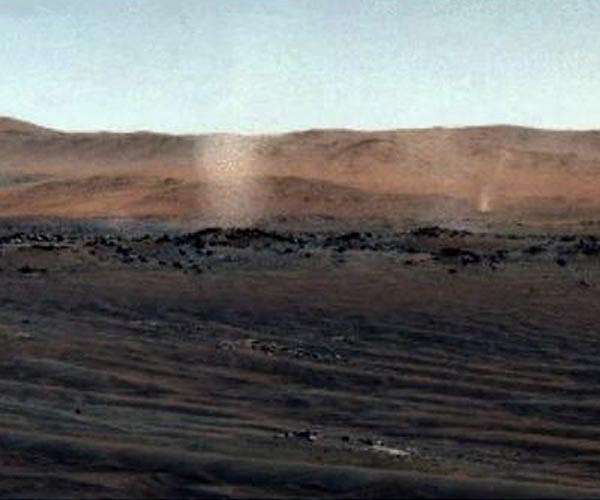
illustration only

GoMars model simulates Martian dust storms to improve mission safety

by Riko Seibo
Tokyo, Japan (SPX) Dec 16, 2025

Researchers in China have used a Mars general circulation model to simulate 50 years of Martian dust activity, aiming to improve forecasts of global dust storms that can disrupt exploration missions.

Mars is dominated by a dry, dusty desert landscape where winds and rotating columns of air lift fine particles into the atmosphere and later return them to the surface. The resulting dust cycle depends on surface - atmosphere interactions, seasonal changes, and the development of occasional planet-encircling dust storms.

A team from the Institute of Atmospheric Physics at the Chinese Academy of Sciences in Beijing ran a half-century simulation with the Global Open Planetary Atmospheric Model for Mars, or GoMars, to examine how dust moves through the Martian atmosphere. The model, independently developed by Chinese scientists, is designed to reproduce key characteristics of the Martian dust cycle and the occurrence of global dust storms.

The study appeared on December 13, 2025, in the journal Advances in Atmospheric Sciences. The authors describe the Martian dust cycle as a system with strong day - night, seasonal, and year-to-year variability, and note that accurately capturing this behavior remains a central challenge for Mars general circulation models used to support future Mars missions.

To evaluate GoMars, the team compared its atmospheric predictions with data from the Mars Climate Database and observations from the Mars Climate Sounder instrument. When direct observations were unavailable, GoMars output was assessed against other Mars general circulation models such as MarsWRF. These comparisons indicate that GoMars reproduces the seasonal and spatial patterns of the Martian dust cycle found in other models and datasets.

In its 50-year run, GoMars generated 11 spontaneous global dust storms at irregular intervals using a fully interactive dust scheme, reflecting the variability seen in observations. According to the authors, the simulation captures the multi-timescale variability of the dust cycle and shows that the model can consistently and realistically reproduce the timing and evolution of several types of global dust storms, a long-standing goal in international Mars atmospheric modeling.

The simulation also resolves smaller-scale processes such as dust devil lifting, in which heated, swirling columns of air move dust from the surface into the atmosphere. GoMars indicates that peak dust devil lifting occurs between 12:00 and 13:00 local time, in agreement with measurements from the Mars Pathfinder mission. The model further identifies strong dust devil activity in the Amazonis region, matching its status as a known dust devil hotspot.

The researchers emphasize that GoMars is still under development and outline several directions for improvement. Planned upgrades include higher spatial resolution, refinements to the model's dynamical core, and better physical parameterizations. The team also intends to incorporate more realistic surface dust and sand source information and to improve how dust-related physical processes are represented.

Future versions of GoMars will expand simulation of the Martian water cycle alongside dust processes. The long-term aim is to build a numerical prediction system for Mars that can assimilate observational data from exploration missions, providing weather-style forecasts tailored to Martian conditions. The researchers ultimately seek to reproduce the full diversity of Martian dust storms and to clarify the mechanisms driving them, thereby supplying meteorological support for future Mars exploration activities.

Research Report:The Fully Interactive Martian Dust Cycle Simulations by the GoMars Model

Related Links
Institute of Atmospheric Physics Chinese Academy of Sciences
Mars News and Information at MarsDaily.com
Lunar Dreams and more

Subscribe Free To Our Daily Newsletters
Tweet

RELATED CONTENT
The following news reports may link to other Space Media Network websites.
MARSDAILY
Bacterial partnership offers pathway to produce Mars regolith bricks for future habitats
Los Angeles CA (SPX) Dec 05, 2025
Human missions to Mars will require robust shelters that can be built without hauling heavy materials from Earth, pushing engineers and scientists to focus on in situ resource utilization of the planet's regolith. A new perspective article describes how carefully selected microbial communities could turn Martian dust into structural elements for habitats, while also contributing to life-support functions. Mars once had a thicker atmosphere, but today the planet's surface is exposed to low pressure ... read more

MARSDAILY
Lunar dust study links space weathering to changes in Moon ultraviolet brightness

Congress warned that the U.S. faces a new space race with China

Astrobotic lunar surface sensor to track cislunar traffic and security

NASA prepares new lunar dust and seismic studies for Artemis IV

MARSDAILY
Experts at Hainan symposium call for stronger global space partnership

Foreign satellites ride Kinetica 1 on new CAS Space mission

Triple Long March launches mark record day for Chinese space program

China prepares Qingzhou cargo ship for low cost resupply flights

MARSDAILY
Micro X ray method reads ancient meteorite impact scars

ICE-CSIC leads a pioneering study on the feasibility of asteroid mining

OSIRIS-APEX spacecraft completes Earth flyby on its journey to explore Apophis

40 000 near-Earth asteroids discovered!

MARSDAILY
Uranus and Neptune may be rock rich worlds

SwRI links Uranus radiation belt mystery to solar storm driven waves

Looking inside icy moons

Saturn moon mission planning shifts to flower constellation theory

MARSDAILY
Cassini study reveals organic compounds from Enceladus ocean plume

Saturn's icy moon may host a stable ocean fit for life, study finds

Unexpected discovery on Saturn's moon challenges our view on chemistry before life emerged

Cassini proves complex chemistry in Enceladus ocean

MARSDAILY
Outage Prevention from Orbit: Why Utilities Are Turning to Satellites and Geospatial Analytics

Gilat wins 10 million dollar order for transportable direct downlink earth observation system

IHI SAT2 hyperspectral CubeSat enters orbit to support forest monitoring and carbon data

LizzieSat 3 completes bus commissioning for multi mission AI operations

MARSDAILY
ISS to change commanders before Soyuz crew leaves orbit

Lodestar Space wins SECP support to advance AI satellite awareness system

Micro nano robots aim to cut carbon buildup in closed life support systems

NASA extends ISS National Lab management contract through 2030

MARSDAILY
RISTRETTO spectrograph cleared for Proxima b atmospheric hunt

Ultra hot super Earth shows dense atmosphere over magma ocean

Hidden circumbinary giant planet emerges from decade old Gemini data

NASA backs WHOI effort to read organic signals from ocean worlds

Subscribe Free To Our Daily Newsletters


The content herein, unless otherwise known to be public domain, are Copyright 1995-2024 - Space Media Network. All websites are published in Australia and are solely subject to Australian law and governed by Fair Use principals for news reporting and research purposes. AFP, UPI and IANS news wire stories are copyright Agence France-Presse, United Press International and Indo-Asia News Service. ESA news reports are copyright European Space Agency. All NASA sourced material is public domain. Additional copyrights may apply in whole or part to other bona fide parties. All articles labeled "by Staff Writers" include reports supplied to Space Media Network by industry news wires, PR agencies, corporate press officers and the like. Such articles are individually curated and edited by Space Media Network staff on the basis of the report's information value to our industry and professional readership. Advertising does not imply endorsement, agreement or approval of any opinions, statements or information provided by Space Media Network on any Web page published or hosted by Space Media Network. General Data Protection Regulation (GDPR) Statement Our advertisers use various cookies and the like to deliver the best ad banner available at one time. All network advertising suppliers have GDPR policies (Legitimate Interest) that conform with EU regulations for data collection. By using our websites you consent to cookie based advertising. If you do not agree with this then you must stop using the websites from May 25, 2018. Privacy Statement. Additional information can be found here at About Us.