A combination of a once-debunked 19th-century identification of a water-carrying iron mineral and the fact that these rocks are extremely common on Earth, suggests the existence of a substantial water reservoir on Mars, according to a team of geoscientists.
"One of my student's experiments was to crystalize hematite," said Peter J. Heaney, professor of geosciences, Penn State. "She came up with an iron-poor compound, so I went to Google Scholar and found two papers from the 1840s where German mineralogists, using wet chemistry, proposed iron-poor versions of hematite that contained water."
In 1844, Rudolf Hermann named his mineral turgite and in 1847 August Breithaupt named his hydrohematite. According to Heaney, in 1920, other mineralogists, using the then newly developed X-ray diffraction technique, declared these two papers incorrect. But the nascent technique was too primitive to see the difference between hematite and hydrohematite.
Si Athena Chen, Heaney's doctoral student in geosciences, began by acquiring a variety of old samples of what had been labeled as containing water. Heaney and Chen obtained a small piece of Breithaupt's original sample, a sample labeled as turgite from the Smithsonian Institution, and, surprisingly, five samples that were in Penn State's own Frederick Augustus Genth collection.
After multiple examinations using a variety of instruments including infrared spectroscopy and synchrotron X-ray diffraction, a more sensitive, refined method than used in the mid-19th century, Chen showed that these minerals were indeed light on iron and had hydroxyl – a hydrogen and oxygen group – substituted for some of the iron atoms. The hydroxyl in the mineral is stored water.
The researchers recently proposed in the journal Geology "that hydrohematite is common in low-temperature occurrences of iron oxide on Earth, and by extension it may inventory large quantities of water in apparently arid planetary environments, such as the surface of Mars."
"I was trying to see what were the natural conditions to form iron oxides," said Chen. "What were the necessary temperatures and pH to crystallize these hydrous phases and could I figure out a way to synthesize them."
She found that at temperatures lower than 300 degrees Fahrenheit, in a watery, alkaline environment the hydrohematite can precipitate out, forming sedimentary layers.
"Much of Mars' surface apparently originated when the surface was wetter and iron oxides precipitated from that water," said Heaney. "But the existence of hydrohematite on Mars is still speculative."
The "blueberries" found in 2004 by NASA's Opportunity rover are hematite. Although the latest Mars rovers do have X-ray diffraction devices to identify hematite, they are not sophisticated enough to differentiate between hematite and hydrohematite.
"On Earth, these spherical structures are hydrohematite, so it seems reasonable to me to speculate that the bright red pebbles on Mars are hydrohematite," said Heaney.
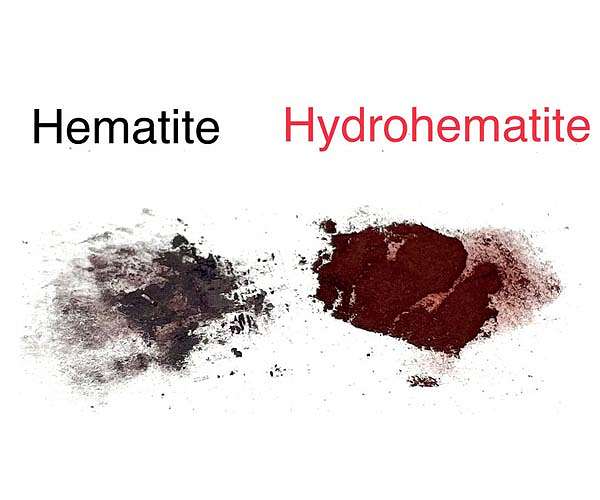
The researchers note that anhydrous hematite – lacking water – and hydrohematite – containing water – are two different colors, with hydrohematite being redder or containing dark red streaks.
Chen's experiments found that naturally occurring hydrohematite contained 3.6% to 7.8% by weight of water and that goethite contained about 10% by weight of water. Depending on the amount of hydrated iron minerals found on Mars, the researchers believe there could be a substantial water reserve there.
Mars is called the red planet because of its color, which comes from iron compounds in the Martian dirt. According to the researchers, the presence of hydrohematite on Mars would provide additional evidence that Mars was once a watery planet, and water is the one compound necessary for all life forms on Earth.
view of Martian landscape, redish brown dirt with occasional rocks showing the tire tracks from the rover
Other researchers involved in this project include Jeffrey E. Post, mineralogist and curator in charge of gems and minerals, Smithsonian Institution; Timothy B. Fischer, Chevron, Houston; Peter J. Eng, research professor, Consortium for Advanced Radiation Sources and the James Franck Institute, University of Chicago; and Joanne E. Stubbs, research associate professor, Consortium for Advanced Radiation Sources, University of Chicago.