
MARSDAILY
Daily records of atmospheric temperature with Perseverance
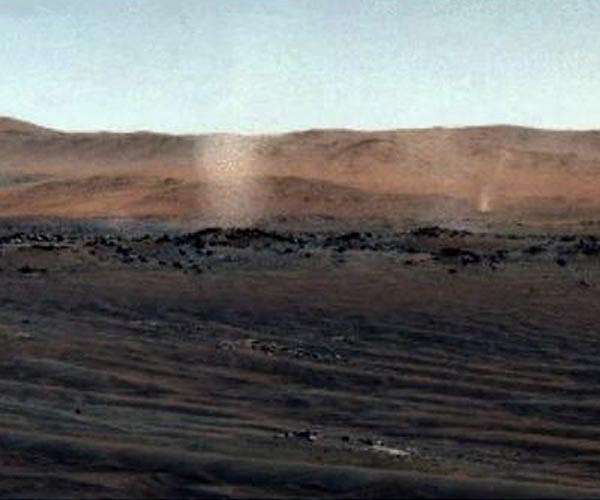
NASA's Perseverance Mars rover used its navigation camera to capture these dust devils swirling across Jezero Crater. See an animation of multiple dust devils events captured in 2021 by Perseverance.
Daily records of atmospheric temperature with Perseverance
by Asier Munguira | PhD Student - University Basque Country
Pasadena CA (JPL) Aug 04, 2023
Atmospheric temperature is a meteorological variable of daily concern to humans. Temperature also has a major impact on Perseverance mission operations (e.g. temperature sensors are distributed throughout the rover to monitor its thermal performance). In addition, temperature data are key to the mission's scientific investigations of the atmosphere. The Mars Environmental Dynamics Analyzer (MEDA) instrument onboard Perseverance records the surface and atmospheric temperature at Jezero crater, Mars. But how does the temperature of Mars differ from that of Earth?

On Mars, the tenuous atmosphere and the absence of oceans make it hard for the planet to retain heat. As a result of the rapid heating and cooling that occurs on Mars, diurnal and seasonal cycles of insolation produce large temperature ranges in the surface and atmosphere. For example, surface temperature typically ranges from -83 Celsius pre-dawn to 5 Celsius at noon (between -83 Celsius and -23 Celsius for air temperature). Can you think of any 90-degree contrast between day and night on Earth?

The MEDA instrument measures near-surface temperatures around the clock and at different altitudes using a combination of thermocouple sensors and a thermal infrared radiometer pointing up to the sky and down to the ground. This data is of interest since strong vertical temperature differences develop near the ground causing intense vertical motions of air during daytime. Because of this turbulence, the unstable layer of the atmosphere extends much higher on Mars than on Earth (10 km vs. 2 km), with implications for the vertical transport of heat, momentum, dust, water and a variety of chemical tracers. One example is dust lifting by convective vortices that can extend unusually high in the atmosphere of Mars (see image).

MEDA temperature data are intended to characterize atmospheric processes on a variety of temporal and spatial scales as never before, and have already proven useful in this sense. Additionally, as the rover travels across the Jezero fan, we expect the topography to cause changes in the local meteorology. May the fun be with us!

Related Links
Perseverance Mars Rover
Mars News and Information at MarsDaily.com
Lunar Dreams and more

Tweet

MARSDAILY
Can we see Mars' Breath in the Winter Cold: Sols 3907-3908
Pasadena CA (JPL) Aug 04, 2023
Earth planning date: Wednesday, August 2, 2023: We don't have a lot of power to play with today, so we have to be careful about how much time we give the different activities. As Arm Rover Planner, I got to sequence the contact science activities today. We start this two-sol plan with a nap to save up power. After waking up in the afternoon, we do a short block of imaging. Mastcam is taking three stereo mosaics. The first is a 4-frame mosaic of the Mt. Sharp foothills, specifically looking at an e ... read more

MARSDAILY
India's moon mission takes another big step

UAH to develop propulsion system to boost surveillance between Earth and Moon

NASA may delay crewed lunar landing beyond Artemis 3 mission

Russia to launch lunar mission Friday, first in nearly 50 years

MARSDAILY
China to launch "Innovation X Scientific Flight" program, applications open worldwide

Scientists reveal blueprint of China's lunar water-ice probe mission

Shenzhou 15 crew share memorable moments from Tiangong Station mission

China's Space Station Opens Doors to Global Scientific Community

MARSDAILY
A Banner Year For The Perseid Meteor Shower

Winchcombe meteorite is helping us to understand more about asteroids

Asteroid Institute Unveils Rapid Online Precovery Tool For Searching Multiple Astronomical Datasets in Minutes

Earth's most ancient impact craters are disappearing

MARSDAILY
Looking for Light with New Horizons

James Webb Space Telescope sees Jupiter moons in a new light

NASA's Juno Is Getting Ever Closer to Jupiter's Moon Io

SwRI team identifies giant swirling waves at the edge of Jupiter's magnetosphere

MARSDAILY
Studying rivers from worlds away

Saturn's Rings shine in Webb's observations of Gas Giant

Key building block for life found at Saturn's moon Enceladus

New study puts a definitive age on Saturn's rings-they're really young

MARSDAILY
IBM collaborates with NASA to launch Geospatial AI on Hugging Face

BlackSky signs Rocket Lab for five launches

Southern Cross and Satelytics Announce Market Development Partnership

Ionospheric study reveals surprising protection by Earth's magnetic field

MARSDAILY
Advanced Space selected for two NASA SBIR Phase I Awards

NASA announces crew for 2024 ISS rotation mission

NASA and Axiom Space join forces for fourth private mission in 2024

NASA back in touch with Voyager 2 after 'interstellar shout'

MARSDAILY
Chemical contamination on International Space Station is out of this world

New exoplanet discovery builds better understanding of planet formation

Violent Atmosphere Gives Rare Look at Early Planetary Life

Using cosmic weather to study which worlds could support life