
Mars Exploration News
MARSDAILY
Curiosity's Nevado Sajama postcard captures Mars on the eve of conjunction
illustration only

Curiosity's Nevado Sajama postcard captures Mars on the eve of conjunction

by Clarence Oxford
Los Angeles CA (SPX) Jan 03, 2026

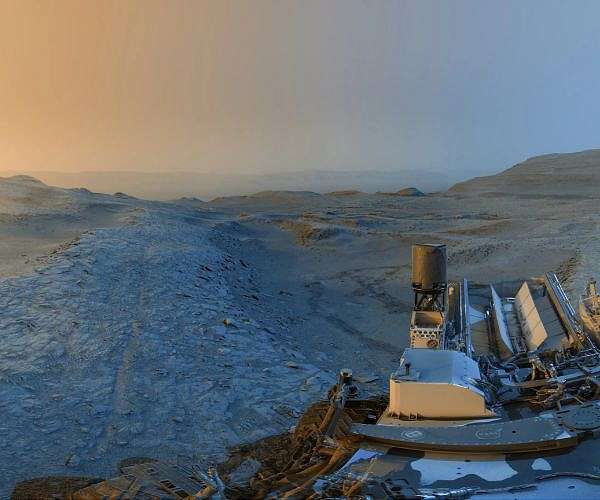
From its perch on a rugged ridge in Gale Crater, NASA's Curiosity rover has stitched together a holiday postcard that doubles as a science panorama, framing the Nevado Sajama drill site against a hazy Martian sky. The scene merges two Mastcam mosaics taken on Nov. 18, 2025 - late afternoon on sol 4722 and early morning on sol 4723 - then tinted in cool blues and warm golds to emphasize changing light, shadows, and atmospheric dust across the crater rim and distant buttes.

The ridge where Curiosity is parked belongs to the so-called boxwork unit, a landscape of resistant ribs and eroded hollows that the team has been dissecting with a focused drill campaign. In the foreground of the postcard, the rover sits atop one of these boxwork ridges overlooking Monte Grande, giving mission scientists a sweeping context view that ties the Nevado Sajama drill hole to nearby hollows, buttes, and fracture networks that record Gale's sedimentary history.

Earlier in the campaign, Curiosity's science team targeted the bedrock block dubbed "Nevado Sajama" as a prime candidate to understand why ridges stand proud while neighboring terrain is carved into depressions. During sols 4716 - 4722, the rover brushed the surface, collected Alpha Particle X-ray Spectrometer (APXS) and ChemCam measurements, and then drilled its 45th hole into the ridge, successfully acquiring a powdered sample for the internal laboratories.

CheMin, Curiosity's mineralogy lab, was given the first look at the Nevado Sajama sample, using X-ray diffraction to identify the crystalline phases that lock in clues to past water and diagenetic alteration. Those data set the stage for a follow-up run by the Sample Analysis at Mars (SAM) instrument, which performed an evolved gas analysis (EGA) experiment similar to a recent test in the nearby Monte Grande hollow to compare how fluids, cementation, and organics differ between ridge and hollow environments.

With extra power available in the planning cycle - a "power gift" - the team packed sols 4723 - 4730 with additional observations that complement the postcard's sweeping view. ChemCam fired its laser at seven nearby rock targets, while Mastcam, NAVCAM, and other cameras built up a massive 360-degree stereo mosaic of the boxwork region, capturing everything from hollow walls and buttes to dust-lifting events and cloud structure in Gale's increasingly dusty skies.

Throughout this intensive campaign, environmental monitoring continued alongside the geology, ensuring the postcard is anchored in a broader seasonal story. REMS and RAD tracked weather and radiation, Mastcam monitored dust opacity, and APXS even turned to the atmosphere itself, measuring argon and other components as the crater edged deeper into the Martian dusty season.

By late December, the mission entered a new operational phase as Earth and Mars approached solar conjunction, when the Sun moves between the two planets and blocks reliable communications. In sols 4750 - 4762, Curiosity wrapped up a pre-planned traverse between the "Valle de la Luna" hollow and the Nevado Sajama ridge, completing chemical and imaging transects of a ridge wall to document how textures, structures, and compositions evolve across the boxwork terrain.

Engineers then guided Curiosity back up onto a safe parking spot on the ridge, documenting the climb with a MARDI "sidewalk" video that tracks how the terrain flows beneath the wheels. Because arm activities with APXS and MAHLI were restricted in the final days before conjunction, the team leaned heavily on Mastcam and the hazard and navigation cameras to capture additional near-field targets and to keep watching for dust devils and other atmospheric changes that might affect rover health and future planning.

The postcard thus arrives as both a science product and a seasonal greeting from a rover preparing for several weeks of enforced quiet. While no new commands will be sent between Dec. 27 and Jan. 20 to avoid radio signals passing too close to the Sun, Curiosity will continue running a carefully uplinked conjunction plan that includes periodic environmental checks, atmospheric argon measurements, and passive monitoring of dust and sky conditions.

When contact resumes on the other side of the Sun, scientists will return to a uniquely well-documented site, armed with drill results from Nevado Sajama, stereo panoramas spanning hollows and ridges, and the context provided by this striking morning-and-afternoon postcard. Together, these data sets promise to sharpen understanding of how Gale's boxwork structures formed, why some layers resist erosion, and how Mars' climate and groundwater once interacted to sculpt this dramatic landscape.

Related Links
NASA Jet Propulsion Laboratory, California Institute of Technology
Mars News and Information at MarsDaily.com
Lunar Dreams and more

Subscribe Free To Our Daily Newsletters
Tweet

RELATED CONTENT
The following news reports may link to other Space Media Network websites.
MARSDAILY
Curiosity Captures Mars Landscape While Talking to an Orbiter
Pasadena CA (JPL) Aug 22, 2025
NASA's Curiosity Mars rover demonstrated a new multitasking capability when capturing this view: It snapped the 15 images that make up the mosaic while simultaneously communicating with an orbiter. The images were taken by the right navigation camera on Curiosity's mast July 26, 2025, the 4,611th sol, or day, of the mission. The rover's tracks cross through a region filled with boxwork formations - hardened ridges created by mineral deposits from subsurface water billions of years ago. This boxwork regi ... read more

MARSDAILY
Lunar dust model maps how charged grains stick to spacecraft

NASA Langley begins plume surface interaction tests to support future lunar landings

Origami style lunar rover wheel expands to climb steep caves

Sandia centrifuge campaign clears NASA VIPER rover for lunar launch

MARSDAILY
China harnesses nationwide system to drive spaceflight and satellite navigation advances

Shenzhou 21 crew complete eight hour spacewalk outside Tiangong station

Foreign satellites ride Kinetica 1 on new CAS Space mission

Experts at Hainan symposium call for stronger global space partnership

MARSDAILY
Micro X ray method reads ancient meteorite impact scars

ICE-CSIC leads a pioneering study on the feasibility of asteroid mining

OSIRIS-APEX spacecraft completes Earth flyby on its journey to explore Apophis

40 000 near-Earth asteroids discovered!

MARSDAILY
Uranus and Neptune may be rock rich worlds

SwRI links Uranus radiation belt mystery to solar storm driven waves

Looking inside icy moons

Saturn moon mission planning shifts to flower constellation theory

MARSDAILY
Titan interior study points to thick slushy ice shell instead of global ocean

Cassini study reveals organic compounds from Enceladus ocean plume

Saturn's icy moon may host a stable ocean fit for life, study finds

Unexpected discovery on Saturn's moon challenges our view on chemistry before life emerged

MARSDAILY
TanDEM X marks 15 years mapping Earth in 3D

Maintaining the Gold Standard: The Future of Landsat Calibration and Validation

NASA Earth science faces rollback as Mission to Planet Earth era winds down

Alen Space begins SATMAR satellite validation over Bay of Algeciras

MARSDAILY
ESA reaches new benchmark in autonomous formation flying

Hydrogen peroxide thruster qualifies for ESA launcher attitude control

China launches twin Shijian-29 satellites to test space-target detection tech

Billionaire Trump nominee confirmed to lead NASA amid Moon race

MARSDAILY
Hubble pinpoints asteroid smash ups in nearby Fomalhaut system

Philosopher argues AI consciousness may remain unknowable

Evolution study finds history and environment shifts can steer species in very different directions

Webb maps carbon rich atmosphere on distorted pulsar planet

Subscribe Free To Our Daily Newsletters


The content herein, unless otherwise known to be public domain, are Copyright 1995-2024 - Space Media Network. All websites are published in Australia and are solely subject to Australian law and governed by Fair Use principals for news reporting and research purposes. AFP, UPI and IANS news wire stories are copyright Agence France-Presse, United Press International and Indo-Asia News Service. ESA news reports are copyright European Space Agency. All NASA sourced material is public domain. Additional copyrights may apply in whole or part to other bona fide parties. All articles labeled "by Staff Writers" include reports supplied to Space Media Network by industry news wires, PR agencies, corporate press officers and the like. Such articles are individually curated and edited by Space Media Network staff on the basis of the report's information value to our industry and professional readership. Advertising does not imply endorsement, agreement or approval of any opinions, statements or information provided by Space Media Network on any Web page published or hosted by Space Media Network. General Data Protection Regulation (GDPR) Statement Our advertisers use various cookies and the like to deliver the best ad banner available at one time. All network advertising suppliers have GDPR policies (Legitimate Interest) that conform with EU regulations for data collection. By using our websites you consent to cookie based advertising. If you do not agree with this then you must stop using the websites from May 25, 2018. Privacy Statement. Additional information can be found here at About Us.