
MARSDAILY
Curiosity Mars Rover explores a changing landscape
by Staff Writers
Pasadena CA (JPL) Aug 18, 2021

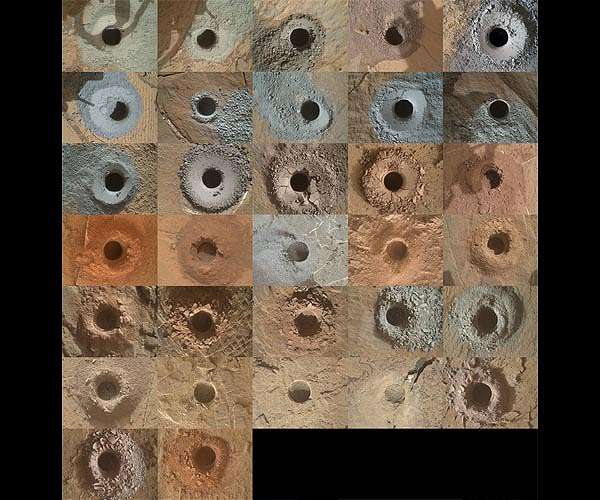
NASA's Curiosity Mars rover has used the drill on its robotic arm to take 32 rock samples to date. The Mars Hand Lens Imager (MAHLI), a camera on the end of the robotic arm, provided the images in this mosaic. Video: NASA's Curiosity Mars Rover Finds A Changing Landscape

Images of knobbly rocks and rounded hills are delighting scientists as NASA's Curiosity rover climbs Mount Sharp, a 5-mile-tall (8-kilometer-tall) mountain within the 96-mile-wide (154-kilometer-wide) basin of Mars' Gale Crater. The rover's Mast Camera, or Mastcam, highlights those features in a panorama captured on July 3, 2021 (the 3,167th Martian day, or sol, of the mission).

This location is particularly exciting: Spacecraft orbiting Mars show that Curiosity is now somewhere between a region enriched with clay minerals and one dominated by salty minerals called sulfates. The mountain's layers in this area may reveal how the ancient environment within Gale Crater dried up over time. Similar changes are seen across the planet, and studying this region up close has been a major long-term goal for the mission.

"The rocks here will begin to tell us how this once-wet planet changed into the dry Mars of today, and how long habitable environments persisted even after that happened," said Abigail Fraeman, Curiosity's deputy project scientist, at NASA's Jet Propulsion Laboratory in Southern California.

Nine Years on Mars
Curiosity landed nine years ago, on Aug. 5, 2012 PDT (Aug. 6, 2012 EDT), to study whether different Martian environments could have supported microbial life in the planet's ancient past, when lakes and groundwater existed within Gale Crater.

The rover pulverizes rock samples with a drill on its robotic arm, then sprinkles the powder into the rover's chassis, where a pair of instruments determines which chemicals and minerals are present. Curiosity recently drilled its 32nd rock sample from a target nicknamed "Pontours" that will help detail the transition from the region of clay minerals to the one dominated by sulfates.

Because it's winter at Curiosity's location, the skies in the new panorama are relatively dust-free, providing a clear view all the way down to Gale Crater's floor. It's provided an opportunity for the mission team to reflect on the 16 miles (26 kilometers) Curiosity has driven during the mission.

"Landing day is still one of the happiest days of my professional career," said the mission's new project manager, Megan Richardson Lin of NASA's Jet Propulsion Laboratory in Southern California. Lin started working on Curiosity just before it launched, joining the surface operations team shortly afterward. She's held several roles on the mission since then.

"We're driving a robot as it explores another planet. Seeing how new discoveries and scientific results guide each day's activities is extremely rewarding."

There's more to discover on the road ahead. Curiosity has already started up a path winding between "Rafael Navarro Mountain," recently nicknamed to honor a deceased mission scientist, and a towering butte that's taller than a four-story building. In the coming year, the rover will drive past these two features into a narrow canyon before revisiting the "Greenheugh Pediment," a slope with a sandstone cap that the rover briefly summited last year.


Related Links
Mars Curiosity Rover
Mars News and Information at MarsDaily.com
Lunar Dreams and more

MARSDAILY
Mars Perseverance team assessing first sampling attempt
Pasadena CA (JPL) Aug 06, 2021
Data sent to Earth by NASA's Perseverance rover after its first attempt to collect a rock sample on Mars and seal it in a sample tube indicate that no rock was collected during the initial sampling activity. The rover carries 43 titanium sample tubes, and is exploring Jezero Crater, where it will be gathering samples of rock and regolith (broken rock and dust) for future analysis on Earth. "While this is not the 'hole-in-one' we hoped for, there is always risk with breaking new ground," said ... read more

Comment using your Disqus, Facebook, Google or Twitter login.

Share this article via these popular social media networks
del.icio.usdel.icio.us DiggDigg RedditReddit GoogleGoogle

MARSDAILY
A 'True' Blue Moon occurs this weekend

Firefly Aerospace selects Redwire as key mission partner in 2023 Lunar lander mission

Xplore receives USAF contract to develop a commercial navigation and timing service for cislunar space

NASA awards grants in Break the Ice Lunar Challenge

MARSDAILY
China's astronauts make spacewalk to upgrade robotic arm

Chinese astronauts out of spacecraft for second time EVA

Chinese astronauts to conduct extravehicular activities for second time

Mars mission outcomes to advance space research

MARSDAILY
Solar System's fastest-orbiting asteroid discovered

Comet Atlas may have been a blast from the past

NASA Mission to Asteroid Psyche one year out from launch

Fizzing sodium could explain Asteroid Phaethon's comet-like activity

MARSDAILY
A few steps closer to Europa: spacecraft hardware makes headway

Juno joins Japan's Hisaki satellite and Keck Observatory to solve "energy crisis" on Jupiter

Hubble finds first evidence of water vapor on Ganymede

NASA Awards Launch Services Contract for the Europa Clipper Mission

MARSDAILY
Saturn makes waves in its own rings

Dragonfly mission to Titan announces big science goals

Icequakes likely rumble along geyser-spitting fractures in Saturn's icy moon Enceladus

Methane in the plumes of Saturn's moon Enceladus: Possible signs of life?

MARSDAILY
Europe's Vega rocket blasts off with Airbus observation satellite

Further evidence of 200 million-year cycle for Earth's magnetic field

BRICS to set up remote-sensing satellite network

Leak and destroy: On the hunt for climate killing gas

MARSDAILY
NASA faces new criticism, possible congressional hearing over spacesuit delays

US still interested in possibility of having astronauts fly on board Soyuz: Roscosmos

Roscosmos planning to send another two space tourists into orbit

NASA tests ways to reduce stress in plants growing in space

MARSDAILY
Did nature or nurture shape the Milky Way's most common planets

New ESO observations show rocky exoplanet has just half the mass of Venus

Small force, big effect: How the planets could influence the sun

Astronomers find evidence of possible life-sustaining planet