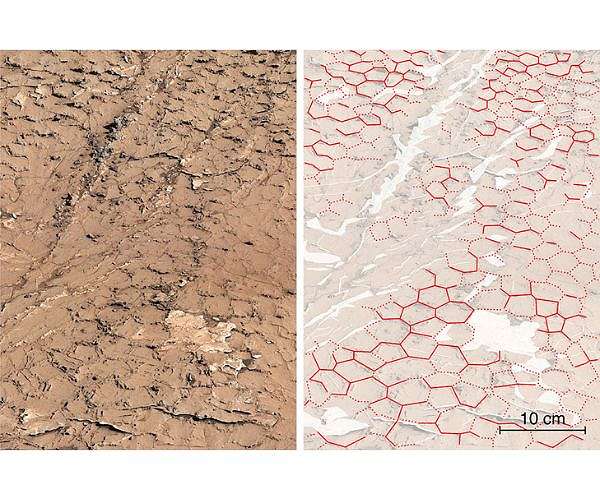
A new paper suggests the same conditions that created the cracks could have been favorable to the emergence of microscopic life. Scientists aren't entirely sure how life began on Earth, but one prevailing theory posits that persistent cycles of wet and dry conditions on land helped assemble the complex chemical building blocks necessary for microbial life. This is why a patchwork of well-preserved ancient mud cracks found by NASA's Curiosity Mars rover is so exciting to the mission's team.
A new paper in Nature details how the distinctive hexagonal pattern of these mud cracks offers the first evidence of wet-dry cycles occurring on early Mars. "These particular mud cracks form when wet-dry conditions occur repeatedly – perhaps seasonally," said the paper's lead author, William Rapin of France's Institut de Recherche en Astrophysique et Planetologie.
Curiosity is gradually ascending the sedimentary layers of Mount Sharp, which stands 3 miles (5 kilometers) high in Gale Crater. The rover spotted the mud cracks in 2021 after drilling a sample from a rock target nicknamed "Pontours," found within a transitional zone between a clay-rich layer and one higher up that is enriched with salty minerals called sulfates. While clay minerals usually form in water, sulfates tend to form as water dries up.
The minerals prevalent in each area reflect different eras in Gale Crater's history. The transitional zone between them offers a record of a period when long dry spells became prevalent and the lakes and rivers that once filled the crater began to recede.
As mud dries out, it shrinks and fractures into T-shaped junctions – which are what Curiosity discovered previously at "Old Soaker," a collection of mud cracks lower down on Mount Sharp. Those junctions are evidence that Old Soaker's mud formed and dried out once, while the recurring exposures to water that created the Pontours mud caused the T-shaped junctions to soften and become Y-shaped, eventually forming a hexagonal pattern.
The hexagonal cracks in the transitional zone kept forming even as new sediment was deposited, indicating that the wet-dry conditions continued over long periods of time. ChemCam, Curiosity's precision laser instrument, confirmed a hardy crust of sulfates along the cracks' edges, which isn't too surprising given the proximity of the sulfate region. The salty crust is what made the mud cracks resistant to erosion, preserving them for billions of years.
The Right Conditions
"This is the first tangible evidence we've seen that the ancient climate of Mars had such regular, Earth-like wet-dry cycles," Rapin said. "But even more important is that wet-dry cycles are helpful – maybe even required – for the molecular evolution that could lead to life."
Although water is essential to life, a careful balance is needed – not too much water, not too little. The kinds of conditions that sustain microbial life – those that allow a long-lasting lake, for example – aren't the same as the conditions scientists think are required to promote chemical reactions that might lead to life. A key product of those chemical reactions are long chains of carbon-based molecules called polymers – including nucleic acids, molecules considered to be chemical buildings blocks of life as we know it.
Wet-dry cycles control the concentration of chemicals that feed the fundamental reactions leading to the formation of polymers.
"This paper expands the kind of discoveries Curiosity has made," said the mission's project scientist, Ashwin Vasavada of NASA's Jet Propulsion Laboratory in Southern California. "Over 11 years, we've found ample evidence that ancient Mars could have supported microbial life. Now, the mission has found evidence of conditions that may have promoted the origin of life, too."
The discovery of the Pontours mud cracks may in fact have provided scientists their first opportunity to study the remains of life's cauldron. Earth's tectonic plates constantly recycle its surface, burying examples of its prebiotic history. Mars doesn't have tectonic plates, so much older periods of the planet's history have been preserved.
"It's pretty lucky of us to have a planet like Mars nearby that still holds a memory of the natural processes which may have led to life," Rapin said.
Research Report:Sustained wet-dry cycling on early Mars